Nikola Tesla Articles
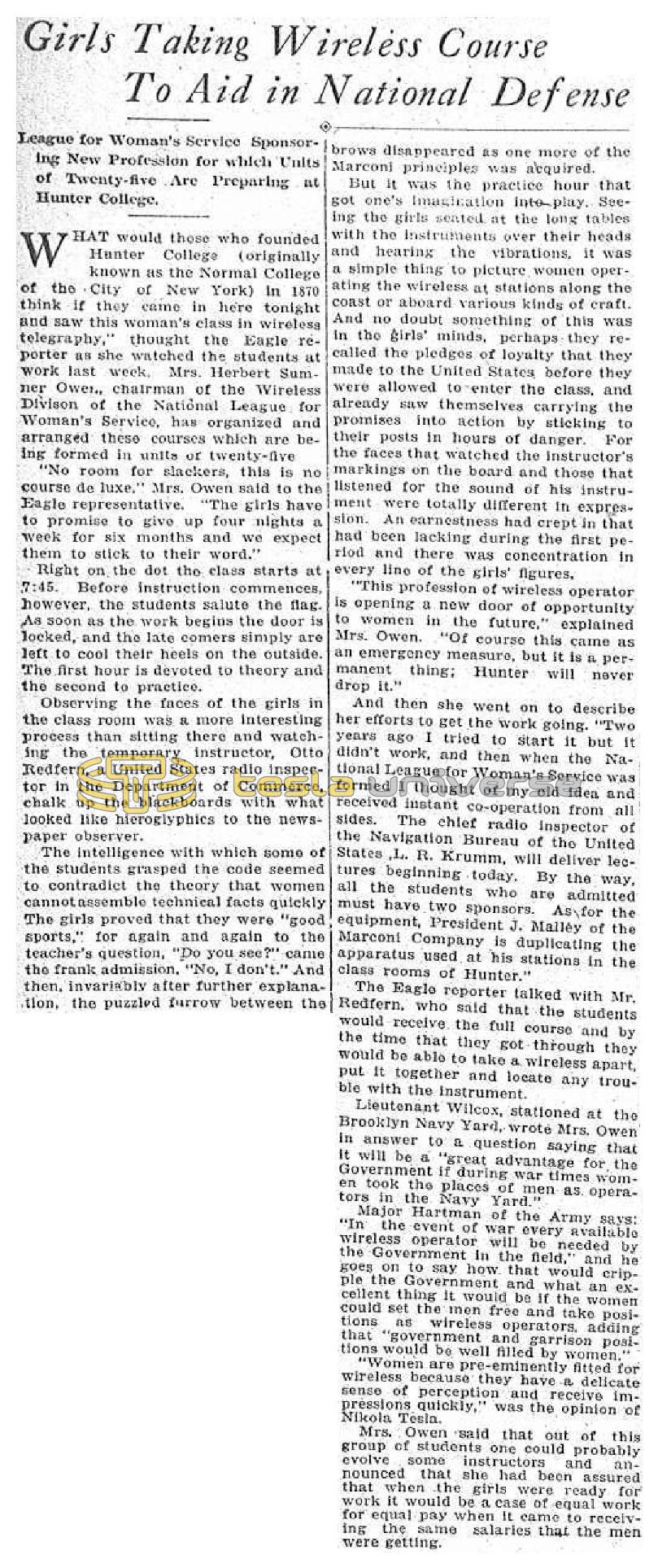
Girls Taking Wireless Course to Aid in National Defense
League for Woman's Service Sponsoring New Profession for which Units of Twenty-five Are Preparing at Hunter College.
What would those who founded Hunter College (originally known as the Normal College of the City of New York) In 1870 think if they came in here tonight and saw this woman's class in wireless telegraphy," thought the Eagle reporter as he watched the students at work last week. Mrs. Herbert Sumner Owen, chairman of the Wireless Divison of the National League for Woman's Service, has organized and arranged these courses which are being formed in units of twenty-five.
"No room for slackers, this is no course de luxe." Mrs. Owen said to the Eagle representative. "The girls have to promise to give up four nights a week for six months and we expect them to stick to their word."
Right on the dot the class starts at 7:45. Before instruction commences, however, the students salute the flag. As soon as the work begins the door is locked, and the late comers simply are left to cool their heels on the outside. The first hour is devoted to theory and the second to practice.
Observing the faces of the girls in the class room was a more interesting process than sitting there and watching the temporary instructor, Otto Redfern, a United States radio inspector in the Department of Commerce, chalk up the blackboards with what looked like hieroglyphics to the newspaper observer.
The intelligence with which some of the students grasped the code seemed to contradict the theory that women cannot assemble technical facts quickly. The girls proved that they were "good, sports," for again and again to the teacher's question, "Do you see?" came the frank admission, "No, I don't." And then, invariably after further explanation, the puzzled furrow between the brows disappeared as one more of the Marconi principles was acquired.
But it was the practice hour that got one's Imagination into play. Seeing the girls seated at the long tables with the instruments over their heads and hearing the vibrations, it was a simple thing to picture women operating the wireless at stations along the coast or aboard various kinds of craft. And no doubt something of this was In the girls' minds, perhaps they recalled the pledges of loyalty that they made to the United States before they were allowed to enter the class, and already saw themselves carrying the promises into action by sticking to their posts in hours of danger. For the faces that watched the instructor's markings on the board and those that listened for the sound of his instrument were totally different in expression. An earnestness had crept in that had been lacking during the first period and there was concentration in every line of the girls' figures.
"This profession of wireless operator is opening a new door of opportunity to women in the future," explained Mrs. Owen. "Of course this came as an emergency measure, but it is a permanent thing; Hunter will never drop it."
And then she went on to describe her efforts to get the work going. "Two years ago I tried to start it but it didn't work, and then when the National League for Woman's Service was formed I thought of my old idea and received instant co-operation from all sides. The chlef radio inspector of the Navigation Bureau of the United States, L. R. Krumm, will deliver lectures beginning today. By the way, all the students who are admitted must have two sponsors. As for the equipment, President J. Malley of the Marconi Company is duplicating the apparatus used at his stations in the class rooms of Hunter."
The Eagle reporter talked with Mr. Redfern, who said that the students would receive the full course and by the time that they got through they would be able to take a wireless apart, put it together and locate any trouble with the instrument.
Lieutenant Wilcox, stationed at the Brooklyn Navy Yard, wrote Mrs. Owen in answer to a question saying that It will be a "great advantage for the Government if during war times women took the places of men as operators in the Navy Yard."
Major Hartman of the Army says: "In the event of war every available wireless operator will be needed by the Government in the field," and he goes on to say how that would cripple the Government and what an excellent thing it would be if the women could set the men free and take positions as wireless operators, adding that "government and garrison positions would be well filled by women."
"Women are pre-eminently fitted for wireless because they have a delicate sense of perception and receive impressions quickly," was the opinion of Nikola Tesla.
Mrs. Owen said that out of this group of students one could probably evolve some instructors and announced that she had been assured that when the girls were ready for work it would be a case of equal work for equal pay when it came to receiving the same salaries that the men were getting.