Nikola Tesla Articles
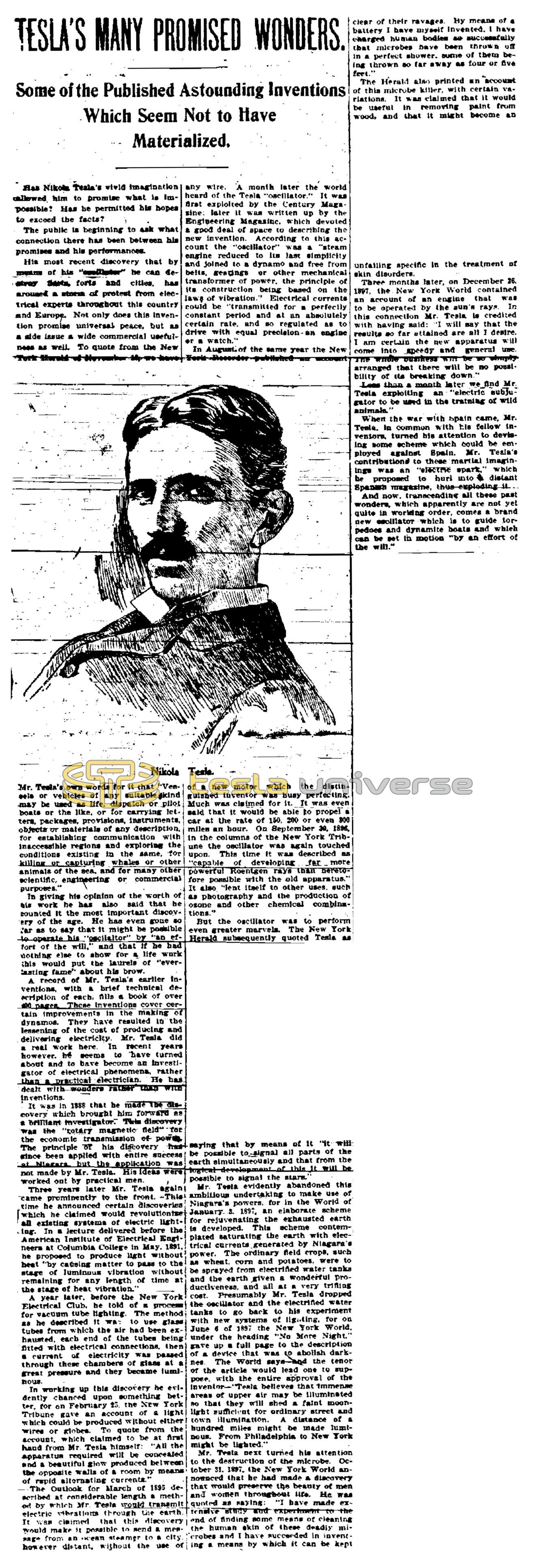
Tesla's Many Promised Wonders
Some of the Published Astounding Inventions Which Seem Not to Have Materialized.
Has Nikola Tesla’s vivid imagination allowed him to promise what is impossible? Has he permitted his hopes to exceed the facts?
The public is beginning to ask what connection there has been between his promises and his performances.
His most recent discovery that by means of his “oscillator” he can destroy fleets, forts and cities, has aroused a storm of protest from electrical experts throughout this country and Europe. Not only does this invention promise universal peace, but as a side issue a wide commercial usefulness as well. To quote from the New York Herald of November 14, we have Mr. Tesla’s own words for it that “Vessels or vehicles of any suitable kind may be used as life, dispatch or pilot boats or the like, or for carrying letters, packages, provisions, instruments, objects or materials of any description, for establishing communication with inaccessible regions and exploring the conditions existing in the same, for killing or capturing whales or other animals of the sea, and for many other scientific, engineering or commercial purposes.”
In giving his opinion of the worth of his work he has also said that he accounted it the most important discovery of the age. He has even gone so far as to say that it might be possible to operate his “oscillator” by “an effort of the will,” and that if he had nothing else to show for a life work this would put the laurels of “everlasting fame” about his brow.
A record of Mr. Tesla’s earlier inventions, with a brief technical description of each, fills a book of over 200 pages. These inventions cover certain improvements in the making of dynamos. They have resulted in the lessening of the cost of producing and delivering electricity. Mr. Tesla did a real work here. In recent years however, he seems to have turned about and to have become an investigator of electrical phenomena, rather than a practical electrician. He has dealt with wonders rather than with inventions.
It was in 1888 that he made the discovery which brought him forward as a brilliant investigator. This discovery was the “rotary magnetic field” for the economic transmission of power. The principle of this discovery has since been applied with entire success at Niagara, but the application was not made by Mr. Tesla. His ideas were worked out by practical men.
Three years later Mr. Tesla again came prominently to the front. This time he announced certain discoveries which he claimed would revolutionize all existing systems of electric lighting. In a lecture delivered before the American Institute of Electrical Engineers at Columbia College in May, 1891, he proposed to produce light without heat “by causing matter to pass to the stage of luminous vibration without remaining for any length of time at the stage of heat vibration.”
A year later, before the New York Electrical Club, he told of a process for vacuum tube lighting. The method as he described it was: to use glass tubes from which the air had been exhausted, each end of the tubes being fitted with electrical connections, then a current of electricity was passed through these chambers of glass at a great pressure and they became luminous.
In working up this discovery he evidently chanced upon something better, for on February 25 the New York Tribune gave an account of a light which could be produced without either wires or globes. To quote from the account, which claimed to be at first hand from Mr. Tesla himself: “All the apparatus required will be concealed and a beautiful glow produced between the opposite walls of a room by means of rapid alternating currents.”
The Outlook for March of 1895 described at considerable length a method by which Mr. Tesla would transmit electric vibrations through the earth. It was claimed that this discovery would make it possible to send a message from an ocean steamer to a city, however distant, without the use of any wire.
A month later the world heard of the Tesla “oscillator.” It was first exploited by the Century Magazine; later it was written up by the Engineering Magazine, which devoted a good deal of space to describing the new invention. According to this account the “oscillator” was “a steam engine reduced to its last simplicity and joined to a dynamo and free from belts, gearings or other mechanical transformer of power, the principle of its construction being based on the laws of vibration.” Electrical currents could be “transmitted for a perfectly constant period and at an absolutely certain rate, and so regulated as to drive with equal precision an engine or a watch.”
In August of the same year the New York Recorder published an account of a new motor which the distinguished inventor was busy perfecting. Much was claimed for it. It was even said that it would be able to propel a car at the rate of 150, 200 or even 300 miles an hour. On September 30, 1896, in the columns of the New York Tribune the oscillator was again touched upon. This time it was described as “capable of developing far more powerful Roentgen rays than heretofore possible with the old apparatus.” It also “lent itself to other uses, such as photography and the production of ozone and other chemical combinations.”
But the oscillator was to perform even greater marvels. The New York Herald subsequently quoted Tesla as saying that by means of it “it will be possible to signal all parts of the earth simultaneously and that from the logical development of this it will be possible to signal the stars.”
Mr. Tesla evidently abandoned this ambitious undertaking to make use of Niagara’s powers, for in the World of January 3, 1897, an elaborate scheme for rejuvenating the exhausted earth is developed. This scheme contemplated saturating the earth with electrical currents generated by Niagara’s power. The ordinary field crops, such as wheat, corn and potatoes, were to be sprayed from electrified water tanks and the earth given a wonderful productiveness, and all at a very trifling cost. Presumably Mr. Tesla dropped the oscillator and the electrified water tanks to go back to his experiment with new systems of lighting, for on June 6 of 1897 the New York World, under the heading “No More Night,” gave up a full page to the description of a device that was to abolish darkness. The World says—and the tenor of the article would lead one to suppose, with the entire approval of the inventor — “Tesla believes that immense areas of upper air may be illuminated so that they will shed a faint moonlight sufficient for ordinary street and town illumination. A distance of a hundred miles might be made luminous. From Philadelphia to New York might be lighted.”
Mr. Tesla next turned his attention to the destruction of the microbe. October 31, 1897, the New York World announced that he had made a discovery that would preserve the beauty of men and women throughout life. He was quoted as saying: “I have made extensive study and experiment to the end of finding some means of cleaning the human skin of these deadly microbes and I have succeeded in inventing a means by which it can be kept clear of their ravages. By means of a battery I have myself invented, I have charged human bodies so successfully that microbes have been thrown off in a perfect shower, some of them being thrown so far away as four or five feet.”
The Herald also printed an account of this microbe killer, with certain variations. It was claimed that it would be useful in removing paint from wood, and that it might become an unfailing specific in the treatment of skin disorders.
Three months later, on December 26, 1897, the New York World contained an account of an engine that was to be operated by the sun’s rays. In this connection Mr. Tesla is credited with having said: “I will say that the results so far attained are all I desire. I am certain the new apparatus will come into speedy and general use. The whole business will be so simply arranged that there will be no possibility of its breaking down.”
Less than a month later we find Mr. Tesla exploiting an “electric subjugator to be used in the training of wild animals.”
When the war with Spain came, Mr. Tesla, in common with his fellow inventors, turned his attention to devising some scheme which could be employed against Spain. Mr. Tesla’s contributions to these martial imaginings was an “electric spark” which he proposed to hurl into a distant Spanish magazine, thus exploding it.
And now, transcending all these past wonders, which apparently are not yet quite in working order, comes a brand new oscillator which is to guide torpedoes and dynamite boats and which can be set in motion “by an effort of the will.”