Nikola Tesla Articles
Westinghouse Company's Annual Report
FULL TEXT OF PRESIDENT WESTINGHOUSE'S REPORT TO THE STOCKHOLDERS—ANNOUNCEMENT OF A LARGE CONTRACT — A DIVIDEND DECLARED — BOARD OF DIRECTORS RE-ELECTED.
Your board of directors present herewith the balance sheet showing the financial condition of your company as of March 31, 1897.
Owing to the removal operations from the old into the new shops, your board of directors was unable to present a balance sheet for March 31, 1896, based upon actual values of inventories.
The class of electrical business conducted by your company has been in a depressed condition during the past two years, owing to the almost complete interruption in the building of new railways and new power stations. Notwithstanding these unfavorable conditions and the heavy charges to current expense account, due to the removal to the new works and the making of new tools, patterns, etc., the company's earnings have exceeded the amount required for the dividends on the preferred stock, which have been promptly paid.
By comparing the present balance sheet with that for March 31, 1895, it will be seen that there has been made a reduction in the surplus account of $1,577,735.93, due to amounts written off in connection with the disbandment of the old factories, the sale of obsolete tools, machinery and stock, depreciation of inventory, bad debts, the adjustment and settlement of old accounts, and the book loss from the sale of stocks and bonds owned by the company, and also the book loss resulting from the sale, at the price mentioned below, of $3,000,000, par value, of "assenting stock."
On June 4, 1896, your company authorized the increase of its capital stock from $10,000,000 to $15,000,000, and your board of directors effected a sale of $3,000,000, par value, of the new assenting stock thus authorized to the Security Investment Company, of Pittsburgh, which realized to the company $2,489,000, of which amount $1,260,000 was received in cash, $329,000 was represented by patents and property, and the remaining $900,000 in interest-bearing notes secured by collateral; $300,000 of such notes were payable July 5, 1897, and have been paid; $300,000 are payable July 5, 1898, and the remaining $300,000, July 5, 1899.
Pursuant to the terms of the contract with the General Electric Company, for the exchange of licenses under the patents of the two companies, of which you were notified by a circular letter dated April 2, 1896, your company has purchased outright for $216,600 the Tesla patents for multiphase-current motor, in order that both companies might manufacture apparatus covered by those patents without the payment of royalties, other than those provided for in the agreement between the two companies. For like reasons your company purchased, for $72,231.17, the entire capital stock of the R. D. Nuttall company, which has a complete workshop for its purposes, and manufactures trolleys for the General Electric Company and your company, and gears and other railway supplies for the general market. The stock purchased is considered fully worth its par value of $118,000. Your company also purchased for $58,500 and the transfer of certain patents acquired through its agreement with the Security Investment Company, 12,433 shares of the Electro-Magnetic Traction Company, out of a total issue of 20,000 shares.
The agreement between the General Electric company and your company has been in force a little over a year, and the wisdom and value of the union of patents has been fully established. The patents of the two companies, thus brought together, have a commercial value which can not be adequately appreciated by those not familiar with the electrical business. These patents are numbered by the thousand, and, within the field covered by the company's business, relate to every conceivable electric system and kind of apparatus to the minutest detail. Their present book value is less than the sum expended in acquiring and developing them. The terms of the contract between the General Electric Company and your company fix the respective values of the patents at 62½ per cent for the General Electric Company and 37½ per cent for your company. The patents owned by your company are carried at $4,689,080.89, or less than 37½ per cent of the aggregate book value of the patents of both companies. Many of these patents have already been sustained by the courts, while in numerous instances infringers, after being made acquainted with the situation, have agreed to cease infringing.
During the past year many valuable patents have been acquired in the interest of the two companies at moderate cost, while the expense of carrying on suits has been greatly less than the sum formerly expended by the two companies.
A liberal course is being pursued in the enforcement of these valuable rights, and there is reason to expect that the time is near at hand when the patent property now being managed as a common interest will be generally recognized as exceeding in value and importance that of any other manufacturing interest.
These items appear on the books at cost. It was the expectation of your board of directors that a large part of the bonds and stocks of lighting companies on hand could be disposed of from time to time, but there has been no market for the sale of such securities during the past two years. These stocks and bonds have, as a rule, increased in intrinsic value, and it is proposed to pursue the policy of selling them whenever advantageous terms can be secured.
It has not yet been possible to dispose of the old factories of your company and of the United States and Consolidated companies. It is expected that with the improvement of business a market will be found for these properties.
It is the hope of your board of directors that the proceeds of the sale of stocks and bonds and old factories will, in the near future, be sufficient to care for the indebtedness of the company, leaving the quick assets for the regular current business.
The utilization of water power, and its transmission by electricity, have given great prominence to the Tesla patents, which, together with numerous other patents controlled by your company and the General Electric Company, should insure to the two companies the sale of all the power-transmission apparatus used in this country.
About two years ago your company installed at Niagara Falls, for the Cataract Construction Company, three 5,000-horse-power generators, and in January of this year were awarded by that company the contract for five additional generators of the same capacity, which are now under construction.
Your company has also just been awarded a contract for 15 5,000-horse-power generators by the St. Lawrence Power Company, which is the largest single order yet given for power-transmission apparatus.
Your company should derive great benefit from the execution of this contract, since no other company has yet attempted work of this size and importance. The securing of these contracts was, without doubt, due to the success of your apparatus at Niagara Falls, and to the most complete facilities which your company now has at its new works, at East Pittsburgh, for the manufacture of large electrical units.
Your company has made marked progress in the development of apparatus for the operation of suburban and interurban trains on main railways, and it has installed at East Pittsburgh, on the tracks of the Pennsylvania Railroad, experimental apparatus, where important experiments are constantly being carried on. We believe your company is now more fully equipped and has better facilities for work of this kind than any other concern.
Your workshops at East Pittsburgh are in complete order, and have the advantages for manufacturing which it was contemplated they should possess. Its facilities, arrangements, machinery and tools enable it to undertake work of the largest character which may be proposed. All that has been said heretofore with reference to the property of your company at this place, and the opportunity it affords for economical operations, has been more than borne out by the facts. These works stand on your books at $2,769,886.26, of which $1,290,732.85 is for real estate and buildings, and $1,479,153.41 for machinery and tools, making an exceptionally low cost for works of such great capacity.
The engineers of your company have acquired a world-wide reputation in mechanical and electrical engineering, a fact well illustrated by the close copying by other manufacturers of plans, systems and designs which had their origin in your offices or works. The character of the apparatus turned out at your new works has given your company substantial trade advantages.
By order of the board,
GEORGE WESTINGHOUSE,
President.
Pittsburgh, Pa., June 23.
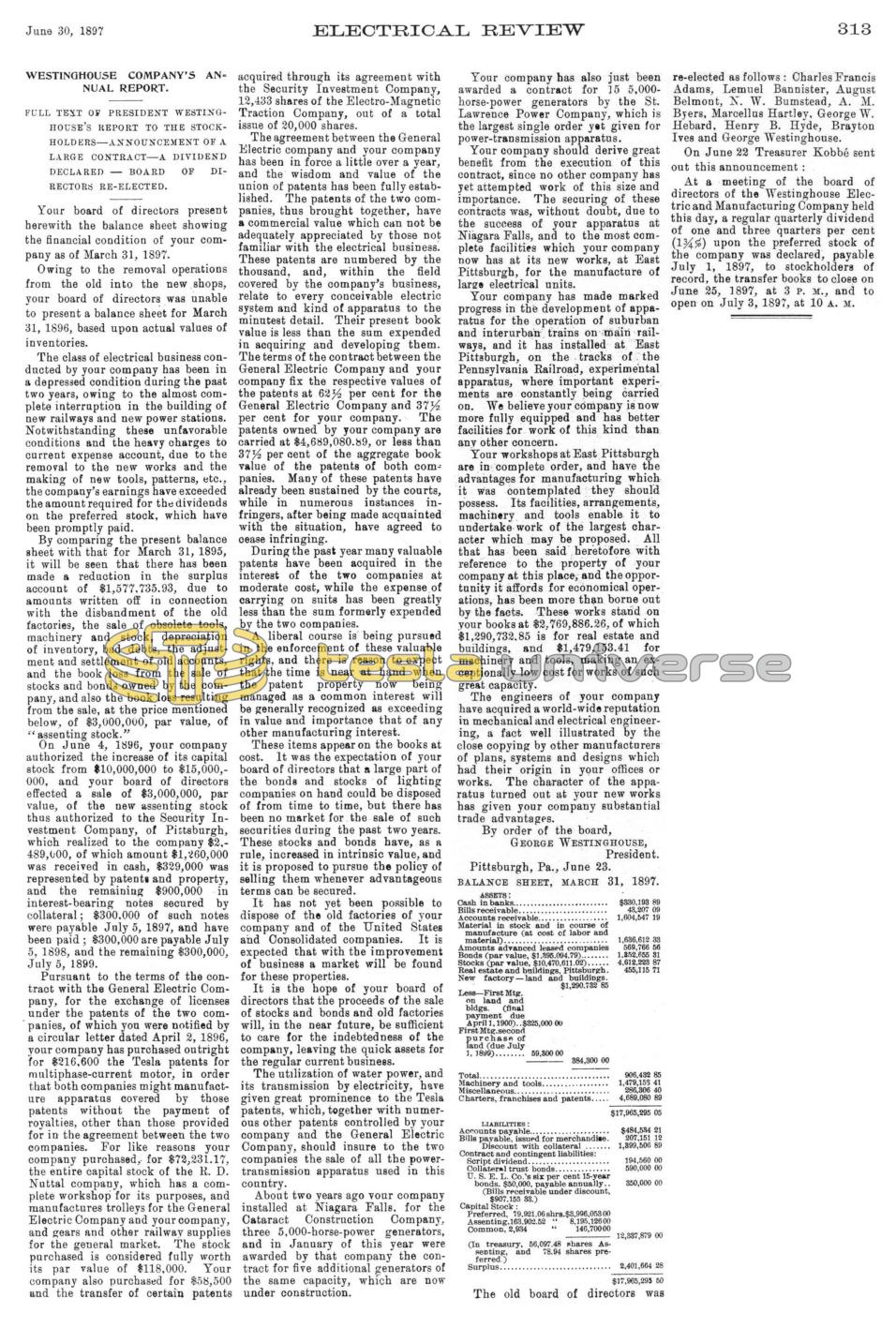
BALANCE SHEET, MARCH 31, 1897.
| ASSETS: | |
| Cash in banks | $330,128 89 |
| Bills receivable | 42,907 09 |
| Accounts receivable | 1,604,847 19 |
| Material in stock and in course of manufacture (at cost of labor and material) | 1,626,612 33 |
| Amounts advanced leased companies | 509,796 56 |
| Bonds (par value, $1,285,094.79) | 1,232,535 31 |
| Stocks (par value, $10,439,411.02) | 4,612,223 87 |
| Real estate and buildings, Pittsburgh | 425,115 71 |
| New factory — land and buildings, $1,290,732.85 | |
| Less — First Mtg. on land and bldg., final payment due April 1, 1900..$325,000 00 | |
| First Mtg. second purchase of land (due July 1, 1800)...59,300 00 | |
| 384,300 00 | |
| Total | 906,432 85 |
| Machinery and tools | 1,479,153 41 |
| Miscellaneous | 284,806 40 |
| Charters, franchises and patents | 4,689,080 89 |
| $17,285,205 05 | |
| LIABILITIES: | |
| Accounts payable | $484,584 21 |
| Bills payable, issued for merchandise | 207,151 12 |
| Discount with collateral | 1,399,504 89 |
| Contract and contingent liabilities: | |
| Scrip dividend | 194,560 00 |
| Collateral trust bonds | 590,000 00 |
| U. S. E. L. Co.'s six per cent 15-year bonds, $50,000, payable annually | 350,000 00 |
| (Bills receivable under discount, $907,100.83.) | |
| Capital Stock: | |
| Preferred, 79,921.06 shrs. $3,996,053 00 | |
| Assenting, 163,902.52 " 8,195,126 00 | |
| Common, 2,994 " 149,700 00 | |
| 12,340,879 00 | |
| (In treasury, 56,097.48 shares Assenting, and 78.94 shares preferred.) | |
| Surplus | 2,401,694 28 |
| $17,965,235 50 | |
The old board of directors was re-elected as follows: Charles Francis Adams, Lemuel Bannister, August Belmont, N. W. Bumstead, A. M. Byers, Marcellus Hartley, George W. Hebard, Henry B. Hyde, Brayton Ives and George Westinghouse.
On June 22 Treasurer Kobbé sent out this announcement:
At a meeting of the board of directors of the Westinghouse Electric and Manufacturing Company held this day, a regular quarterly dividend of one and three quarters per cent (1 3/4%) upon the preferred stock of the company was declared, payable July 1, 1897, to stockholders of record, the transfer books to close on June 25, 1897, at 3 P. M., and to open on July 3, 1897, at 10 A. M.