Nikola Tesla Articles
George Westinghouse - A Hundred-Thousand-Horse-Power Man
A BIG man, with a hundred thousand horse power inside him; a masterful man, with twenty-five thousand men directly under his leadership; a man who controls whatever he touches; an absolute ruler, as absolute as the Czar. George Westinghouse is a trained engineer, an inventor, a manufacturer, and a financier. The combination is unique.
Other men have won high places in commerce and industry, have been, and are, great forces. But they have not worked in his single-handed fashion. They have had strong partners; they have surrounded themselves with men of money. But this man has no partners, and you do not hear his name associated with groups of assistant multimillionaires. He stands apart like a tower that draws all attention to itself by its altitude, its proportions, and position.

All his interests, it is true, are in company form, incorporated; but he controls the companies and his word is the law that governs their energies. These organizations afford the most conspicuous example of one-man power in the industrial world today. They are not American enterprises only; they are international. There are nine manufacturing companies of his in the United States, one in Canada, and five in Europe — two of the latter being in England, one in France, one in Germany, and one in Russia. In New York there is also a great company of contracting engineers. In Pittsburg there is a financial company, and in London another. The manufacturing companies divide the world between them as the market for their output. In every considerable city you will find their offices or their agents. This business system is imperial in plan and operation. It is a world-encircling empire with an absolute monarch at its head.
Stephenson taught us how to move a railway train; Westinghouse taught us how to control its movements, and he made modern railway traffic possible. We could not travel at the speed we do, nor operate the long and heavy trains, without being able to regulate their movements perfectly and instantly. The Westinghouse brake is the device by which the end is gained. Wherever there are railways you will find this brake.
His Activity Lasting.
The invention has been known so long a time that one encounters many persons who think it must have been invented by this man's father. But the inventor was none other than the renowned Pittsburgher, who is to-day at the height of his activities, fifty-eight or fifty-nine years young.
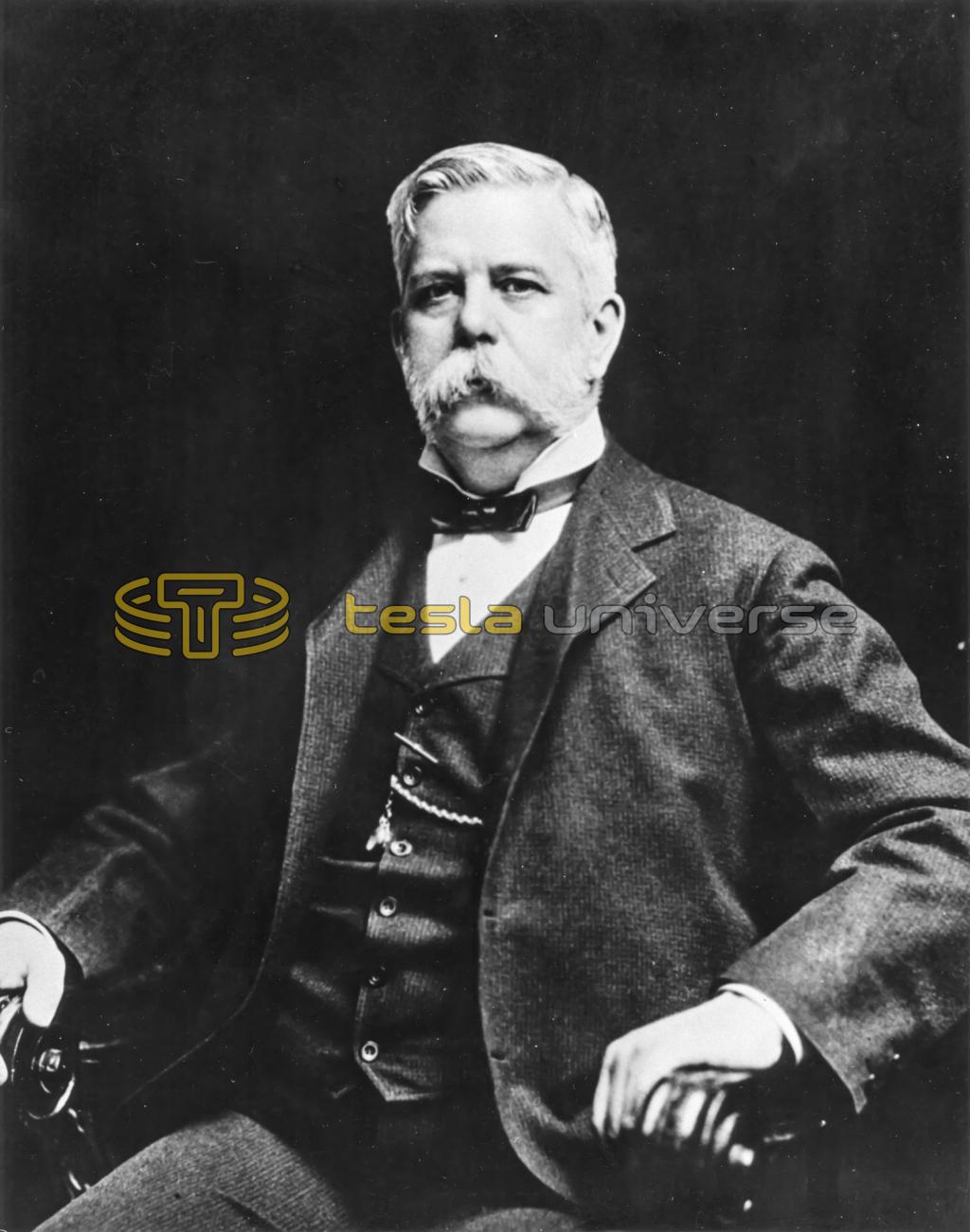
He was in his early twenties when the brake was first applied to a train, and he had been experimenting for months at least before he hit upon the idea of using compressed air. There is no truth in the story which has been going about the world ever since, in every language, and which is still turned up every week by the press clipping men, that Commodore Vanderbilt summarily concluded an interview which the young inventor had sought, declaring that he hadn't time to listen to "the damned fool idea of trying to stop a train with air." The story is good enough to be true, but I have heard Mr. Westinghouse say that it is sheer invention.
On the first run of the first train to which the air brake was applied, an accident was prevented and lives were saved. Young Westinghouse, having a better business head and more nerve than inventors usually are said to possess, declined to sell his patents. He formed a company, had the majority of shares allotted to himself, and then strode on to fortune. "That's the mint," I once heard him say to a visitor who, seeing in the distance the big manufactory of the brake company, asked what it might be.
Having shown the world how to stop a train, he next undertook to show when to stop it. He invented signaling systems and formed a company to manufacture them.
Applying electricity to signaling work, he was led further afield. Electricity fascinated his imagination. He began to experiment with it in other directions, and fitted up a laboratory for research work. In 1885 or 1886 he organized the Westinghouse Electric Company, which has outgrown all his other undertakings. In Europe experiments with the alternating current were attracting expert attention. He purchased the patent rights for America. He brought Tesla to Pittsburg and backed him in his researches. The induction motor was a result. He bought Tesla's patents and immediately began to develop alternating current machines for commercial purposes.
Everybody said he was reckless. That didn't matter. Then they tried to stop him. He increased his efforts. Experts, competitors, scientific men, at home and abroad, prophesied failure. As he didn't fail, they filled the air with cries of "public danger". Prohibitive legislation was invoked in a dozen States (or were they twenty-two?) on the ground that by the use of the alternating current the risk to human life and to property would be so great that the system should be forbidden by law. But Westinghouse went on and succeeded; the opposition spluttered and died, and for years past the great developments in electrical work have been through the alternating current system.
Boundless Versatility.
He organized an engine-building company, built steam engines, gas engines, and was the first man in the United States to undertake seriously the development of the steam turbine. He acquired the Parsons turbine patents for America. He organized an incandescent lamp company, the Nernst Lamp Company, and a company for manufacturing the Cooper-Hewitt lamp. He will organize a company without more ado than another man will make over eating his breakfast. I have known him at the breakfast table buy a copper mine, send a man to Europe to investigate a newly announced electrical discovery, and give instructions for a series of experiments to be made in some entirely new direction.
A big man with a hundred thousand horse power inside him! He has more physical endurance than any ten of the twenty-five thousand men in his employ. He is always working, except when he sleeps, and he is a good sleeper. When one thing is accomplished another is begun. The successes do not chain his interest. Achievement attracts him, so he is ever doing some new thing, and thus his undertakings multiply. Once, when he sold a property at a price that would have been a snug fortune for another man, I heard him say: "This will give me a little ready cash to conduct such and such experiments". He probably has expended a quarter of a million on these experiments, and one of these days a new industry will spring from them.
A typical Pittsburg day with him is of this order:

Breakfast comes at 7:30, and almost invariably there is someone staying in the house with whom he can talk business, otherwise there is always the telephone. After breakfast there is a railway journey of several miles to the Westinghouse works. He takes them in the order of their accessibility; first, the Machine Company, where the engines come from. This concern began with steam engines; then it added gas engines to its output after years of experiment, and now it adds to these two lines the steam turbine, also after years of test. He walks through the shops, watches the progress on special work, watches tests, sees how things generally are running. He interviews the management, makes suggestions, asks questions — searching ones — calls for blueprints, ascertains the money value of orders and deliveries, and before you, if you are a layman, can take breath he is out of this place and into another — the gigantic works of the Westinghouse Electric and Manufacturing Company.
This place is too vast for even his exhaustless energy to traverse physically every day. Mentally he surveys it at all hours. But the buildings are so huge — experts say they are the largest machine shops in the world — their two-story floor space so vast, and the variety of operations and of things produced so numerous, that he must confine his visit to a specific section for a specific purpose, or there would be no end to his journeying. As it is, you marvel how, out of this infinite variety, proper parts arrive at a stated time at a certain place, where they are put together and form a new machine — a Niagara generator, a pair of motors for an electric car, a mighty machine for driving the trains in the New York subway.
Orders a Special Train.
There is a Westinghouse railroad, several miles long, connecting the several works, carrying castings and supplies, delivering the mechanisms that are made, and giving opportunity for experiments with cars and trains and systems of electric distribution. Mr. Westinghouse orders a train and supervises a test of his latest device for simultaneously operating and controlling all the motors on the train, or he orders out the car on which are fitted the new single-phase alternating current motors, which, it is said, are going to change the practice on all electric roads. He consults with his manager of works, his chief electrician, chief engineer, the head of the commercial end of the organization, and any number of others. And then he goes to the brake works, where also there are tests of new devices.
After luncheon he will visit the Westinghouse foundry, his newest establishment at Trafford City, a little town just building up beyond Pittsburg and named with a certain deference to Trafford Park, in Manchester, England, where the British Westinghouse works were built two or three years ago.
Then he goes back by railroad to town, fifteen miles or more, to his own office. In the evening there will be a dinner party. Perhaps some distinguished scientist is present, or visiting engineer or railroad President or European Ambassador. If there be none of these, it is a business dinner of half a dozen, or maybe a dozen and a half, of his principal men, and the things that could not be talked about during the day are discussed closely.
After three or four days like this in Pittsburg, his private car is connected to a Pennsylvania express train, and Eastward he goes. If it's Friday night and Winter, he goes to Washington and passes Saturday and Sunday at his home there. If it is Spring or Summer or Autumn, his destination is his country home at Lenox, in the Berkshire Hills. On Monday his car takes him to New York, and there his work is chiefly financial, and his office at 120 Broadway the center of negotiation.
Here this industrial sovereign sits on his American throne. When he goes abroad he issues his decrees from the Westinghouse Building in London. And he goes abroad twice a year.
This big-bodied, big-brained man, with a hundred thousand horse power inside him, has the double blessing of superb health and a sanguine temperament. He is the most hopeful of optimists. As soon as he evolves an idea it seems almost to rank in his mind with the accomplished facts — mechanical and financial. Difficulties are merely things to overcome. Obstacles — and they are many — are simply to be overborne or shattered. They do not keep him awake at night. He is the personification of force, and the man who opposes his will must "'ware bridge".
He is one of the men who make two blades of grass grow where one or none has grown before. It is "playing the game" that interests him. He is not one of the millionaires who keep yachts, racing stables, automobiles, and picture galleries; he does not gamble, he does not smoke, and he never plays second fiddle in any orchestra. He always conducts. What he cannot control he will not touch. Amalgamations, consolidations, are not for him unless he is to be ruler of them. He takes quick likings and strong dislikes, and his ambition is to extend his great industries to many countries, to build them up there so that they become, as it were, national institutions, and to have their products on every sea and in every land.
His Worldwide Ambition.
He is not far from realizing this ambition. Already the British Westinghouse Electric and Manufacturing Company is the greatest of its kind in the United Kingdom and has become in two or three years the most widely known industrial undertaking in the British Empire. On the Continent of Europe, he has three manufactories. The commercial territory of one of them extends from St. Petersburg to the Pacific. His foresight planned those companies, and his energy got them working before the countries in which they are placed could seriously oppose the import of American manufactures by a wall of prohibitive tariffs. Let them have tariffs now if they choose. These European industries of his are European, employing the capital and the labor of the countries where they are planted. The conception and the execution of this plan were Napoleonic.
The manner in which his British company was started was characteristic of the man. Anybody else would have begun over there in a comparatively small way. But he began there on a grand, even a gigantic scale, everything about it entirely new.
New works were erected at Manchester large enough to employ thousands of men at the start — there were 6,500 men on the pay roll when I saw the place in September last. All the machinery was new, and specially made for this establishment. Four thousand men were required to build the works. Add the thousands who are daily employed inside — in the foundries, the electric works, the engine works, the draughting rooms, the offices — and think what all this means to the earning power of Manchester, the sums distributed weekly in wages and paid out for material and supplies! Is it strange that Europe should welcome a man at whose word industries spring up like this, full-fledged?
Exceptional Self-Reliance.
Self-reliance is developed in George Westinghouse to an extent unusual even among those types of men we call born leaders. That fact gives the clue to his successes and his methods. He can do himself so many things that other men require trained assistance to bring forth. He lost an important patent suit after a hard fight, but within a few days he invented a device which fulfilled the requirements. Many a time in his career opponents have thought they had him in a corner, but he always broke through and gained abundant elbow room.
In the hard times he kept things going under the severest stress. No one knew how hard pressed he really was, but he never showed the white feather. On the contrary, he was laying the plans for all the developments which have come since then; he was literally making the plans for new works, and thinking out new undertakings. He succeeded in every one of them. Such a man must have his own way of looking at other men, and at all things. You could hardly expect him to take ordinary views and deal in ordinary ways. I was aboard ship with him once, crossing the Atlantic. He is a good sailor, by the way, and in his youth, during the civil war, was a naval engineer. On this voyage, except for the time he was abed o' nights, and at meals during the day, he constantly walked the deck. We used to say that he walked the greater part of the distance from Sandy Hook to Queenstown. Sheer vital force-not nervous energy!
He has made a chain of world-encircling industries. Presumably he is proud of it, and he has a right to be. No other man has done this thing. It is an achievement imperial in its scope. It may be asked from what special achievement he derives most satisfaction. It is a natural question, and one night he made a remark which may be taken as the answer to it.
We were bowling along at high speed in his private car coupled to the end of a fast express. Suddenly we felt the grip of the brakes, and the swift train pulled up within its own length at a dead stop. Looking ahead from the platform we could just make out in the murky night a deep ravine. Far down at the bottom of a precipitous descent flaming torches were moving. No bigger than fireflies they seemed from our height. There had been a washout, and the train was switched over to creep across a dizzy bridge. Peering down into the flame pierced gloom, Mr. Westinghouse said:
"If some day they say of me that with the — airbrake I contributed something to civilization, something to the safety of human life, it will be sufficient."
The succession of his enterprises has been logical. First, the brake to stop the train; then the signal showing when to stop it. Somewhere about that time, as he was becoming interested in electricity through signal work, he became interested in natural gas. He found the gas under a field adjoining his lawn. Before long he had a company which controlled the natural gas supply for Allegheny County. To use the gas as a motive power was the next step. He already had a steam engine manufactory, and in it he began to experiment with gas engines.
Editors’ Picks
While other men were talking about the possibilities of electricity, he was making the possibilities actualities. He built the first great electrical generators, as big as the biggest steam engines of the time — the generators for Niagara, 5,000 horse power each, ten of them! He has built larger ones since. But even when he was constructing these early giants he foresaw that limits must be placed ere long on the dimensions of the mechanism of this new force. Why, the generators for the New York subway are forty-two feet in diameter over all. They had to be built in sections and put on the trains in sections. Electrical machinery has assumed such bulk that a single section of one generator will just pass through a railway tunnel without touching the tunnel roof above the train or the crossing rails beneath.
If electrical generators could be made smaller and yet give equal power, they must be driven at much higher speeds. To drive them at the highest possible speeds is a task beyond the capacity of the great reciprocating steam engines.
Mr. Westinghouse had experimented for years with rotary engines. He acquired the American rights for the Parsons steam turbine, improved it to meet American conditions, and before others were ready for the commercial benefits of these new conditions he had been for four years driving his air-brake works by electricity, coupling the generators to turbines operating at 2,400 revolutions per minute. Four years the turbines revolved without a stop for overhauling and without costing a cent for repairs. They are still running as merrily as ever.
On that proof of their possibilities turbines were installed in various parts of the country, and the engine works are now driven to their capacity in supplying the market. More power with less bulk and less cost.
Power, power, power! That is the thought one associates with this man. Force and new endeavor-one would think he has enough on his hands already, but he will go on till the last gun fires. There are no brakes on that vitality, except the man's self-control. No one else can throttle that hundred thousand horse-power.
Administration of such huge and complex affairs demands on the one hand the application of high scientific training and of the latest scientific discoveries. It demands on the other hand executive capacity of the first rank. This is the world of the engineer — our age the engineering age. And wherever you go, on this side of the Atlantic or the other, you find that George Westinghouse is recognized as one of the men who make the molds for the age to run in.
He thinks so rapidly that it is hardly possible for any of his men to keep pace with him. He is the motive power of all his industries. He will strike an idea in New York, get aboard his private car, work at a plan for a new device, and, arriving at Pittsburg, hand the drawing to one of his head men with the instruction:
"Make that."
Anticipating the developments of many industries, he has been able to keep his forces at the front, ready for any emergency. Years ago he invented his friction buffer and draft-gear for railway cars-years before the railways were ready. He continued to perfect this device. By and by the railway trains became longer and heavier, and the fifty-ton steel cars appeared. Trains of such length and weight could not have been handled had he not been ready for them. He is always ready, always watchful. And he is as much of a power in the Old World as in the New. ARTHUR WARREN.
