Nikola Tesla Articles
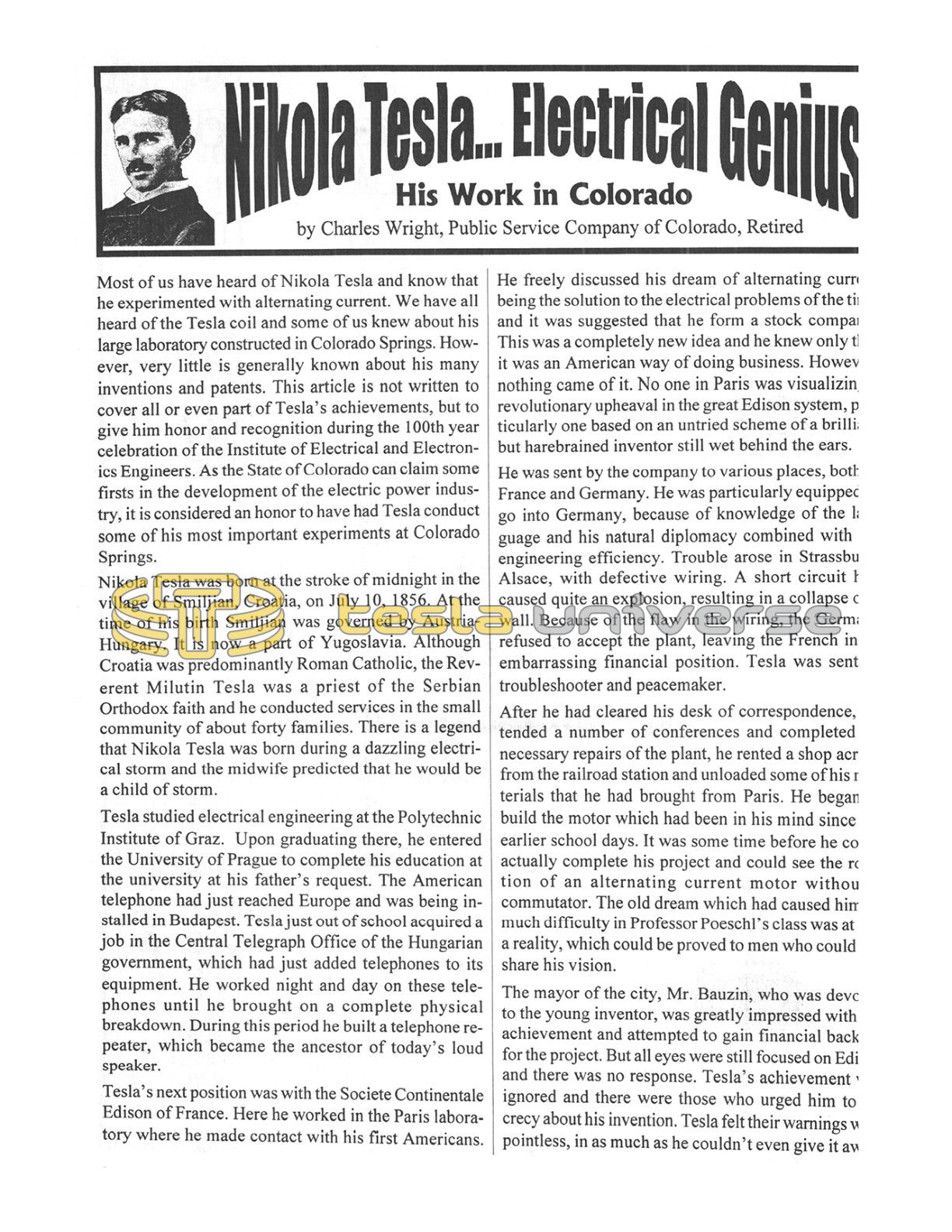
Nikola Tesla - Electrical Genius - His Work in Colorado
by Charles Wright,
Public Service Company of Colorado, Retired
Most of us have heard of Nikola Tesla and know that he experimented with alternating current. We have all heard of the Tesla coil and some of us knew about his large laboratory constructed in Colorado Springs. However, very little is generally known about his many inventions and patents. This article is not written to cover all or even part of Tesla’s achievements, but to give him honor and recognition during the 100th year celebration of the Institute of Electrical and Electronics Engineers. As the State of Colorado can claim some firsts in the development of the electric power industry, it is considered an honor to have had Tesla conduct some of his most important experiments at Colorado Springs.
Nikola Tesla was born at the stroke of midnight in the village of Smiljan, Croatia, on July 10, 1856. At the time of his birth Smiljan was governed by Austria-Hungary. It is now a part of Yugoslavia. Although Croatia was predominantly Roman Catholic, the Reverend Milutin Tesla was a priest of the Serbian Orthodox faith and he conducted services in the small community of about forty families. There is a legend that Nikola Tesla was born during a dazzling electrical storm and the midwife predicted that he would be a child of storm.
Tesla studied electrical engineering at the Polytechnic Institute of Graz. Upon graduating there, he entered the University of Prague to complete his education at the university at his father’s request. The American telephone had just reached Europe and was being installed in Budapest. Tesla just out of school acquired a job in the Central Telegraph Office of the Hungarian government, which had just added telephones to its equipment. He worked night and day on these telephones until he brought on a complete physical breakdown. During this period he built a telephone repeater, which became the ancestor of today’s loud speaker.
Tesla’s next position was with the Societe Continentale Edison of France. Here he worked in the Paris laboratory where he made contact with his first Americans. He freely discussed his dream of alternating current being the solution to the electrical problems of the time and it was suggested that he form a stock company. This was a completely new idea and he knew only that it was an American way of doing business. However, nothing came of it. No one in Paris was visualizing a revolutionary upheaval in the great Edison system, particularly one based on an untried scheme of a brilliant but harebrained inventor still wet behind the ears.
He was sent by the company to various places, both in France and Germany. He was particularly equipped to go into Germany, because of knowledge of the language and his natural diplomacy combined with engineering efficiency. Trouble arose in Strassburg, Alsace, with defective wiring. A short circuit had caused quite an explosion, resulting in a collapse of a wall. Because of the flaw in the wiring, the Germans refused to accept the plant, leaving the French in an embarrassing financial position. Tesla was sent as troubleshooter and peacemaker.
After he had cleared his desk of correspondence, attended a number of conferences and completed the necessary repairs of the plant, he rented a shop across from the railroad station and unloaded some of his materials that he had brought from Paris. He began to build the motor which had been in his mind since earlier school days. It was some time before he could actually complete his project and could see the rotation of an alternating current motor without a commutator. The old dream which had caused him so much difficulty in Professor Poeschl’s class was at last a reality, which could be proved to men who could share his vision.
The mayor of the city, Mr. Bauzin, who was devoted to the young inventor, was greatly impressed with the achievement and attempted to gain financial backing for the project. But all eyes were still focused on Edison and there was no response. Tesla’s achievement was ignored and there were those who urged him to secrecy about his invention. Tesla felt their warnings were pointless, in as much as he couldn’t even give it away.
Tesla was urged to return to Paris, but it was the spring of 1884 before all the petty details were concluded and the Strassburg plant was formally accepted, so he could return. Upon his return to Paris, Mr. Batchellor, the manager of the Edison Company, encouraged Tesla to go to America with a view of redesigning Edison machines. Both of them were convinced that America was the land of golden promises, Tesla was, also, to find it a land of broken promises.
Sometime in 1884, Tesla arrived in America with only four cents in his pocket. Before leaving Paris, he had managed to be robbed of his luggage, steamship tickets and money. He was able to remember the number of his ticket and as no one else claimed the reservation, he was allowed to make the trip to New York. He still possessed a book of his own poems, a scientific article, a package of calculations relating to his plans for a flying machine and a letter of recommendation from Batchellor to Edison. Mr. Batchellor was an old associate of Edison and was now an executive of the Continental Edison Company.
Mr. Edison employed Tesla with certain misgivings. For one thing, Tesla had a formal educational background and Edison did not. Tesla, also, had a phobia against writing notes or reports, or making drawings. He insisted on doing all his calculations in his head before telling anybody what he was doing. The biggest problem was that Tesla was devoted to alternating current, while Edison, having committed himself to direct current, had become bigoted on the subject. Tesla was still eager to develop his alternating current motor, which he would share with his new employer. Edison bluntly refused to listen and told the young upstart that his plant was doing all right as it was.
Even with this setback Tesla made himself very useful by troubleshooting and meeting Edison’s rigid requirements. Tesla worked hard to improve the Edison dynamos. He was sure he could increase the output, lower the cost and reduce maintenance. Edison was pleased with the results. Although he had previously told Tesla, “If you can do this, young man, it will be worth $50,000.00 to you,” he failed to make the payment. Upon being asked for the money, Tesla was brushed off by Edison’s reply, “Tesla, you don’t understand our American humor.” Tesla did not.
Furious with Edison, Tesla quit his employment. For a time in 1887, he was reduced to working as a day laborer. Then he acquired backing for a small company of his own. The Tesla Electric Company made induction motors, on which Tesla had taken out a number of patents.
Edison’s rival, George Westinghouse, heard of Tesla. He came to see the magical motor and offered Tesla a million dollars plus royalty for the exclusive right to make it. Tesla accepted. Westinghouse arranged for Tesla to work as a consultant for a year in his Pittsburgh laboratory. Tesla’s financial worries were over and he was relieved to place the details in the practical and capable hands of Westinghouse.
In only a short time there arose a great deal of friction between the Westinghouse engineers and the young inventor. Tesla was adamant in his choice of sixty cycles for alternating current, as opposed to the 133 cycles which had been accepted as standard. Problems were beginning to enter into the single-phase operation and Tesla was getting the embryo idea for an improved polyphase system. However, he was not working with the commercial urgency of the Westinghouse engineers. Also, he found it difficult to endure the opposition of the young Pittsburgh novices. Finally, he left the Pittsburgh plant, but later relished the news that the engineers had been forced to accept his sixty cycle ideas.
In the year 1891, many things were developing in the electrical industry. The foremost question of the day and the most publicized was the so-called “Battle of the Currents.” Westinghouse was pushing for alternating current systems and General Electric and Edison were supporting the direct current system. Westinghouse was having little success in the East. Unsuspectedly, Westinghouse’s answers came from Telluride, Colorado.
A young lawyer by the name of Lucien Lucius Nunn was heavily involved in mining in the Telluride area and was looking for a more efficient and economic form of power to operate the mines. Nunn had long been interested in the pioneer work of Westinghouse. As a result, a contract was signed with Westinghouse to build a hydro plant. The plant was designed for 3000 volts, 133 cycle, single-phase electric system and went into operation in 1891. This was the first successful high voltage alternating current system built for the transmission of power and others were soon to follow. Tesla received very little credit for this success. However, the generator and motors were built to his designs. It was also during this year that he invented the Tesla coil.
After Tesla’s separation with Westinghouse and tour of Europe, he equipped his own laboratory at 33-35 South Fifth Avenue in New York. This was a period of great experimentation and the laboratory literally vibrated with activity. Tesla and his assistants were working with shadowgraph pictures, forerunner of X-ray principles. Simultaneous with his work on shadowgraph, he continued work on teleautomatics and the perfection of an electron microscope. He also developed a carbon button lamp which held principles of the atom-smasher-to-be.
The 13th of March, 1895, was a disastrous day for Tesla. The Fifth Avenue laboratory burned to the ground. Not one article or memento was saved. The fire was not only a complete shock, but there was no insurance. Friends offered condolences, but it was the enemy forces (direct current) who came forth with financial backing. Tesla was able to reopen a new laboratory at 46 East Houston Street with a grant of $40,000.00 from Edward Dean Adams, head of the Morgan group. Tesla was also offered an alliance with General Electric, but this was refused. He wanted no more complications with other engineers. Work continued at the Houston Street address for a period of four years. During this time he conducted experiments of teleautomatics, telegeodynamics and all his theories on resonance. With all of this he was literally outgrowing the New York laboratory.
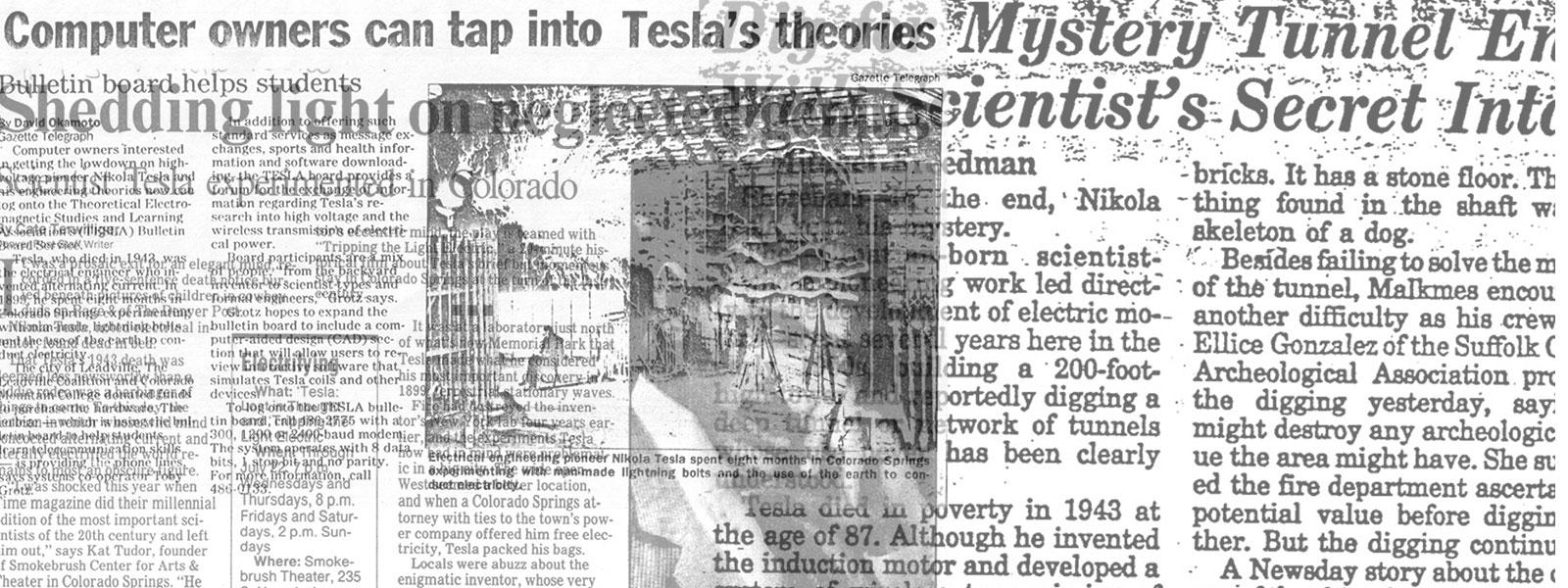
On May 17, 1899, Tesla’s arrival in Colorado Springs created quite a stir in their bustling community, known as “Little London,” located at the foot of the Rockies. Before his arrival he had written to Leonard Curtis explaining his need for space. His experiments had become too dangerous for New York, as his coils were producing 4,000,000 volts. Sparks jumping from wall to ceilings were a fire hazard. He had also stated that his work was secret and that he needed electrical power, water and his own laboratory.
This project was financed by Astor, as well as Crawford and Simpson, all of whom were familiar with his work in New York. Mr. Curtis had arranged for all of Tesla’s requirements. The land would be free. He would live at the Alta Vista Hotel and as Curtis held interests in the city power plant, the electricity would also be free.
The press, being no different in 1899 than today, surrounded Tesla after arriving at the hotel. He was questioned as to why he was there and what he intended to do. Tesla replied that he intended to study lightning at high altitude and expected to do wireless experiments. Due to other questions, he also stated that he was not here to do stunts, but that his work was serious business.
On the morning after his arrival, Tesla contacted a carpenter, Joseph Dozier, and showed him the laboratory drawings. A high spot on the prairie was chosen about a mile east of the post office and directly back of the School for the Deaf and Blind. A mile to the southeast was the Union Printers Home. There was nothing built in between. Work began immediately on the laboratory and Tesla sent for Lowenstein, his assistant, to oversee construction and to locate equipment. The barn-like structure was approximately 100 feet square and braced on three sides. Above the sloping roof was an 80-foot tower through which extended a 200-foot mast. On top of the mast was placed a one meter copper sphere. The completed structure was surrounded by a fence with notices written in large letters warning, KEEP OUT - GREAT DANGER.
By mid-summer of 1899, the laboratory was usable for preliminary investigations of Tesla’s wireless telegraphy theories. He was extremely pleased with the western state as the site for his experiments. The rarefied air provided exceptional opportunities for the study of high potential electrical phenomena. “No better opportunities for such observations as I intend to make could be found anywhere,” said Tesla. “Colorado is a country famous for the natural displays of electric force.”
The interior of the laboratory was filled with a variety of Tesla innovations. High-voltage transformers, dynamos, resonant-tuning devices, capacitor-discharge apparatus, oil insulated capacitors (a Tesla invention) and a large metered control panel were among the items neatly spaced about the room. At one end was the secondary coil of a giant Tesla transformer, which was termed a “magnifying transmitter.” Its primary coil, buried below the floor, was fifty-one feet in diameter and wound with heavy copper bars. In the center of the secondary was another coil having a diameter of ten feet. It carried one hundred turns of wire and served to function as an extension of the secondary. With these devices, Tesla intended to determine if the earth possessed an electrical charge and to institute experiments that would alter its magnitude. At that time only Tesla would be so bold as to undertake a scientific investigation of such proportions.
In the middle of June, Tesla arranged one of the receiving transformers in a novel manner to determine experimentally the electric potential of the globe and study its periodic and casual fluctuations. “This formed part of a plan carefully mapped out in advance. A highly sensitive self-restorative device, controlling a recording instrument, was included in the secondary circuit, while the primary was connected to the ground and an elevated terminal of adjustable capacity. The variations of potential gave rise to electric surgings in the primary. These generated secondary currents, which in turn affected the sensitive device and recorder in proportion to their intensity. The earth was found to be, literally, alive with electrical vibrations, and soon I was deeply absorbed in this interesting investigation.”
Over the next two weeks Tesla noticed several times that the instruments were affected more by discharges taking place at great distances than by those near by. This was quite a puzzle. A number of observations proved that it could not be due to the differences in the intensity of the individual discharges, and it was readily ascertained that the phenomenon was not the result of a varying relation between the periods of the receiving circuits and those of the terrestrial disturbances.
It was the third of July — the date I shall never forget — when I obtained the first decisive experimental evidence of a truth of overwhelming importance for the advancement of humanity.
A dense mass of strongly charged clouds gathered in the west and towards evening a violent storm broke loose. After spending much of its fury in the mountains, the storm moved with great velocity over the plains. Heavy and long persisting arcs formed almost in regular time intervals. Tesla was able to observe the recording apparatus indications becoming fainter and fainter with the increasing distance of the storm. As Tesla continued his observation, the indications again began growing stronger and stronger and after passing through a maximum, gradually decreased and again ceased once more. The same actions were repeated at regularly recurring intervals. Similar observations were made by Mr. Lowenstein and shortly afterward several opportunities presented themselves, which brought out the unmistakably true nature of the wonderful phenomenon.
No doubt whatever remained. I was observing stationary waves.
As the source of disturbance moved away, the receiving circuit came successively upon their nodes and loops. Impossible as it seemed, this planet, despite its vast extent, behaved like a conductor of limited dimensions. The tremendous significance of this fact in the transmission of energy by my system had already become quite clear to me. Not only was it practicable to send telegraphic messages to any distance without wires, as I recognized long ago, but also to impress upon the entire globe the faint modulations of the human voice, far more still to transmit power, in unlimited amounts, to any terrestrial distance and almost without any loss.
Tesla considered his experiments in Colorado Springs so conclusive, both in wireless communications and wireless transmission of power, that he began work towards making the system commercially available for the transmission of energy in small amounts for specific purposes, as well as for industrial use. The system involves the use of a number of plants which are capable of transmitting individualized signals to all parts of the world. Each plant would be located near some important center of civilization and the news it received through any channel would be flashed to all points of the globe. A cheap and simple device, which might be carried in a person’s pocket, may then be set up to receive the world’s news. “Thus the entire earth will be converted into a huge brain, as it were, capable of response in every one of its parts. Since a single plant of but one hundred horsepower can operate hundreds of millions of instruments, the system will have a virtually infinite working capacity, and it must immensely facilitate and cheapen the transmission of intelligence.”
The first of these plants, and only one, was built on Long Island. Again J.P. Morgan was the only one willing to support Tesla. An advance of $150,000 was made to build the gargantuan tower for a multiplex trans-Atlantic broadcasting system. Tesla agreed to assign 51 per cent of all his patent rights relating to wireless telegraphy and telephony, as well as any other patents that might emerge from the Colorado Springs test.
Financial panic and his inability to raise additional funds dealt Tesla a blow from which he never recovered. He had underestimated the cost and could not complete the equipment he needed to prove his theories. Tesla’s talents never included money management.
The tower was never completed and during World War I it was demolished for fear that Tesla, an Austro-Hungarian, might use it to send messages to the Central Powers. After the war, Tesla’s remaining life was spent quietly in the New Yorker Hotel. He lived the last several years on a pension from the Yugoslav government.
Tesla died at the age of 86, January 7, 1943. The last few years were nonproductive, but he never ceased dreaming. Each year on his birthday he held a news conference at which he would announce great forthcoming inventions. He was still convinced there could be wireless transmission of power. He discussed interplanetary communications, then a death ray and scheme for lighting the whole night side of the earth. Many of his ideas, for which he was never given credit, have been developed to realities.
Today there is a historical marker in the Colorado Springs Memorial Park. The marker is located near the site of Tesla’s laboratory and serves to remind us of Tesla’s very remarkable and creative life. On May 7, 1966, a memorial dinner was held at the El Paso Club in the same room where Tesla dined with dignitaries when he first came to Colorado Springs. Among those attending the dinner was our own James J. Stringer representing the Institute of Electrical and Electronics Engineers and then the Section Chairman of the Denver Section.
— CRW