Nikola Tesla Articles
Photographs Sent by Wire; Time and Space Annihilated
Suppose an event of great importance takes place in some far Western city — something that the great army of newspaper readers would like to visualize by photographic record. Will they be obliged to wait three or four days or until a time when interest has grown cold to see it? No. By the remarkable invention of M. Edouard Belin, a French engineer, a picture taken in, say, Kansas City on Saturday afternoon can be put on the telegraph wires, sent by a series of electric vibrations to a local newspaper and reproduced in the Sunday morning edition. Once more has science set time and distance at naught.
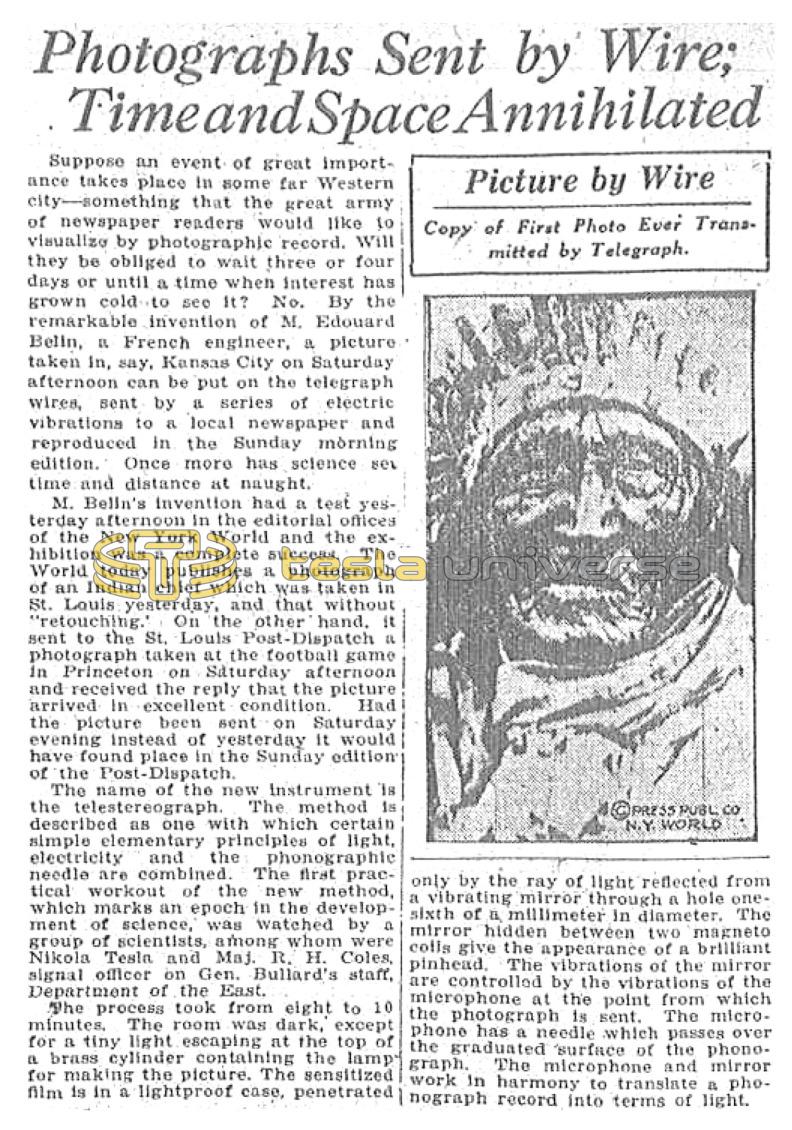
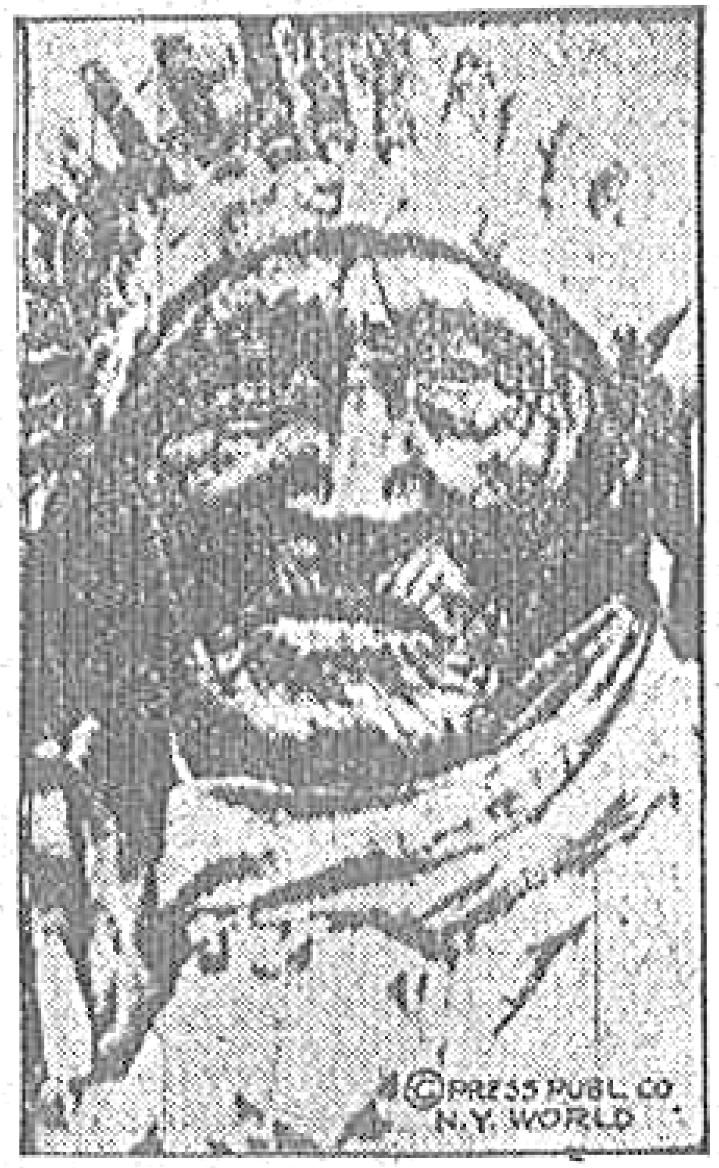
M. Belin’s invention had a test yesterday afternoon in the editorial offices of the New York World and the exhibition was a complete success. The World today publishes a photograph of an Indian chief which was taken in St. Louis yesterday, and that without “retouching.” On the other hand, it sent to the St. Louis Post-Dispatch a photograph taken at the football game in Princeton on Saturday afternoon and received the reply that the picture arrived in excellent condition. Had the picture been sent on Saturday evening instead of yesterday it would have found place in the Sunday edition of the Post-Dispatch.
The name of the new instrument is the telestereograph. The method is described as one with which certain simple elementary principles of light, electricity and the phonographic needle are combined. The first practical workout of the new method, which marks an epoch in the development of science, was watched by a group of scientists, among whom were Nikola Tesla and Maj. R. H. Coles, signal officer on Gen. Bullard’s staff, Department of the East.
The process took from eight to 10 minutes. The room was dark, except for a tiny light escaping at the top of a brass cylinder containing the lamp for making the picture. The sensitized film is in a lightproof case, penetrated only by the ray of light reflected from a vibrating mirror through a hole one-sixth of a millimeter in diameter. The mirror hidden between two magneto coils gives the appearance of a brilliant pinhead. The vibrations of the mirror are controlled by the vibrations of the microphone at the point from which the photograph is sent. The microphone has a needle which passes over the graduated surface of the phonograph. The microphone and mirror work in harmony to translate a phonograph record into terms of light.