Nikola Tesla Articles
Wireless Transmission of Energy - Dream or Possibility Page 29
Galaxy - September 1st, 1984
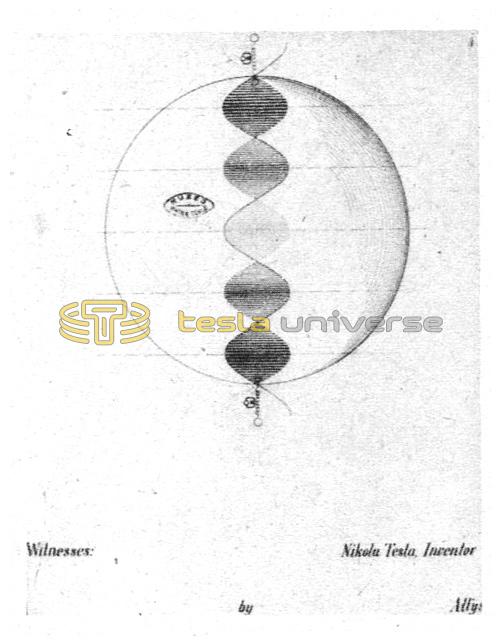
scientists of that time. As early as 1893 he described in detail how a system for the transmission of electrical energy without wires might look. At the transmitting place a metal plate is to be set in the ground and a second, insulated plate raised into the air. The ends of the generator are connected to these two plates. On the receiving side a similar combination of a grounded and a raised plate is set up, and resonance may be used to increase the effect of the receiver.
In the patents of 1897 he stated that high antennas had to be made if the system operating with currents of low frequency was to be efficient, that is, that high voltages and currents of high frequency had to be combined in order to transmit larger amounts of energy successfully. It is certain that at that time Tesla was the first to transmit larger amounts of energy through plasma and to show that it could be a medium for transmission with small losses. From the documentation in the Nikola Tesla Museum in Belgrade it is seen that Tesla carried out an experiment in the transmission of electrical energy through rarefied gas, and that this was a confirmation that a similar medium could be used on a global scale. With the application of voltages of the order of hundreds of millions of volts, and antennas which would have to be several tens of kilometers high, Tesla considered that an ionized layer would form in the rarefied layers of the atmosphere, so that through this layer and the earth a current would flow which, with small losses, would reach a distant receiver, that is, the user of electrical energy. For Tesla the earth is like a conducting metal ball, and everything that can be done with metal spheres can be done with the earth!
The vision of a system for the wireless transmission of energy became Tesla’s obsession. Sources of energy are often in places far from the centers where energy is consumed for the needs of industry and of people in general. An economical system of transmission must be such that energy can be directed to the most distant points of the terrestrial globe. Tesla considered that he would realize such a system by applying his oscillator of currents of high frequency and extremely high voltages, which would disturb the electrical load of the earth. In his laboratory in New York Tesla entertained guests by experimenting with the transmission of energy from wires in the near field of an oscillator of currents of high frequency. Tubes with rarefied gas glowed throughout the laboratory as soon as his oscillator began to work. For more serious experiments he needed still higher voltages and freer space around the laboratory. At the end of 1898 he set out in search of a location for a new laboratory.
Laboratory in Colorado Springs
After studying various places and the other important conditions, he finally decided on Colorado Springs. He raised the laboratory on a plateau at about 2,000 meters above sea level, on a bare spot surrounded by high mountains. The region was known for its exceptionally clean atmosphere and great activity of natural electricity. Near Tesla’s new laboratory one of the first hydroelectric plants with a polyphase system of alternating currents had been built. Tesla built a wooden barrack, large enough to house his largest transformer without iron, with a primary and a secondary coil of 15 meters. He chose such dimensions because of the extremely high voltages with which he intended to work. A detailed description of the various devices in this laboratory is found in Tesla’s notes from Colorado Springs. There Tesla kept an orderly research diary and recorded everything very carefully. Toward the end of the experiments, which were carried out day and night, numerous photographs of Tesla’s apparatus at work were taken with the help of a professional photographer. In these photographs are shots of streamers and sparks of great length. Sometimes these were discharges from spheres, and sometimes from a row of crowded wires on the final turns of the secondary. The sights must have been extraordinary, as are the photographs themselves. The great transformer in Colorado Springs was a novelty in that Tesla applied three oscillating circuits. With the third oscillating circuit, placed inside the great primary and secondary, Tesla drew the maximum from his oscillator.
The effects were astonishing, and for a long time the storm of excitement around the Colorado experiments did not subside. It is known that similar experiments have been repeated three times to this day, but there are no data that anything more significant went beyond what Tesla achieved with this apparatus. In every case Tesla is still being copied, in the hope of better understanding why Tesla did all this and whether it is possible to establish whether the assumptions about the wireless transmission of energy are exact, and everything written about these experiments in the press at the beginning of this century. According to Fleming, Tesla succeeded in transmitting by wireless a sufficient amount of energy to light several lamps at a distance of 42 kilometers. Tesla himself, so far as is known, nowhere wrote that he had achieved such a thing. Some of his statements could be taken that way, but when the matter is examined carefully it seems to us that this was not so. Out of caution Tesla never gave exhaustive statements with all the results he achieved, and so the impression could be created, and a conclusion drawn, that he had done much more than he wrote and published. It still seems to us that Tesla many times spoke of the theoretical possibilities of his system of energy transmission without wires. In most cases this was not based on the data of experiments actually performed.
In interviews with newspapermen, and even in magazines such as The Century Magazine or The Electrical World and Engineer, Tesla put forward bold assertions about the possibility of the wireless transmission of energy in small amounts for the transmission of messages, and perhaps in larger amounts for other applications. He also showed photographs of lamps connected to a coil which glowed although they were not connected to a generator. Likewise, he showed how lamps connected to the ends of a coil in the form of a loop could be lighted. However, all these were experiments in the transmission of energy for supplying lamps at a small distance of a few tens of meters from the great oscillator.
The problem of increasing human energy
In the middle of 1900 Tesla published a long article in the magazine The Century Illustrated Monthly Magazine under the title “The Problem of Increasing Human Energy.” The title is undoubtedly unusual, and so is the whole text of the article. The publisher asked Tesla to describe his experiments in Colorado Springs, and what
