Nikola Tesla Articles
Wireless Transmission of Energy - Dream or Possibility Page 31
Galaxy - September 1st, 1984
an assumption — that the Earth is one large sphere over which it is possible to transmit energy by disturbing the electrical charge — he worked out further with more detailed calculations of the transmitted power, the method of exciting waves in the earth, the choice of operating frequency, and so on.
According to Tesla, the Earth can be used for the transmission of electrical energy without wires by connecting an elevated metal sphere and a metal plate in the earth to a generator of alternating currents. A monopole is thus formed. Let us imagine that we have connected some direct voltage U to the monopole. The equivalent circuit of the elevated-sphere–Earth system is shown in Fig. 3. This is a simple circuit for which, in the steady state, the following equation holds:
\( \dfrac{q}{c} + \dfrac{q}{C} = U \),
where q is the quantity of electricity that has passed, c is the capacitance of the sphere, and C is the capacitance of the terrestrial sphere. Since \( c \ll C \), the potential of the sphere is considerably greater than the potential of the Earth.
The static model we have just described served Tesla in arriving at the basic relations between the charge and the potential of the sphere, and on the basis of these he calculated the peak power with which he excited the terrestrial globe. By a sudden discharge of the sphere a short impulse is created which forms a wave along the terrestrial globe. Tesla imagined that energy is transmitted by a current wave through the Earth. As the earth may be imagined to represent an electrical conductor, the propagation is affected by the distributed inductance and the distributed capacitance of the Earth. Tesla endeavored to calculate these in order, on the basis of them, to determine the most favorable operating frequency at which the transmission of energy would be optimal.
According to Tesla, the current density along the Earth’s surface changes according to the law
\( J = \dfrac{I}{\pi r^{2}} = \dfrac{I}{d^{2}} \cdot \dfrac{\theta^{2}}{\pi \sin^{2}\theta} \)
where I is the current at the point of excitation, d is the distance to the place at which the current density J is found, on a ring distant d from the source, and θ is the angle between the radii of the Earth which pass through the source and through the point of observation. The quantity r is the radius of the Earth’s cap at a distance d measured along the surface of the Earth. Tesla calls this law the “law of current density.”
In the Long Island Notes (29 January 1904), where he was calculating the elements of his system for the wireless transmission of energy, Tesla writes the following on the estimation of the Earth’s constants:
“…Taking the mean radius of the terrestrial sphere as 6,367.4 km, it is found that the capacitance of the Earth is 707.5 μF. For calculating the capacitance per mile by an approximate model, the spherical Earth is replaced by a cylinder of a length of two Earth radii and a diameter determined on the basis of the condition of equal capacitances of the sphere and the cylinder.”
The ratio of the capacitance of a ring of a width of half a wavelength and the capacitance of the sphere (or terminal, that is, an antenna which may be different from a sphere!), according to Tesla, makes it possible to find the ratio of the potential of the sphere and the Earth. The second method of calculating the potential, according to Tesla, is based on the already mentioned law of current density. According to that law, the same total current always flows through a cross-section of the Earth. At the equator the current density is thus
\( J_{ek} = \dfrac{I}{a^{2}\pi} \),
where a is the radius of the Earth. Up to the equator the current density falls, and then it begins to rise toward the antipode.
Resonances of the terrestrial sphere
Tesla’s model of propagation along the surface of the Earth is, in the extreme case, unusual. On the one hand he observes the static case of charging the sphere and thus determines the charge on the sphere–Earth system. At the moment when the sphere discharges (for example, by connecting the sphere to a grounded plate) a current impulse appears, and then, according to Tesla, the propagation of the disturbance of the electrical charge along the Earth’s surface and through the whole cross-section of the Earth comes on the scene. In Tesla’s time there was no solution of this problem on the basis of Maxwell’s equations, and this was done only several decades later. It is also interesting that Tesla, with his simple model, arrived at an incredibly accurate value for the resonance of the Earth. The calculation is based on the assumption that the diameter of the Earth is an odd multiple of a quarter-wavelength of the waves which create a standing wave on the Earth. With a diameter of the Earth of about 12,735 km Tesla calculated that the lowest resonance of the Earth would be about 6 Hz. When the resonant frequencies were calculated in the 1950s, the lowest frequency obtained was about 10 Hz. After measurements of the resonances were made by analysis of the noise of atmospheric discharges, it was found that the lowest resonance is somewhere about 7.5 to 8 Hz! This datum best illustrates Tesla’s ability to perceive what is most essential and, with his simple model, to discover what would require complicated mathematics or precise and special instruments, which he neither had at his disposal nor were known in his time.
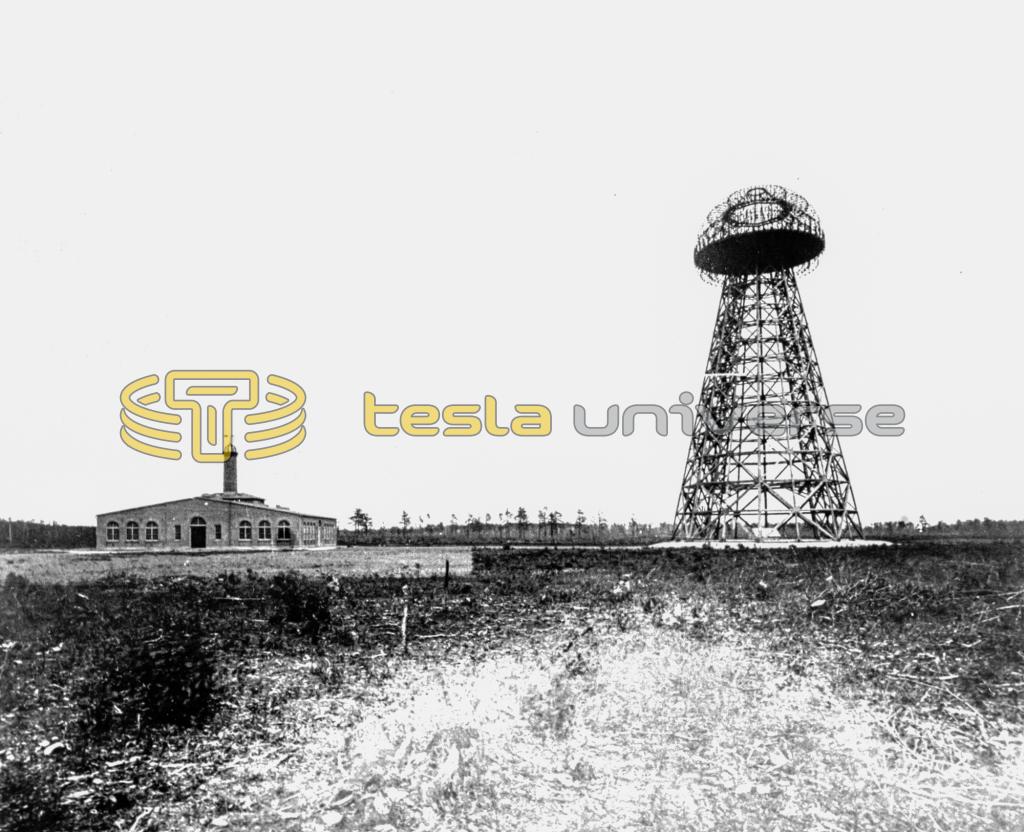
Tesla’s model and the attempts to realize a system for the wireless transmission of energy no longer gave individuals any peace, especially not from the time when a system was being sought which would make it possible to communicate with submerged submarines. In the 1970s extensive experiments were carried out in the United States which were a continuation of what Tesla had wished to investigate at the beginning of this century. In an introductory article which preceded a series of articles on a system for communication at great distances and under the sea, Tesla’s name and his experiments in Colorado Springs and on Long Island were among the first to be mentioned. It was said that Tesla’s experiments of that time were in many respects similar to the later investigations which led to the creation of a system of communication with submerged submarines at extremely low frequencies, with which Tesla worked and intended to create a system for the wireless transmission of energy.
When the Colorado Springs Notes of Nikola Tesla appeared, many believed that they would find in them the answer to the question of how to transmit electrical energy by wireless. The disappointment was not small when it was found that not a step had been made toward seeing the solution of the problem. Some tried to make use of the changes in the comments on Tesla’s Colorado diary when these were translated into English
