Nikola Tesla Articles
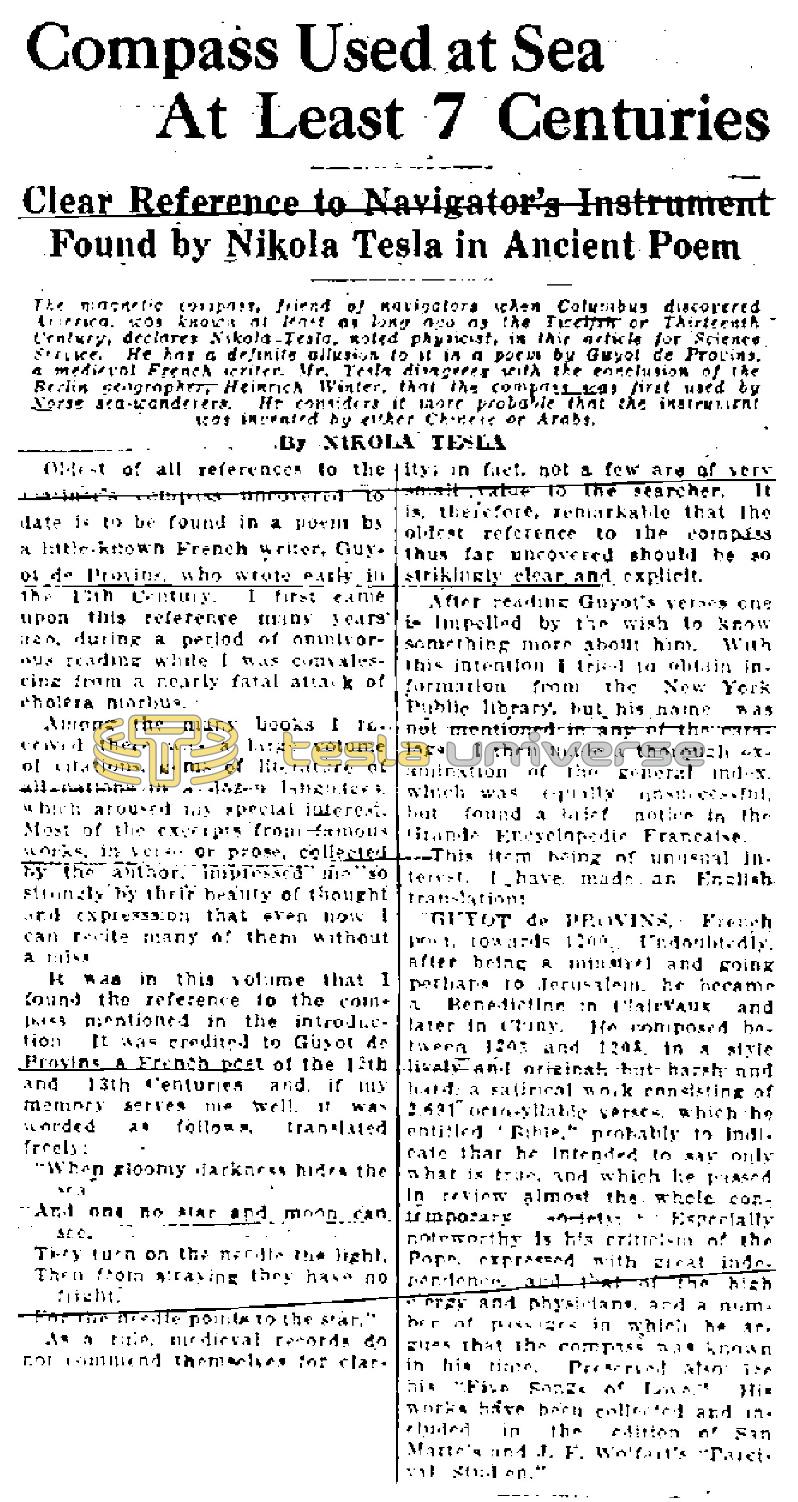
Compass Used at Sea At Least 7 Centuries
Clear Reference to Navigator’s Instrument Found by Nikola Tesla in Ancient Poem
The magnetic compass, friend of navigators when Columbus discovered America, was known at least as long ago as the Twelfth or Thirteenth Century, declares Nikola Tesla, noted physicist, in this article for Science Service. He has a definite allusion to it in a poem by Guyot de Provins, a medieval French writer. Mr. Tesla disagrees with the conclusion of the Berlin geographer, Heinrich Winter, that the compass was first used by Norse sea-wanderers. He considers it more probable that the instrument was invented by either Chinese or Arabs.
Oldest of all references to the magnetic compass uncovered to date is to be found in a poem by a little-known French writer, Guyot de Provins, who wrote early in the 13th Century. I first came upon this reference many years ago, during a period of omnivorous reading while I was convalescing from a nearly fatal attack of cholera morbus.
Among the many books I received there was a large volume of citations, gems of literature of all nations in a dozen languages, which aroused my special interest. Most of the excerpts from famous works, in verse or prose, collected by the author, impressed me so strongly by their beauty of thought and expression that even now I can recite many of them without a miss.
It was in this volume that I found the reference to the compass mentioned in the introduction. It was credited to Guyot de Provins, a French poet of the 12th and 13th Centuries and, if my memory serves me well, it was worded as follows, translated freely:
“When gloomy darkness hides the sea And one no star and moon can see, They turn on the needle the light, Then from straying they have no flight, For the needle points to the star.”
As a rule, medieval records do not commend themselves for clarity; in fact, not a few are of very small value to the searcher. It is, therefore, remarkable that the oldest reference to the compass thus far uncovered should be so strikingly clear and explicit.
After reading Guyot’s verses one is impelled by the wish to know something more about him. With this intention I tried to obtain information from the New York Public Library, but his name was not mentioned in any of the catalogues. I then made a thorough examination of the general index, which was equally unsuccessful, but found a brief notice in the Grande Encyclopédie Française.
This item being of unusual interest, I have made an English translation:
“GUYOT de PROVINS, French poet, towards 1200. Undoubtedly, after being a minstrel and going perhaps to Jerusalem, he became a Benedictine in Clairvaux and later in Cluny. He composed between 1203 and 1208, in a style lively and original but harsh and hard, a satirical work consisting of 2,691 octosyllabic verses, which he entitled ‘Bible,’ probably to indicate that he intended to say only what is true, and which he passed in review almost the whole contemporary society. Especially noteworthy is his criticism of the Pope, expressed with great independence, and that of the high clergy and physicians, and a number of passages in which he argues that the compass was known in his time. Preserved also are his ‘Five Songs of Love.’ His works have been collected and included in the edition of San Marte’s and J. F. Wolfart’s ‘Provençal Studies.’”