
Nikola Tesla Articles
Scrapbook Provides Glimpse Into Past

Colorado Springs was one row of buildings on a treeless prairie when H. Hoyt Stevens brought his bride here Oct. 15, 1871. They rode into town on the first run of the Denver and Rio Grande Railroad from Denver. The train was drawn by “Old 168,” the locomotive now on display in Antlers Park.
The Stevens were one of the city’s first families and intimately linked to the early history of the region. Mrs. Stevens started a scrapbook sometime in those early years and carefully filled it with clippings, pictures and mementos.
Florence Stevens Knight, the Stevens’ youngest daughter, died last August. She left this scrapbook, bulging with stories of the city’s past, to Penrose Public Library for its local history collection.
The scrapbook provides a fascinating glimpse of the things that interested one family in the inner circle of early Colorado Springs’ social and business life.
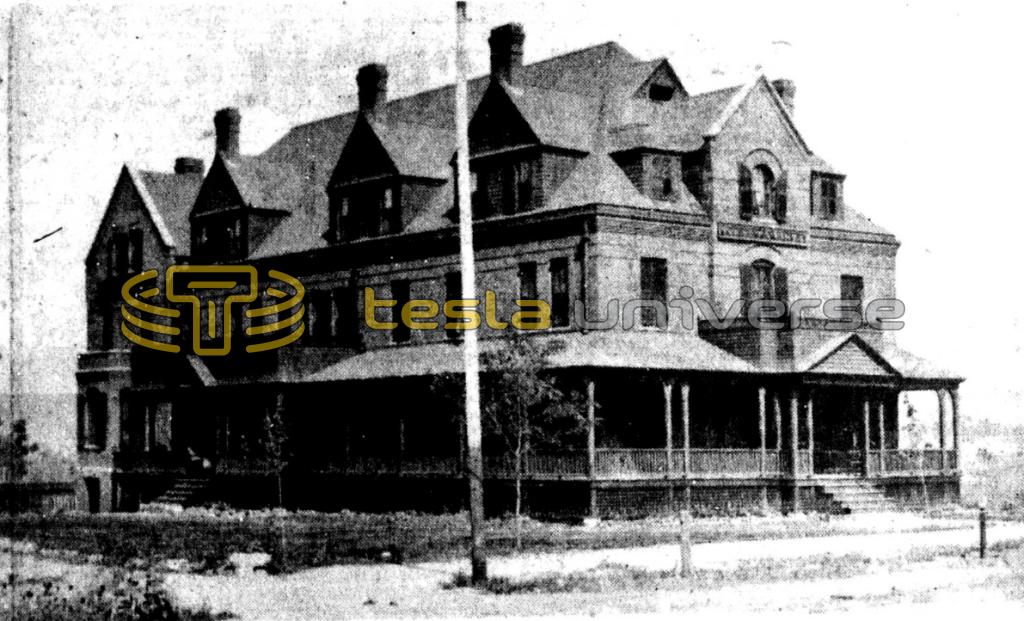
Stevens built and operated the Alta Vista Hotel, which stood until 1961 at 118 N. Cascade Ave. It was considered one of the area’s finest. At one time he had a livery stable and introduced a mule-drawn tram that led to the city’s streetcar network. He also had ranching interests in South Park and interests in a lead silver mine in Ophir.
Originally from Canada, he married Mrs. Stevens in Vermont on May 31, 1871. The young couple with his sister and brother-in-law, the Channing Sweets, and their 2-year-old son went to Chicago. There they were caught in the disastrous fire that Mrs. O’Leary’s cow became famous for. For a few terrifying hours the two women became separated from the men, who were helping fight the fire, when a connecting bridge was burned through.
Though they eventually found safety, they decided to move on to Colorado. It happened that Sweet had formerly been in Colorado City and had been at the ceremony the previous July when Gen. William Jackson Palmer drove the first stake for his new town. It was this connection that brought the Stevens to Colorado Springs. William Sweet, the little boy who shared their travels, later became governor of Colorado.

Stevens, who was very much interested in local history, liked to tell that when he first came to town the “post office” was a packing box at the corner of Cascade Avenue and Huerfano Street (now Colorado Avenue). Here the mail that came in on the train was dumped for people to sort through at their pleasure.
Their first callers on arrival here were Gen. and Mrs. Palmer, so it is appropriate that the first pictures in the scrapbook are those of Palmer and a very elegantly dressed Queenie.
Though the Stevens moved for a few years to South Park, where he established a ranch at 11 Mile, they returned to Colorado Springs. Stevens went into the livery business with Frank Rouse. One of their ventures was a Herdic bus, a light 12-passenger vehicle drawn by two mules, which carried passengers on a Tejon Street route from Cucharras Street to Cache La Poudre. The fare was five cents.
Stevens opened his first hotel, really a boarding house, in 1886. It was called Park View Cottage and drew many tourists. The Alta Vista was built several years later as a three-story, gabled red brick building with surrounding porches. He kept adding on as business increased, completing it as a four-story structure in 1899. The final addition in 1915 brought it to 120 rooms.

The Alta Vista became a center of social life. The scrapbook contains a number of elegant menus for special events and programs for musical entertainments held there, as well as newspaper accounts of the guests who stayed there and of many parties, weddings, balls and meetings.
Mrs. Stevens entertained often. Her “at homes” at times featured young performing artists, at others the Alta Vista Hotel Orchestra, and the names of those who attended were dutifully recorded on the newspaper society page.
The hotel also figured in news stories other than social events, also clipped and recorded. There was the story about the clerk who disappeared when his accounts were found to be $50 short, and about the former waitress who became converted after moving to the West Coast and sent back two silver spoons.
There was also the tragic incident where a young elevator operator apparently became ill and lost consciousness at her work. She fell, striking her head on some metal part, and was killed. Her 12-year-old girl passenger managed to bring the cage to a halt and run for help.
On another occasion a man “blew his brains out” in his hotel room, after his sweetheart, a young actress, killed herself in similar fashion at the Broadmoor.
Stevens was proud of his hotel. He boasted that it was the first hotel in Colorado to have an electric sign, the first to have hot and cold running water and the first to cook with electricity.
The scrapbook contains many clippings about Colorado Springs that did not relate to the hotel, such as the disastrous downtown flood in 1935 and many other vagaries of the weather, from the hottest day to the worst hail storm.
There were many community events, such as the celebration of the Gen. Palmer Centennial and the opening of the Cheyenne Mountain Zoo. Mrs. Stevens also clipped stories of the new buildings in town, the new County Courthouse in 1903, the graceful City Hall in 1905, the Federal Building in 1910 and the elegant Burns Theater in 1911.
The Stevens lived to celebrate their 68th wedding anniversary. Toward the end of their lives they spent their winters in San Diego, but they remained a vital and energetic force in the community, and were honored as the city’s oldest resident couple. Mrs. Stevens died in 1940 at the age of 88. Stevens survived her until 1944, when he died at the age of 94.
The Stevens’ children were also well known here. Fred, the oldest son, was a photographer. Two of his pictures “Sunrise from Pikes Peak” and “Sunset, Pikes Peak” were famous across the country. He was also known for his pictures of the St. Louis Exposition in 1904. He invented a process for putting identifying photographs on season tickets to that fair.
Florence, the youngest of the five children, was born at the Alta Vista, and lived there until her marriage to Fred Purdy in 1914. Her name and picture appeared in many accounts of social events.
She married Alfred Knight in 1955. She was a lifelong resident of Colorado Springs, was an accomplished musician, and was prominent in local club and church activities.
The scrapbook that her mother filled and that she kept for so many years is a gift to the community that will interest many local historians.
