Nikola Tesla Articles
The Latest Progress in Spark Telegraphy
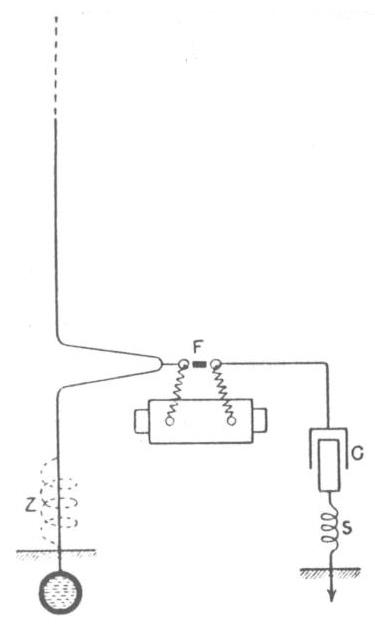
The latest form of connections of the wireless telegraph apparatus made by the Allgemeine Elektricitäts Gesellschaft are as follows. The transmitter (Fig. 1) consists of wire fastened to the flagstaff of the building, which is led to earth and connected with the water main. A loop in this wire is led through the window into the room, and is connected to an induction coil, F, the other pole of whose secondary winding is connected to earth through a tuned condenser, C. If we wish to telegraph with a greater wave-length, it is only necessary to connect an additional coil, Z, in the earth wire, as shown by the dotted line. It corresponds to a certain equivalent length of wire by which we increase the quarter wave-length, and a whole set of such coils can be employed. In each case, however, it is necessary to tune the oscillation produced in the circuit closed by the earth connection to the oscillation of the wire, in order to obtain the greatest effect. This is done in the simplest manner by adjusting an adjustable self-induction, S, or the condenser C, which bear particular marks for this purpose.
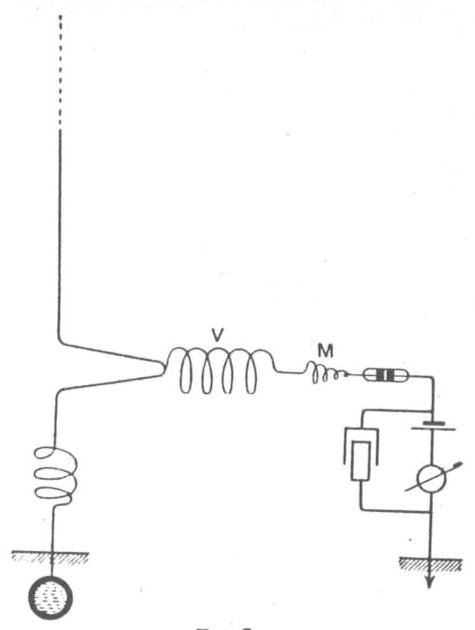
A similar wire serves as the receiver (Fig. 2), to which, also, an extension wire in the form of an equivalent coil, V, is connected by means of the loop. The pressure is at its maximum at the end of the latter, and is strengthened by a tuned intensifying coil M, which is connected directly to the coherer. It is also possible to replace the action of the two coils by a single coil with corresponding winding. The earth connection of the coherer contains the dry cell and the relay, which are bridged by a condenser in order not to disturb the oscillations. The Allgemeine Elektricitäts Gesellschaft guarantees with this arrangement a tuning to the required wave-length within certain limits, and a clear deciphering of signals at distances of 100 km. on the sea with masts 50 metres high.
Spark telegraphy has now left the condition of tentative experiment and has developed into actual engineering to accomplish a definite object, and the active forces of the industry will soon do what is needful to extend its sphere of applicability. It will, in the first instance, become an indispensable means of communication on the coast and on the open sea, where the life and property of mankind is most endangered, and I do not think it will be long before every large ship will be equipped with this simple and useful apparatus. But spark telegraphy will also, in the future, replace cable in many cases for submarine communication, although in this respect we must not place our hopes too high. We can almost now see the limits, putting aside extravagant plans, as, for instance, elevating a wire 1,000 metres by means of balloons, which may be possible in an individual experiment, but is worthless in practice for reliable continuous working. We can scarcely expect a transmission of signals of more than a few hundred kilometres even with more perfect development of the means at present at hand.
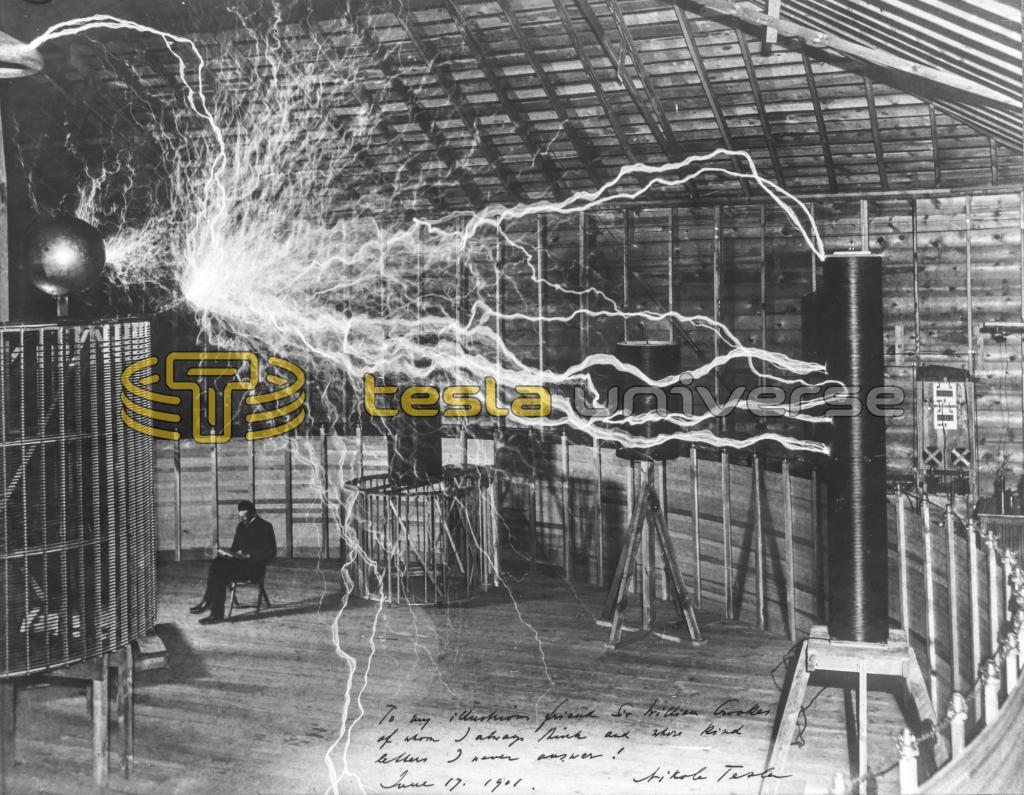
The way open for further progress is also clear. The distance of transmission depends essentially on three things, the length of the parallel wires, the frequency of the pulsations, and the mean value of the current employed. The first two can hardly be increased, and also extending the length of the wire requires longer wave-lengths and consequently slower frequency; and, therefore, quite a new means would have to be found to make the wave-length independent of the length of wire employed. An increase of the induced current only remains therefore. This depends on two quantities, the capacity or receptive power of the wire, and the actual pressure of the spark. The higher we take the wire the smaller will be the capacity of the parts distant from the earth, and the longer it is the harder it will be to secure it in stormy weather. Thus I hope to have shown that the future of spark telegraphy lies exclusively in the direction of producing higher electrical pressures. What we have used in this direction hitherto is very modest if we compare it with what has been shown to only a few of the initiated, far from here on the other side of the ocean, on the high Rocky Mountains at the sources of the Colorado River, by an investigator who has shut himself off from the world — Nikola Tesla. I cannot report on it as an eye witness, but can only form my opinion from some photographs which he has most kindly sent me a few days ago. Here (Fig. 3) one sees him in his lonely house surrounded by artificially-produced spark discharges, which throw into the shade all that our most daring fancy has dreamt of. May his theoretical knowledge and his eminent technical ability soon be placed at the practical service of spark telegraphy.
* Extract from a lecture delivered at the forty-second general meeting of the Verein Deutscher Ingénieure, at Kiel.