
Nikola Tesla Articles
Nikola Tesla, The Electrician
The republic has the property of a magnet; it attracts iron characters. New York is the intellectual and commercial center of the country and the magnetic “field of force” is most intense in our greatest city. It has been said by many that, while the city attracts strong characters, it is not the best place for the higher intellectual life. The student and thinker should seek the calm of sleepy, academic towns “far from the madding crowd.” These forget that modern life makes it possible to have the deepest seclusion and space for high thinking in the very focus of the city. Eternal calm is not the only desirable thing. Friction, attrition, even heavy grinding are as essential to the intellectual life as to cut glass.
It is, therefore, not surprising to find to-day one of the few great students of our times, a man of remarkable intellectual gifts, drawn from the far East of Europe to our chief city. In the turmoil of the dry-goods district he has set up his workshop, and by his presence added new fame to Broadway. Just as Ericsson lived and worked in New York, far from his native fiords, so to-day Nikola Tesla works in his Houston Street laboratory, far from the mountain home of his ancient Serbian race.
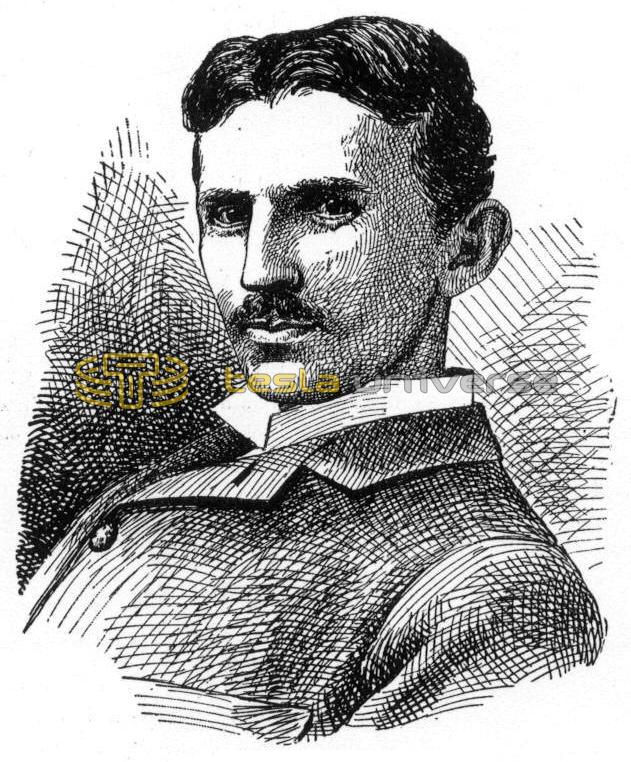
In Smiljan Lika, Austria-Hungary, there has long lived an old and respected family. One branch of this family had born to them in 1857 a son. The father was a clergyman in the Greek Church, the mother apparently a Connecticut Yankee astray in another race. She was not only a good house-mother, but she had the precious gift of handiness, and was a designer and maker of those ancient tools the loom and churn. It is small wonder that the son of such parents should have at once the mechanic and the prophetic mind.
The boy Nikola attended the public school at Gospich. At the end of three years he graduated to the Real Schule. At the end of three more years he advanced to the higher Real Schule at Carstatt, Croatia, graduating in 1873. It is curious to note that it was here the youthful Nikola first saw a locomotive. Naturally the father hoped the son’s education would lead him to the church, but the boy’s bent of mind was too pronounced to long admit of such expectations. He seemed plainly destined for a professor of physics, and joined the Polytechnic School at Gratz. This too proved a blind guess at the young man’s future. In the lecture-room there was soon mental rebellion. In vain the professor demonstrated the impossible. The student denied the impossible. Curiously, the subject under discussion was a Gramme dynamo, requiring, as was clearly demonstrated, commutators or brushes. The student imagined a dynamo without brushes. Imagination is the mother of invention. The youth clearly had an inventive mind. He could see the impossibilities of other minds quite possible in his own. Teaching was not for such a student. After one year at the Polytechnic he began the study of engineering. On graduation he, with a broad grasp of the great world-sciences, saw that he must be a linguist, and mastered several languages that he might be unhampered by locality.
His feet turned westward. Prague and Budapest were but way-stations in his progress. He served as assistant engineer in the government telegraph engineering department and began at once to suggest improvements on the practical side of the science. The field was too small. He must go farther, was soon in Paris, where he secured employment in an electric light company.
Here he seemed to catch the wider air of another land. He met Americans who told him of the greater chances of a newer civilization. He was already a dreamer of dreams scientific. Where could dreams be so quickly realized as in America? Without hesitation he sailed at once for New York and went on the day he landed to the laboratory of Edison. Mind sought mind. Smiljan, Prague, Paris, Orange, New Jersey, marked the progress to the West. Here was room and space enough to work — to realize dreams, to prove the impossible to be real and practical. Naturally, with an original mind there must be special methods, peculiar environment, and in time the young Tesla sought, in the heart of roaring Broadway, the seclusion and calm of his own laboratory, where he might work out in his own way his own ideas. The experience in the Edison laboratory was invaluable, but it was an experience and not an end.
Almost immediately in his new workshop Tesla brought with infinite diligence some of his ideas to practical commercial results. He had come to the right place. Business and capital are the handmaids of invention. It is wise to dream in their neighborhood. Now began the real life of an original mind exploring the higher ranges of the most difficult and least known science in the world. Under his eye the dim horizon of the unknowable began to retreat, in his workshop a light that was never seen on sea or land flared up in purple fires — the flames of the cosmos, the very pulse-beats of the planet made visible in almost unearthly fire.
It is one of the perplexities of science that the schoolmasters have fenced the field into town lots of knowledge, while there is clearly to-day one great science of the universe. For the common mind it is enough to master a corner lot of knowledge. For greater minds mathematics, chemistry, mechanics, physics are only branches of knowledge, and the student must possess all. To be a great electrician you must be mechanic, engineer, chemist, steamfitter, gas-man, lineman — everything, and be good in every trade. To be an inventor and discoverer means to add to all knowledge patience, diligence, and imagination — and the greatest of these is imagination. This universal knowledge, this imagination, appear to be the chief characteristics of the student workman Nikola Tesla. It is their rare combination and the remarkable results that have come from his labors that have attracted the attention of the scientific world and made the Houston Street workshop famous.
There was printed three years ago a book* of five hundred pages cataloguing Mr. Tesla’s inventions and discoveries up to 1874. A single invention would have been regarded as sufficient for the fame of a lifetime, and yet since the publication of that immense list of work accomplished Mr. Tesla has gone on perfecting and completing work already done and invading new fields of science. To the average reader this catalogue of Mr. Tesla’s work is simply unintelligible, because the science of electricity has been compelled to coin new terms to express new knowledge. “Polyphase currents,” “rotating magnetic fields,” “currents of high frequency and high potential” are terms employed to express in part some of Mr. Tesla’s work, and yet it is almost impossible to make them clear without a new language.
Broadly stated, Mr. Tesla’s inventions are improvements in the making of dynamos, the reduction of the cost of producing and conveying electricity. His most remarkable researches have been in that new field of electrical study made possible by his own inventions. He creates electrical conditions unknown before, and under these new conditions exhibits nature in wholly new and unexpected aspects. Producing by new appliances new forms of electrical manifestations, he proves that under new conditions new phenomena appear. Some of these phenomena are so strange that they appear unreal, unearthly. Light that is cold, white, harmless, flames that do not burn, innocent lightnings suggest the magical art, yet they are simply workshop experiments that may some day be household conveniences.
The most striking application of his ideas to practical work upon a large scale is shown at Niagara. Here was designed to be the greatest utilization of natural power ever attempted. It was proposed to harness the power of the falls and to convey the power to a distance by means of electricity. Familiar plans and appliances were suggested. Mr. Tesla proposed new plans, new methods, and declared that new results could be obtained. His advice was taken and the actual utilization of the power of Niagara in the streets of Buffalo is to-day a monument to his prophetic insight. The most interesting single invention brought out by Mr. Tesla is, perhaps, his mechanical and electrical oscillator. This prime mover or motor is in line with modern science, because it seeks to reduce the steam-engine to the last simplicity, to reduce the number of its parts, to reduce its cost of construction and maintenance, and to increase its value as a prime mover used to produce electricity. It is a steam-engine joined to a dynamo, but free from all belts, gearing, or other mechanical transformer of power. It is direct acting, its own piston-rod bearing the armature of the dynamo. Its invention and application show its inventor to have combined the mind of a Watt and a Franklin with the highest skill of the steam-engine builder.
This most important invention is still the subject of study. Its perfected form may or may not be reached. It is potential of great things, because it has already opened a new field in electrical research, already suggested whole districts of work and study in which other able men are already busy.
Civilization is to-day based on power. The continued progress of the race demands cheap and abundant power. The very front and aspect of all our cities are being changed because cheap power has come into our streets. If people can be conveyed quickly and cheaply their houses will be farther apart, gardens and parks will grow, tenements will be deserted for cottages, flats for homes. Manufactures, commerce, governments, armies, and navies are everywhere seeking power. Human strength and labor and the labor of animals are daily freed from heavy toil because power can be conveyed by a wire. Power cheapens living and makes life easier. It is better than charity because it reduces the struggle for existence. The true helper of the race is the man of science who shows us how to produce and convey power cheaply. True science seeks to utilize power as found in nature for the benefit of humanity. All science is for the uplifting of men and women.
These simple statements are doubly interesting because they express Nikola Tesla’s own thoughts upon science. He said much of this in other words in a notable speech at a banquet in Buffalo given to celebrate the conveyance of power from Niagara to Buffalo. Tesla is not alone a plodding workman. He is a dreamer of wise dreams, a poet, and a humanitarian, working with new tools for the benefit of all. He is a man who wonders at the folly of men who invent guns when they might invent tools. His spirit is naturally hopeful. He looks forward to new things, to improved science that shall work to uplift the common lot of man. He looks not so much at the world as at the universe. He finds power in the waterfall, and at the same time looks forward to a time when we may, perhaps, tap the unseen forces of the planets and use the cosmic energy that swings the stars in their courses. He looks to a time when power shall be so cheap, so universal, that all labor shall be done by tireless machines and every man’s life be thus so much more worth living.
Born in Eastern Europe, it is interesting to observe that Tesla’s speeches and writings are examples of clear and vigorous English. He can explain in the purest technical language his inventions to the understanding of men of science, and yet speak to plain folks in English that is simple, direct, and touched with a Shakespearian flavor, as if he had gone to the right source for his models. His first important paper was read before the American Institute of Electrical Engineers in New York in May, 1888. Since then he has spoken before learned bodies in England and in France and several times in this country. Everywhere he has been received with the highest honors, everywhere listened to with profound attention. To show the spirit of the man we may quote two paragraphs from a lecture delivered before the Institution of Electrical Engineers, London, England, in February, 1892. They also happily illustrate the man’s use of a language not his mother tongue. Speaking of Crookes and his experiments and writings, he says:
When I was at college, a good while ago, I read in a translation (for then I was not familiar with your magnificent language), the description of his experiments on radiant matter. I read it only once in my life — that time — yet every detail about that charming work I can remember to this day. Few are the books, let me say, which can make such an impression upon the mind of a student.
In the same lecture he says:
We observe how the energy of an alternating current traversing the wire manifests itself — not so much on the wire as in the surrounding space — in the most surprising manner, taking the forms of heat, light, mechanical energy, and, most surprising of all, even chemical affinity. All these observations fascinate us, and fill us with an intense desire to know more of these phenomena. Each day we go to our work in the hope of discovering — in the hope that some one, no matter who, may find a solution of one of the great pending problems; and each succeeding day we return to our task with renewed ardor. And even if we are unsuccessful our work has not been in vain: in these efforts we have found hours of untold pleasure, and we have directed our energies to the benefit of mankind.
It is one of the essentials of modern scientific research and invention that there be uninterrupted seclusion. Mr. Tesla is at work. His workshop is therefore sacred to work, and few people have visited or can visit it. He is at work. It is enough for us to wait until the master workman comes forth in his own time and in his own way tells us what he is doing. It is enough that he is at work not alone for himself and for those who may buy and sell his inventions, but for “the benefit of mankind.” He has been thought to be a dreamer, because no stream of practical, every-day, selling “notions” flows from his shop. Yet what he has done has modified much that is done in this special field of work. His position is that of a leader, an inspirer, the guide blazing a new path through the forest, leading toward undiscovered countries of knowledge. It is fortunate for us he is here in our own time and country, if for nothing more than the inspiration of his presence, the example for all our young people. He is at home now. He is an American in the best sense, working here because this is the grandest place in the world to do grand work. The roar of Broadway that jars the windows of his shop cannot disturb its calm, and yet this very nearness to the active life of a great city is of itself a help and inspiration to work. He is still a young man, of tireless energy and exhaustless patience. Wonders have already come from his hand and mind, greater things may yet be near. At present we can simply wait, knowing that such minds never labor long in vain.
