
Nikola Tesla Articles
Nikola Tesla - Pathfinder of the Electrical Age
Most engineers associate the name Tesla with the “Tesla coil,” so popular for high-voltage demonstrations in the school laboratory. Few, however, know this strange, lonely genius as the inventive giant who not only laid much of the groundwork for radio, induction heating, and gaseous-tube lighting, but also invented the induction motor and the whole polyphase system which is the foundation of the modern electric power industry.
NEXT MONTH, the American Institute of Electrical Engineers will dedicate its Fall General Meeting in Chicago, Ill., to the 100th Anniversary of the birth of Nikola Tesla — late Vice-President, Fellow, and Edison Medalist of the AIEE, strange and prolific genius — one of the greatest electrical inventors of all time.
This will be a memorial, long overdue, for the practical and prodigal dreamer who gave the world — besides basic discoveries in radio, electrotherapeutics, high-frequency induction heating, gaseous tube and fluorescent lighting, and wireless control of vessels and torpedoes — the foundations for its whole modern electric power industry.
Back in 1895, Tesla’s revolutionary induction motor and polyphase system for the generation and transmission of electric energy made possible the first large-scale harnessing of Niagara Falls. Today, practically all the electricity in the world — more than 1,000 billion kwhr last year — is generated, transmitted, and turned back into mechanical power by means of Tesla’s motor and system. As proof that the Tesla system is as vital to the future Atomic Age as it was in helping to create the present age of electric power, the new General Electric power station at West Milton, N. Y., pours the same kind of Tesla polyphase electricity into the same Niagara-Mohawk network as the Niagara (N. Y.) plant of 1895, which is still going strong.
The story of how Tesla’s polyphase inventions — first demonstrated dramatically at Niagara — transformed an era of local electric lighting to the new age of electric light and power everywhere, and how this universal availability of electricity has in turn changed the life, industry, and economy of the world, is an epic of engineering that has yet to be completely told.
A BRUSHLESS MOTOR
In 1877, Tesla, then 21, had begun to study engineering at the Polytechnic School in Gratz, Austria. A Gramme dynamo had just been received from Paris and Professor Poeschl was running it before the class as a motor. Noticing that the brushes sparked badly, Tesla wondered out loud whether a motor could not be designed without brushes. Poeschl exploded. Would this young marvel convert a steadily pulling force, like that of gravity, into a rotary effort? It was another impossible scheme!
But Tesla had more faith in his own instincts than in his teacher’s knowledge, and for the next five years mentally designed and operated various types of d-c and a-c machines. In 1880, he transferred to the University of Prague and the following year he took a position with the newly formed telephone company in Budapest, Hungary.
One afternoon in 1882, the solution to his “impossible” motor flashed through his brain. Tesla saw clearly a brushless, commutatorless rotor spinning in an electric whirlwind, a rotating magnetic field produced by two alternating currents out of step with each other. Picking up a stick, Tesla drew diagrams on the sand — diagrams for the induction motor he was to present before the AIEE six years later.
Tesla came to New York in 1884 with four cents in his pocket, a headful of ideas for developing his brainchild, and a contract to redesign d-c motors for Thomas Edison. Completing this job, Tesla left Edison to work on his own. At first, finding no backing for his radical plans, he was forced to earn a living by digging ditches. By 1887, however, he had formed the Tesla Electric Company and had built models of his brushless motor which compared favorably with the best d-c machines of the day.
On May 1, 1888, Tesla was granted basic patents on his motor and on the associated method of transmitting power by polyphase currents. Two weeks later he delivered his classic lecture, “A New System of Alternate Current Motors and Transformers,” before the AIEE.
When, in 1917, the AIEE presented the Edison Medal to Tesla for these inventions, Dr. B. A. Behrend commented on this lecture: “Not since the appearance of Faraday’s ‘Experimental Researches in Electricity’ has a great experimental truth been voiced so simply and so clearly as this description of Mr. Tesla’s discovery of the generation and utilization of polyphase alternating currents. He left nothing to be done by those who followed him. His paper contained the skeleton even of the mathematical theory.”
WESTINGHOUSE BUYS TESLA’S PATENTS
Tesla’s motor arrived at the height of the “battle of the currents and the systems.” In 1888, there were operating in the United States several score of electrical “systems,” each designed for a special use and usually named for a promoter or inventor. The fight between the advocates of direct current and alternating current was also under full sway.
Edison’s low-voltage direct current had become popular for local lighting in big cities and was running a few small motors in printing plants and factories. Because direct current could not be transmitted economically more than about half a mile, however, d-c stations had to remain small and practically in a customer’s backyard. Alternating current, however, could be generated in large bulk and transmitted many miles, but there was no practical a-c motor.
To George Westinghouse, who had founded the Westinghouse Electric Company two years before and already was America’s foremost champion of alternating current, Tesla’s motor seemed the missing key to a-c supremacy. By the end of July, Westinghouse had acquired rights to the polyphase patents and to Tesla’s services.
The Tesla polyphase motor, however, proved to contain all the headaches and heartaches of an invention ahead of its time. In the first place, it was not an isolated device that would run by hitching it to an existing a-c line. It was part of a whole new method for the generation, transmission, and utilization of power. To sell the motor, Westinghouse would first have the job of selling Tesla’s radical new system.
THE SPLIT-PHASE MOTOR
To help out in the meantime, Tesla invented the split-phase motor, an ingenious adaptation that made one phase do the work of two. Even this motor would not work well on the 133-cycle current then in use. After long and costly experimentation, Westinghouse engineers finally decided to change the central station frequency to suit the motor. The frequency settled on was 60 cycles, the one now standard for general use.
Westinghouse’s big chance to introduce the polyphase system came in 1892 when he was awarded the contract to light the Chicago World’s Fair of 1893. For this job he improvised twelve 1,000-hp 2-phase generators from twenty-four 500-hp single-phase generators (the largest then in existence) coupled in pairs. As an extra attraction, he exhibited the first complete polyphase system ever assembled. In this, current from a 2-phase generator was stepped up by a transformer, sent over a transmission line, stepped down again by transformers, used as 2-phase current to run induction and synchronous motors, and as single phase to light lamps and run split-phase motors. To show the complete adaptability of the system, a rotary converter changed polyphase alternating current into direct current for running a railway motor.
POLYPHASE SYSTEM HARNESSES NIAGARA
This exhibit so impressed the engineering and scientific advisers of the Niagara Falls Power Company, which had been trying for years to find a satisfactory means to harness 100,000 hp of Niagara’s power, that — against the advice of such authorities as Edison and Lord Kelvin — they decided to adopt the Tesla system on the spot.
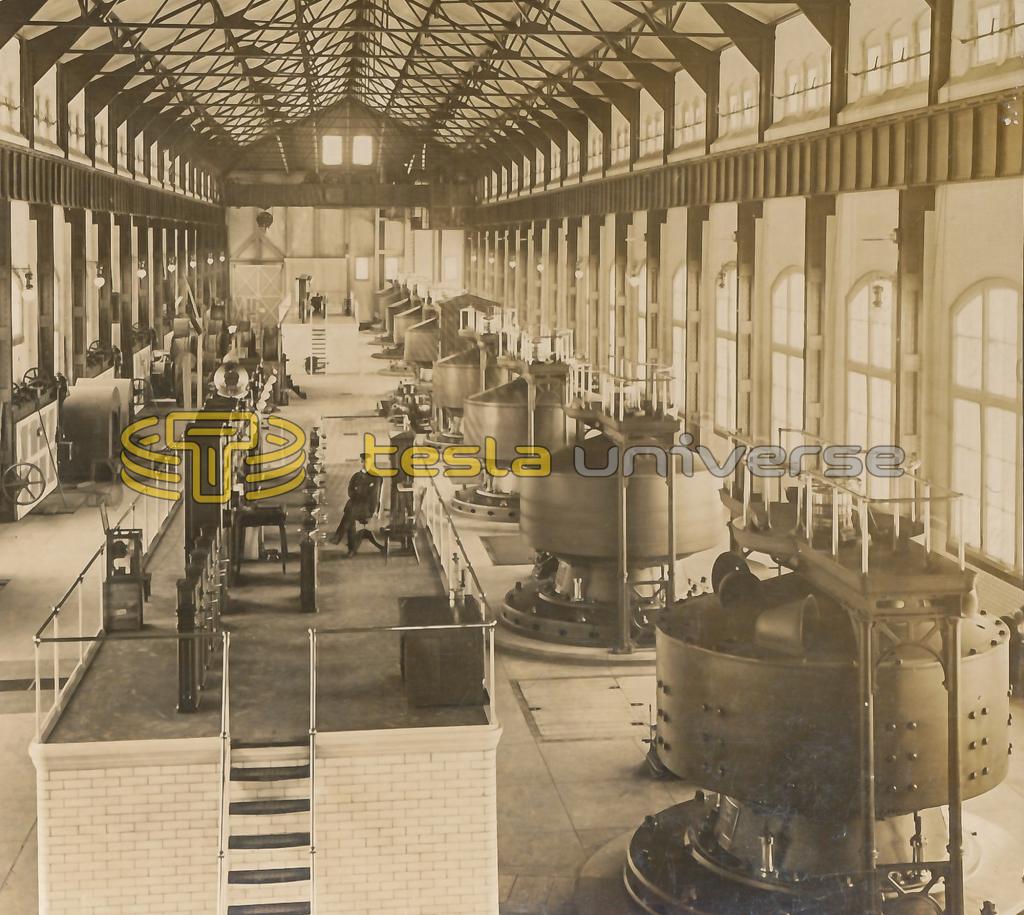
In 1895, the first two 5,000-hp Tesla-Westinghouse polyphase generators began turning at Niagara. In 1896, a 22-mile line erected by J. G. White and equipped with transformers and rotary converters by the General Electric Company, carried Niagara power to run street cars and operate lights in Buffalo.
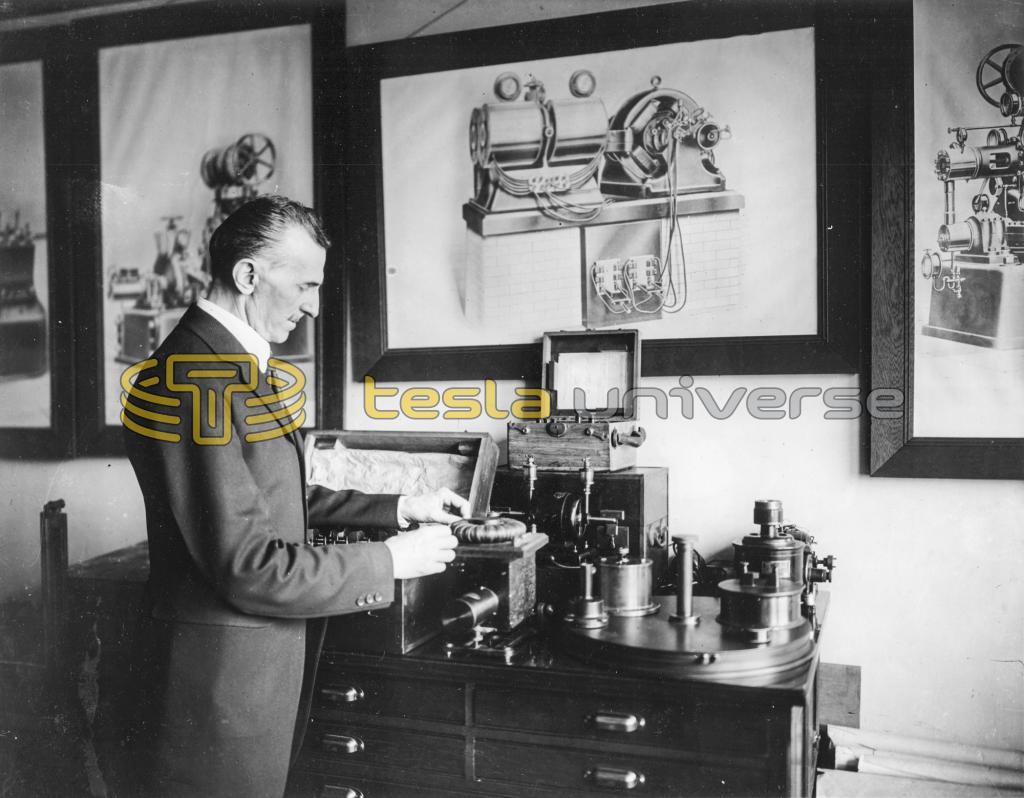
The success of Niagara was immediate and contagious. Seven more 5,000-hp generators were ordered from Westinghouse to complete Power House No. 1, and the General Electric Company (which was permitted to use the Tesla patents by a cross-licensing arrangement made with Westinghouse in 1896) was given a contract to make 11 similar generators for Power House No. 2. By the time the plant had been completed in 1903, practically all other big generating stations in the United States either had adopted the Tesla system or were about to change to it.
FIRST PLANT FOR INDUSTRIAL POWER
Before Niagara, electric plants were designed primarily for lighting; the use of electricity for motors and heating was incidental. The Niagara plant was the first big station in the world planned primarily to deliver industrial power. Besides taking the place of steam engines in factories, this new power, provided in previously unheard-of quantities, made possible the commercial electric furnace and inaugurated a giant electrochemical industry.
The first customer of Niagara power was the Pittsburgh Reduction Company, now the Aluminum Company of America. Cheap Niagara power helped turn this now indispensable metal from an expensive novelty into a commercial success. With an electric furnace operated by a steam-driven generator, Dr. E. G. Acheson had made a commercial failure of carborundum. As Niagara’s second customer, he was enabled to found a giant artificial abrasives industry. Calcium carbide for acetylene; calcium cyanamide for nitric acid, explosives, and fertilizer; artificial graphite for motor brushes, furnace electrodes, battery carbons, lubrication; ferrasilicon, ferrochromium, ferrotitanium, for machinery, dies, armor; chlorine, phosphorus, caustics, ammonia, and so on — all these were born with the aid of Niagara power or made more cheaply because of it.
POLYPHASE PATENTS PROVED INVULNERABLE
Like all successful inventions, the polyphase system and motor became involved in long and costly litigation. The biggest companies and the best brains in electrical engineering took sides in defending and fighting a series of inventions which covered all generation and use of polyphase power in the United States. To the astonishment and dismay of engineers who had regarded Tesla as an impractical genius, the polyphase patents turned out to be not only the most fundamental but also the most concrete patents in the industry. They were never broken. Originally nearly sending the Westinghouse Electric Company into bankruptcy, these patents soon became the foundation for its later greatness.
NEW FIELDS TO CONQUER
With characteristic indifference to the commercial development of his ideas, Tesla left his polyphase system for others to introduce and plunged on to new frontiers of science. Before the turn of the century, he had made substantial contributions to practically every branch of electricity.
Several years before the very first experiments of Marconi, Tesla developed high-frequency alternators and his famous “Tesla coil” for producing high voltages, a device which remains today in one form or other in every radio and television set. He then went on to invent and build rotary and series spark gaps, oil-insulated transformers and capacitors, mica capacitors impregnated with wax under a vacuum, stranded conductors of separately insulated wires (later called “Litzendraht”), arcs for producing continuous waves, choke coils, apparatus for selective tuning by means of a complex of several waves, and a “ticker” for receiving continuous waves.
Before 1897, Tesla had developed a number of wirelessly controlled mechanisms, and in that year built several boats that were started, stopped, steered, and otherwise operated by radio. He demonstrated these widely in New York in 1898, and before the Commercial Club in Chicago in 1899. This work, with what Tesla called “telautomatics,” was the beginning of the concept which has led to today’s array of wirelessly guided weapons.
WIRELESS LIGHTS AND RADIO BROADCASTING
During the early 1890’s, Tesla devised all kinds of wirelessly lit vacuum and gas-filled tubes. He increased the brilliance of some by using uranium glass or coating them with phosphors, thus creating pioneer fluorescent tubes. He bent many to suit the requirements of the room they were to light, and others to form words or names, as in modern display lighting. Tesla displayed some of his neon-type tubes in his personal exhibit at the 1893 World’s Fair.
Among other achievements, he devised a turbine with smooth parallel blades and synchronous electric clocks which he hoped some day to power as well as synchronize by radio. He also attempted to transmit power wirelessly by disturbing the electrical charge of the earth. Before Marconi had flashed his famous “S” across the Atlantic, Tesla talked of a “World Wireless” system which not only would send messages, but also would connect all the telephone exchanges and stock tickers on the globe, send facsimiles of photos, checks, and records, and inaugurate a system of world printing. At the turn of the century, he gave a detailed description of the radio broadcasting that blossomed forth several decades later.
INSPIRATION TO OTHER PIONEERS
Besides his personal accomplishments and the countless fertile ideas which he scattered for others to harvest, Tesla’s lectures and writings inspired many others into the new fields of radio and electrical engineering.
While a student at Yale, Dr. Lee De Forest began reading Tesla’s writings. He wrote in his diary: “His (Tesla’s) works are the greatest exciters to zealous work and study. . . . To read those chapters on the higher vibratory forms, the intimate connection between light energy and electricity . . . fires me with ambition to emulate. . . . It would make a genius of any man whose soul is not of clay.” In his autobiography, De Forest states further that this inspiration gave him the first clear intimation of the fascinating field of research that was later to frame his life.
Gano Dunn assisted Tesla at his historic lecture before the AIEE at Columbia University, May 20, 1891, “Experiments with Alternate Currents of Very High Frequency and Their Application to Methods of Artificial Illumination.” Attendance at this lecture included a veritable “Who’s Who” of electrical pioneers: Prof. W. A. Anthony, H. Ward Leonard, E. W. Rice, Jr., Frank J. Sprague, William Stanley, Elihu Thomson, Edward Weston, Schuyler S. Wheeler, J. G. White, E. A. Sperry, and Prof. George Forbes. This contact, wrote Dunn to Tesla 40 years later, “left an indelible impression and an inspiration which has influenced my life.”
Dr. Robert Millikan, Prof. John B. Whitehead, Major Edwin Armstrong, Dr. E. F. Northrup, Count von Arco, Andre Blondel, Jonathan Zenneck, D. McFarlan Moore, Charles F. Scott, are among others who have publicly acknowledged a similar debt.
Thomas C. Martin’s book, “Inventions, Researches and Writings of Nikola Tesla,” published in 1894, was often the main source of stimulation. Of this, Armstrong wrote at the time of Tesla’s death in 1943, “. . . one can imagine the inspirational effect of the book forty years ago on a boy about to study the electrical art. Its effects were profound and decisive.” In 1894, Moore — who later developed one of the earliest practical tube lights, the Moore Light — told T. C. Martin that this book would still be a classic a hundred years hence.
In 1931, when Tesla was turning 75, it was my privilege to collect letters of birthday greetings from pioneers in radio and electrical engineering from all over the world. Dr. B. A. Behrend and Prof. Charles F. Scott were cosponsors of this little gesture of affection and esteem, and 14 past presidents and more than 50 members of the AIEE took part.
Many of the letters gave further evidence of the role of Tesla’s brilliant pioneering efforts in inspiring the later practical developments of others. Dr. Northrup told how, as a boy in 1893, he was thrilled by a Tesla demonstration at the Franklin Institute, and how in 1916, when he was searching for a new method for melting metal electrically, he had turned back to Tesla’s ideas. Using these ideas, Northrup developed his high-frequency induction furnace.
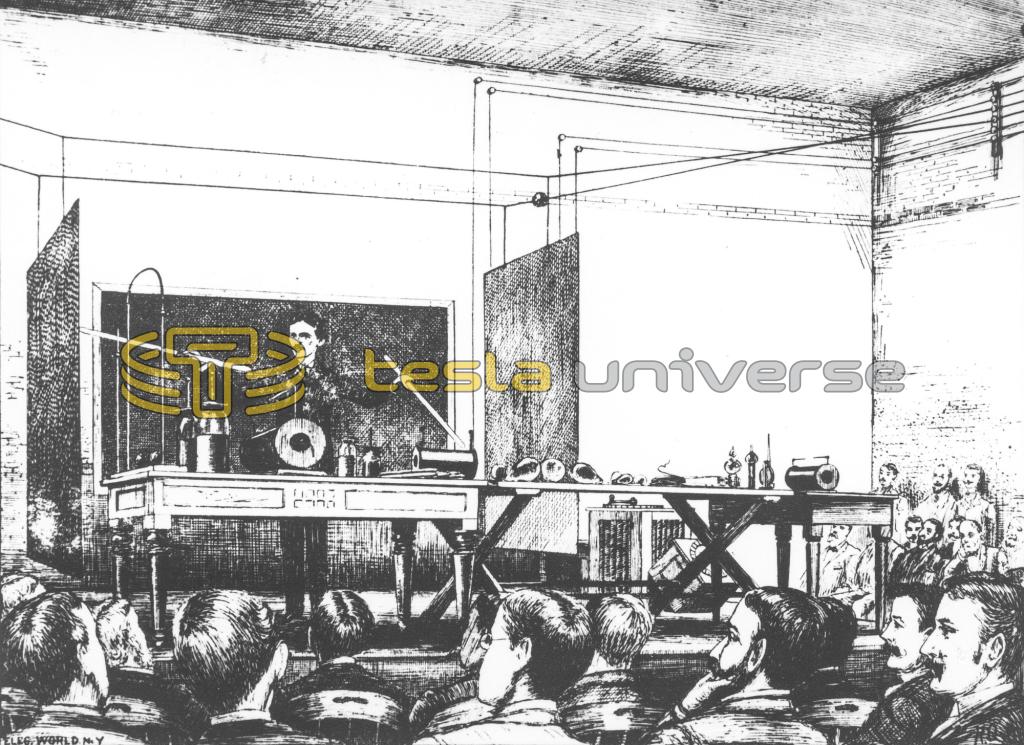
Prof. André Blondel wrote from Paris: “In 1892 I had the pleasure of assisting at the public demonstration you gave to the Société Française des Électriciens which united about you all the notables of French science and electrical engineering. . . . From this demonstration and from your remarkable publications preceding it there was born the development of high frequency currents in various fields and particularly the medical field thanks to the beautiful researches of Prof. d’Arsonval.”
John Hays Hammond, Jr., while still a student at Yale, knew Tesla and was inspired by Tesla’s wirelessly controlled boat. Later, Hammond established a research organization in which he spent more than 20 years creating and developing radio-controlled devices for ships, airplanes, and missiles — many of which are incorporated in guided missiles of today. Hammond spoke of Tesla as “the poet of science of our generation.”
SHARED FAME WITH EDISON
At the turn of the century, Tesla and Edison were, without doubt, the most famous electrical men in the world. Of the two, opinion was sharply divided as to which was the greater. In 1894, in the New York World, Arthur Brisbane wrote about Tesla’s “wonderful discoveries” under the headlines: “Our Foremost Electrician — Greater Even than Edison.” In 1895, Charles A. Dana wrote editorially in the Sun: “It is not in any degree an exaggeration to say that the men living at this time who are more important to the human race than this young gentleman can be counted on the fingers of one hand; perhaps on the thumb of one hand.”
Tesla’s personal lecture-demonstrations — which he gave before the AIEE, the Franklin Institute, the National Electric Light Association, the Royal Institution, the Institution of Electrical Engineers in London, and so on — were world renowned. After his lectures in England and France, in 1892, the Electrical World spoke of “the laurels still fresh that were accorded him by the savants abroad, the equal of which have been accorded to no one before while living.” His lecture before the National Electric Light Association in St. Louis, in 1893, had to be moved from the regular meeting place of the association to the Grand Music Hall, seating 5,000. Complimentary tickets were sold at $4 and $5 each; 4,000 programs, containing biographical sketches of Tesla, were sold on the streets.
In Europe, Tesla’s fame has never diminished. Celebrations of Tesla anniversaries have been held in England, France, Germany, Austria, and Yugoslavia. Several books about his achievements have been published in German. Yugoslavia, the land of his birth, has established a Tesla Institute for scientific research and a Tesla Museum in which is housed all his personal papers and other belongings.
After Tesla’s death, the British Institution of Electrical Engineers arranged a memorial lecture at which Dr. A. P. M. Fleming recreated some of Tesla’s classic demonstrations. At the end, Dr. W. H. Eccles, himself a noted engineering pioneer, said he “had been driven to the conclusion that Tesla was the greatest electrical inventor we have had on our role of membership; in fact we might go so far as to say that he was the greatest inventor in the realm of electrical engineering.”
Commemorations by the AIEE, the Institute of Radio Engineers, universities, the press, radio, and television are this year expressing some of the gratitude and esteem of America, the country Tesla officially adopted in 1891 and in which he lived to do all his great work.
Dr. E. F. W. Alexanderson, one of the most noted pioneers in electric power engineering still with us, wrote me a year ago: “We think of Tesla’s contribution much oftener than that of Ampere and Ohm, although their names have become part of the language . . . the induction motor and our power system are enduring monuments to Nikola Tesla.”
As this is being written, word comes that Tesla’s name has just been added to those of Ohm and Ampere. At its meeting in Munich, June 29–July 7, the International Electrotechnical Commission agreed formally to adopt the name “Tesla” for the unit of magnetic flux density in the MKS or Giorgi system.
K. M. Swezey is a science and engineering writer and was a close personal friend of Tesla for many years.
Reprinted from ELECTRICAL ENGINEERING, September, 1956
(Official organ of the American Institute of Electrical Engineers)To Mrs. Agnes Heden
— a dear friend of
a dear friend —
from
K. M. Swezey
