Nikola Tesla Articles
Discovers New Law
Nikola Tesla Finds Capacity of Electrical Conductor Not Constant.
Makes a Study of a Phenomenon Which Results in Revealing an Error in the Accepted Theories of Electrical Laws.
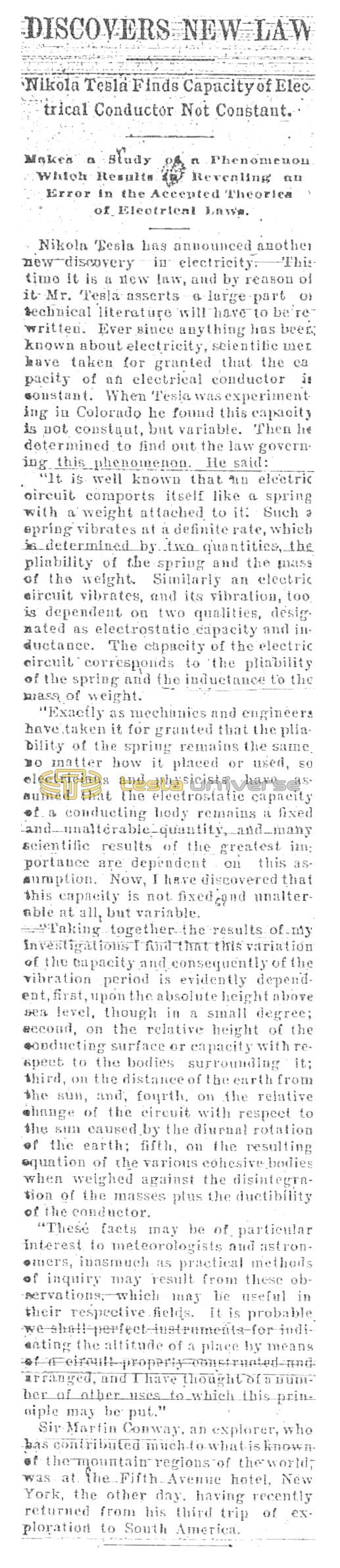
Nikola Tesla has announced another new discovery in electricity. This time it is a new law, and by reason of it Mr. Tesla asserts a large part of technical literature will have to be rewritten. Ever since anything has been known about electricity, scientific men have taken for granted that the capacity of an electrical conductor is constant. When Tesla was experimenting in Colorado he found this capacity is not constant, but variable. Then he determined to find out the law governing this phenomenon. He said:
“It is well known that an electric circuit comports itself like a spring with a weight attached to it. Such a spring vibrates at a definite rate, which is determined by two quantities, the pliability of the spring and the mass of the weight. Similarly an electric circuit vibrates, and its vibration, too, is dependent on two qualities, designated as electrostatic capacity and inductance. The capacity of the electric circuit corresponds to the pliability of the spring and the inductance to the mass of weight.
“Exactly as mechanics and engineers have taken it for granted that the pliability of the spring remains the same, no matter how it placed or used, so electricians and physicists have assumed that the electrostatic capacity of a conducting body remains a fixed and unalterable quantity, and many scientific results of the greatest importance are dependent on this assumption. Now, I have discovered that this capacity is not fixed and unalterable at all, but variable.
“Taking together the results of my investigations I find that this variation of the capacity and consequently of the vibration period is evidently dependent, first, upon the absolute height above sea level, though in a small degree; second, on the relative height of the conducting surface or capacity with respect to the bodies surrounding it; third, on the distance of the earth from the sun, and, fourth, on the relative change of the circuit with respect to the sun caused by the diurnal rotation of the earth; fifth, on the resulting equation of the various cohesive bodies when weighed against the disintegration of the masses plus the ductibility of the conductor.
“These facts may be of particular interest to meteorologists and astronomers, inasmuch as practical methods of inquiry may result from these observations, which may be useful in their respective fields. It is probable we shall perfect instruments for indicating the altitude of a place by means of a circuit properly constructed and arranged, and I have thought of a number of other uses to which this principle may be put.”
Sir Martin Conway, an explorer, who has contributed much to what is known of the mountain regions of the world, was at the Fifth Avenue hotel, New York, the other day, having recently returned from his third trip of exploration to South America.