Plans
Tesla Apparatus and Experiments Page 1
Practical Electrics - November 1st, 1921
How to Build Both Large and Small Tesla and Oudin Coils and How to Carry On Spectacular Experiments with Them
By H. Winfield Secor
Associate Member American Institute of Electrical Engineers

High frequency current demonstrations have always held the undivided interest of every audience - whether in parlor or theatre - which has seen they presented. Undoubtedly you have seen the stage performer, who played with the electrical sparks and flames, as if they were perfectly harmless and they were - thanks to the fact that the sparks produced by the Tesla or Oudin high frequency transformer oscillate or alternate many thousand times per second, usually above a frequency of 10,000 cycles per second. Dr. Nikola Tesla (whose classic work, “Experiments with Currents of High Potential and Frequency,” may be consulted at any public library, but which is out of print now) has subjected his body to several hundred thousand volts potential difference, when the current oscillated at a frequency of several hundred thousand cycles per second. Sparks a foot or more in length jumped between the metal balls of the apparatus and his hands, while evacuated glass tubes and ordinary incandescent lamps could be lighted up in the manner explained in detail below.
A Small Oudin Coil Wound on a Bottle
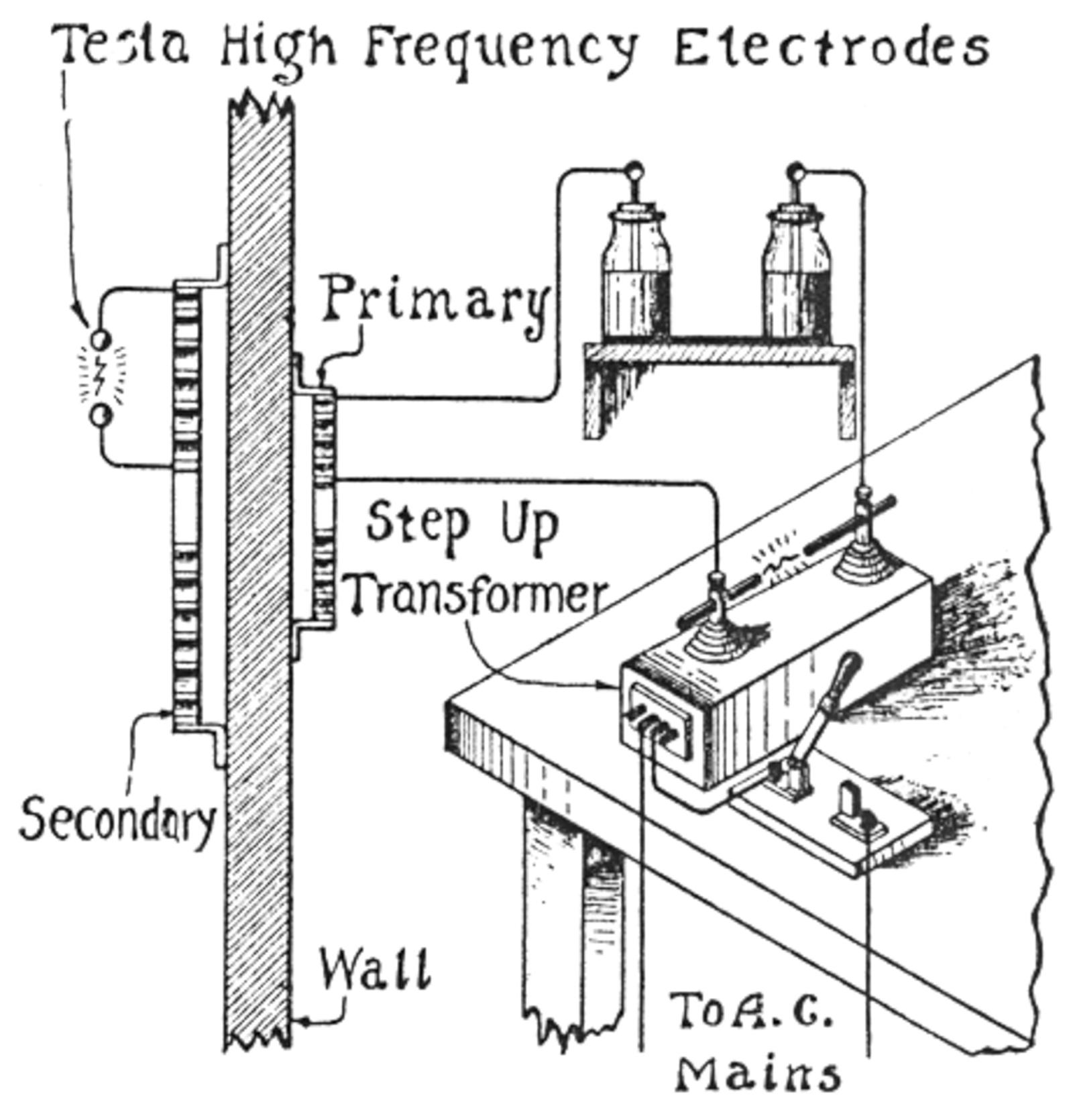
Radio and electrical experimenters who happen to have a step-up transformer rated at 1/4 to 1/2 kilowatt, and producing a secondary potential of 10,000 to 15,000 volts or more, will find this bottle Oudin coil a little wonder. This coil may also be suitably excited from a fair sized spark coil, say one giving a 6" to 8" spark. Fig. 1 shows a sectional view of the bottle Oudin, while Fig. 2 shows how it is connected to a glass plate or Leyden jar condenser, together with its spark gap and step-up transformer, or spark coil. The closed circuit, which includes the primary or heavy wire winding of the Oudin coil, the high tension condenser in series, and the spark gap in parallel, forms the
