Plans
Currents of Ultra-High Frequency and Potential
With a Description of the Usual Apparatus Involved in Their Production.
Experiments with electric currents of ultra-high frequency and potential, form probably the most interesting phase of electrical science, both for the layman and experienced electrician as well. The apparatus for producing these interesting currents is fortunately of low first cost, and thus it is well within the reach of every electrical student.
Our first photograph, Fig. 1, illustrates a large size Tesla high frequency apparatus, recently built by the E. I. Co. for theatrical purposes. Of course, most of our readers have possibly seen one or more of the so-called "Electrical Conquerors," touring the country, who style themselves variously as "Masters of the Electric Current," or "The Man Who Cheated the Electric Chair," etc., etc. Anyone can cheat the electric chair, if the Electrocution authorities would only be so kind as to charge the chair with half a million volts, at a "frequency of 500,000 cycles per second, or so." In other words, when we deal with such electrical currents as this, they may be readily taken through the body, without feeling them to any appreciable extent.

In the usually accepted meaning of the term, "high frequency," the number of cycles occurring per second is not any such low figure as found on lighting circuits, viz., 60 cycles, but in the order of 100,000 to 1,000,000 cycles per second.
When such high frequency currents as these are employed, many wonderful and unlooked for phenomena take place; among other things the currents of such a frequency can be handled with impunity, and even passed through the body, notwithstanding that the voltage may be several million, and the amperage several amperes (½ ampere through the body at 2,000 volts D. C., or low frequency, A. C. means death).
High frequency currents of this order no longer obey the rules governing the ordinary low frequency oscillating currents. For one thing, they travel only on the surface of conductors, not through them, penetrating only a few thousandths of an inch below the surface, this phenomena being known in electrical parlance as the "skin effect" which accounts for the reason that these currents do not hurt the body when handled, i. e., they possibly do not reach far enough below the skin of the body, to shock or destroy the nerves and muscles. This is the theory in general acceptance to-day.
A great part of our knowledge of these high frequency currents is due to the untiring and exhaustive researches of Nikola Tesla, a well-known Electrical Engineer and Scientist, after whom the Tesla coil, which is used to produce high frequency currents with, is named. To the student interested in this little known field of electrical science, it is recommended that he procure a copy of Mr. Tesla's book. "Experiments with Currents of High Potential and High Frequency."
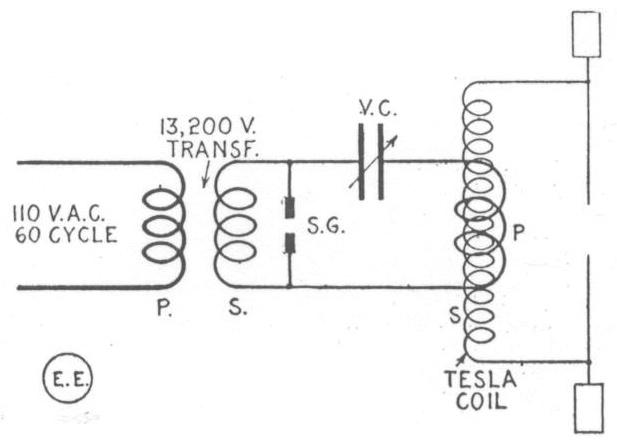
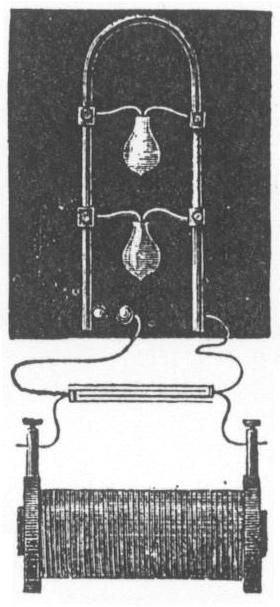
High frequency alternating currents may be produced by a special dynamo, such as Prof. Fessenden's, or by a regular high frequency disruptive discharge set, as shown at Fig. 1, employing a step-up transformer excited by another high voltage transformer or induction coil, coupled with a spark gap and condenser in the exciting circuit, after the manner depicted in Fig. 2, which is the commonest arrangement.
In the diagram shown, I is the induction coil of not less than 2 inch spark capacity. T is the air core, Tesla or high frequency transformer, serving to step-up the voltage delivered by the induction coil secondary to many times its original value. C is a condenser composed of glass plates, coated with tin foil on both sides, or regular Leyden jars. S G is the spark gap, in which the disruptive discharge of the condenser takes place. G is the discharge gap of the Tesla coil secondary winding, across which the high frequency oscillations surge.
The action of the apparatus is as follows: - The induction coil or transformer I, is excited from the battery shown at B or the regular line wires, and its secondary current at 10,000 volts pressure or more, is caused to charge the condenser C, which immediately discharges itself through the primary coil of the Tesla transformer P, and the spark gap S G; and due to the conditions imposed by such a circuit, the condenser discharge becomes not a single oscillation for each cycle of induction coil current, but many thousand, so that with certain proportions to the circuits as regards their inductance and capacity, the frequency of the current passing through the Tesla coil primary, may reach a million or more cycles per second, rendering the current harmless owing to the "skin effect" already mentioned. The currents thus produced are, of course, highly damped, i. e., the series of oscillation corresponding to each cycle of primary transformer current, dies down to zero before the next series of oscillations start.
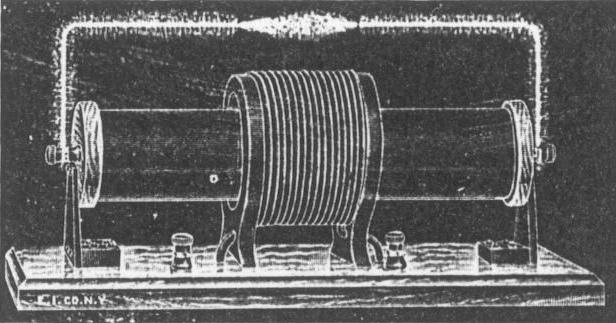
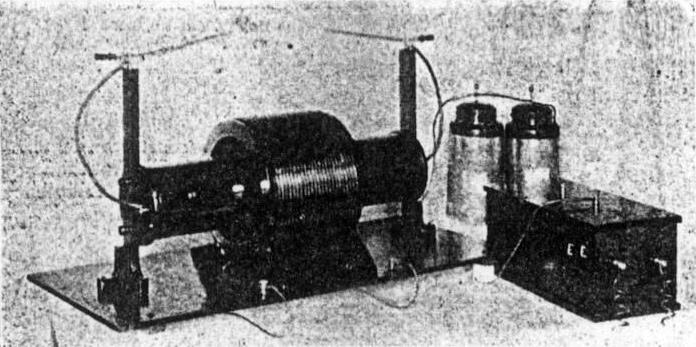
Referring again to the cut, Fig. 1, the large Tesla coil here pictured is capable of delivering 10 to 15 inch high frequency sparks at its secondary terminals, when excited by a 1/4 to 1/2 K.W: set-up transformer or a large induction coil of 8 to 12 inch spark capacity. In this particular set of apparatus, the exciting transformer is of special design, and of the open core type, so that it may be operated on 110-volt direct current circuits by means of a "Gernsback" Electrolytic Interrupter, or on 110-volt, 60 to 120-cycle, alternating current circuits directly. This is necessary for stage equipment, as the service available is sometimes Direct, and sometimes Alternating Current. This is the cheapest manner of arranging a universal Tesla Coil outfit. The better way is to employ one of the Electro 1/4 K.W. step-up wireless transformers, wound 110 volts primary, to 13,200 volts secondary, and of the closed-core type. On A. C. circuits the transformer just mentioned is simply connected as in the manner indicated at Fig. 3. In the outfit shown at Fig. 1, two 2-qt. Leyden jars are used for the oscillation condenser. In the set just being outlined and utilizing the closed-core transformer, a special adjustable $10.00 E. I. Co. No. 531A, type H. F., glass plate condenser, is preferably used. The spark gap in these particular sets is an ordinary fixed one. A rotary gap is in every way superior, however, and the "Electro" $15.00 rotary type, fitted with 110-volt universal D. C. or A. C. motor is highly recommended. With the fixed gap, the discharge often tends to arc and this destroys the proper discharging of the condensers. Lowering of the frequency is then most liable to occur, and so a rotary gap should always be used. The connections of the high frequency generating circuit, including the spark gap, condenser, and Tesla coil primary circuit, should all be made with a large low-resistance high frequency electrical conductor, such as 1/32 in. x 5/8 in. copper strip; or also stranded copper cable, about No. 4 B. & S. gauge capacity or larger, as the high frequency current only traverses the outer skin of any conductor. Hence the greater the skin surface, the better. The penetration at radio frequency is but a few hundredths of an inch.
The large Tesla coil here portrayed has an inner secondary coil, about 2 feet long and 5 1/4 inches in diameter. It is wound with comparatively fine magnet wire in a special manner, to give the highest possible dielectric strength; as this winding has generated in its potentials approximating 700,000 to 1,000,000 volts. The primary coil on this particular coil is formed of several turns of finely stranded copper cable, insulated with pure para rubber. Its turns, of course, do not have the potential stress imposed on them that the secondary coil has. The frequency and character of the Tesla secondary discharge, is made variable by charging the number of primary turns, and also the amount of condenser capacity in circuit. The mathematical expression for computing this frequency is as follows:
$$ F = \frac{5{,}033{,}000}{\sqrt{L \times C}} $$
Where F is the frequency in cycles per second, L is the inductance of the exciting circuit in Cm. and C is the capacity of the circuit in M.F.
Decreasing the number of Tesla Primary turns or the condenser capacity thus increases the frequency; which also is an inverse function of the wave length. If the wave length of the circuit is ascertained by means of a wave meter, then the corresponding frequency is found by dividing the wave velocity through ether, viz., 300,000,000 meters, by the wave length in meters, and the result is "frequency in cycles per second."
For the open core transformer shown at Fig. 1, it is necessary to also connect in the primary 110 volt A. C. or D. C. circuit and adjustable impedance coil.
For operating the second mentioned set with 13,200 volt closed-core transformer, on direct current service, a dynamotor delivering 110 volts A. C. 60 cycles, is most adaptable. This would cost $51.00 from the E. I. Co. The Tesla coil alone sells for $15.00 and is finely finished. This set is very well suited to Physician's Electrotherapeutical requirements also, as well as stage or Experimental work.
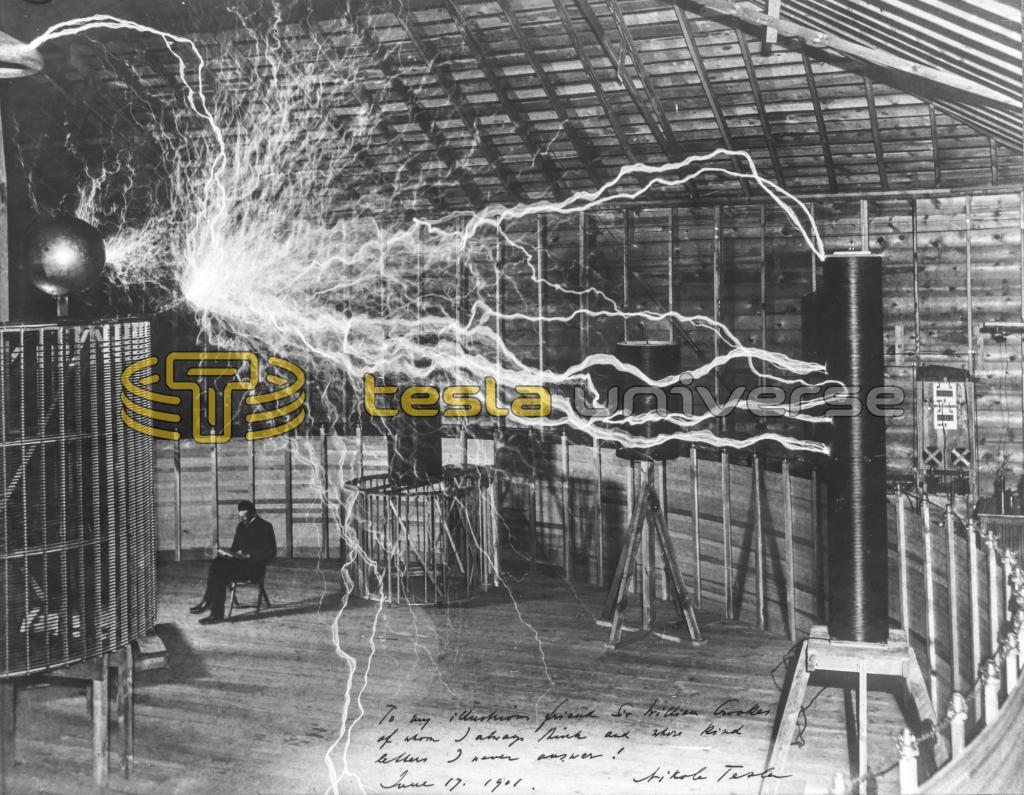
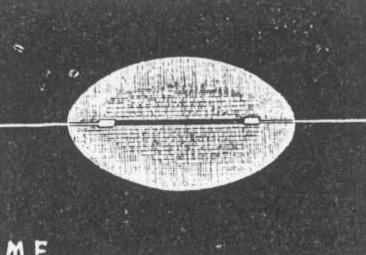
While on the subject of large Tesla disruptive discharges, it may be of interest to refer to Fig. 4, which shows some of the stupendous sparks obtained by Nikola Tesla, some years ago, in experiments carried out by him.
Tesla, in some of his researches, had these high frequency discharges developed to such a degree that, in one test he was able to make the current leap a gap, twenty-five feet long, the sparks being two to three feet in diameter, and accompanied by a roar, which could be heard ten to twelve miles away. The voltage of this discharge was up in the billions, and the amperage 800.*
The object of all these experiments by Nikola Tesla, was along his line of work regarding the wireless transmission of electrical energy, for useful purposes. It may seem like a dream to-day, but then it is only a little over fourteen years ago that man only dreamed about the wireless telegraph, and at the end of this short space of time, there are laws passed which compel its use on all ships that travel the high sea.
Tesla, in his first book, published over twenty years ago, advocated the cause of the wireless transmission of energy, for the lighting of lamps and running of motors, and at that time, in a lecture before the institute of Electrical Engineers, at London, England, he demonstrated wireless lights and a "no-wire" motor operating over short distances.
The form of the energy was to be in high frequency oscillations stepped up to many million volts, and radiated from extra high aerial wires, extending into the upper strata of rarefied air, through which the high voltage currents travel easily.
The aerial wire would of necessity be quite high, probably more than 50 miles.
A very neat and efficient Tesla transformer designed especially for experimental research, is built by the Electro Importing Company, of New York City.
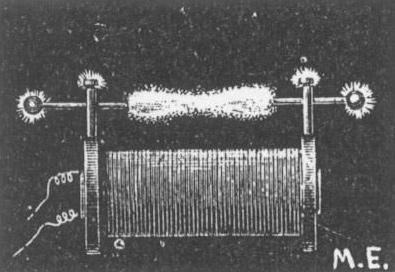
A cut showing their instrument in full activity is portrayed at fig. 5, which shows the wonderful display it gives when excited from a two inch spark coil run on batteries. A larger exciting spark coil will of course increase the activity of the Tesla coil considerably. The same company also build large size Tesla transformers, complete with condensers, rotary spark gaps, and exciting transformers, upon request, from six to thirty-six inch Tesla spark. In fig. 2, is shown the wiring connections from the Tesla transformer mentioned above. The transformer itself sells for an extremely low price and should certainly commend itself to experimenters, school laboratories, and demonstrators.
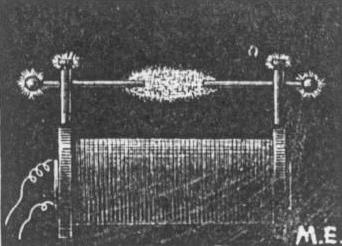
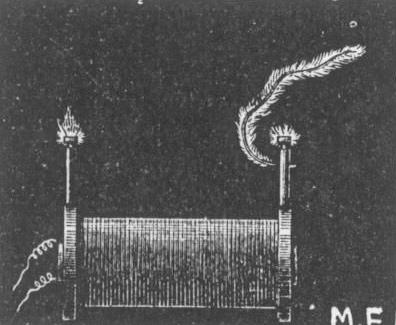
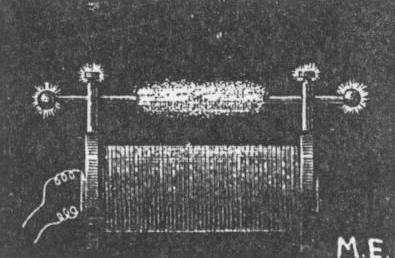
Some of the marvelous and mysterious experiments that can be performed with this Tesla coil are reproduced in the cuts figs. 6 and 7. These experiments and numerous others, together with the manner of making them are fully explained in a brochure supplied with the Tesla coil.
This size of high frequency coil, which is capable of delivering three to four inch sparks at its secondary terminals when excited by a two inch spark coil, employs a simple fixed spark gap, fitted with ball or pointed electrodes, flat faced one having not been found suitable in the small sets. This Tesla high frequency set will produce an oscillatory high potential current of several hundred thousand volts, at a periodicity of half a million cycles per second or more.
The application of high frequency currents to the body in various ways was first developed by Prof. d'Arsonval of Paris, and he made a number of different tests, to ascertain the effects of various currents applied to the body, and having different frequencies. When the current applied did not have a frequency greater than 15 cycles per second it was found that a succession of separate on "Clonic" Muscular Contractions were produced. With a frequency of 20 to 30 cycles per second a series of continuous contractions or in other words, a "Tetanus," or "Tonic Spasm," occurred. When the frequency of the oscillations or currents were increased beyond this point, the Tetanus effect was also increased. When a Periodicity of alternation approximating 3000 cycles per second, was employed, the maximum intensity in the muscular contractions took place; and a further increase of frequency caused a decrease in the strength of the contractions, until at a frequency of 10,000 cycles per second absolutely no effect was produced upon either the Motor or Sensory Nerves. Therefore an alternating or oscillating current, which alternates at 10,000 or more cycles per second, is termed a "High Frequency Current" from a therapeutical point of view, and sensibly also, from an electrical point of view.
* See Sewall's "Wireless Telegraphy," $2.25 postpaid from the E. I. Co.