
Nikola Tesla Articles
Multiphase Motors and the Transmission of Power

A question so important as the long distance transmission of power had been apparently overlooked in the preparations for the recent International Electrical Congress, as no papers on this subject appeared in the programme, and this fact excited more or less comment. When it was understood that the matter would come up for consideration in the section of Pure Practice, over which Prof. E. J. Houston presided, it was evident that the discussion would be followed with great interest, and that the attendance in Section B during that time would be very large. The idea, it is stated, originated with Dr. Louis Duncan, of Johns Hopkins University, who has always taken an active interest in this question, and is regarded as one of the leading exponents of the transmission of power by alternating currents in this country.
On Thursday forenoon the chairman of Section B accordingly called upon Dr. Duncan to open the discussion, and as many points of great value and interest were brought out it is given below in more detail than the brief synopsis which appeared in the report of the proceedings of the congress in the last issue of The Electrical World.
Dr. Duncan first explained why the discussion had arisen; it was found that there were no papers on the list of those to be read before the congress which touched upon the subject, and as a great many men, who had a large amount of practical experience, and who probably knew a great deal more about multiphase systems than any one in this country were present at the congress, it was desirable, if possible, to get hold of their knowledge and experience.
Dr. Duncan then briefly described the theory of the multiphase motor, and showed that the distribution of E. M. F. was such as to give a higher efficiency than is possible in direct current machines. Taking the case of two independent alternating currents with a difference of phase of 90 degrees, one is at zero when the other is at maximum, and if these are led around the magnets of a four-pole dynamo it is evident that a maximum E. M. F. is induced in each wire when it is placed in the best possible position in the field of natural strength. There is, then, a distribution of electrical force in the conductors about the armature, such that the highest electrical force is obtained exactly where it is desired. The distribution is such that the current is obtained exactly where we want it, and for that reason the conditions are better than in a continuous current machine. It has been found in the first place in working up the problem that the electrical efficiency of such a motor is a very simple expression, equal to the angular velocity of the armature divided by the angular velocity of the field. Such a motor would start up just like a continuous current motor, and would have an efficiency greater than a continuous current motor, provided there were no lagging of the current. The starting of the motors is the most serious question which has to be dealt with; if we have a motor where the drop of potential is 10 per cent. or something like that, and if the machine when starting has a current of many times the normal current, the whole distribution is disarranged. It is just as if a continuous current motor were started with the brushes shifted almost 90 degrees from the neutral point of the commutator: The question is, How is it possible to get rid of this trouble? The first thing to do would be to decrease the self-induction; this has been done by the Stanley company by placing short-circuited coils near the armature coils; but this is done at the expense of a good deal of space which could otherwise be filled with iron, and it is questionable whether it would not be just as well to utilize that space by putting more iron into it. Another way is to increase the armature resistance of the motor. There has been a great deal of trouble with multiphase motors, and one of the reasons for it is this: Suppose that a wave is applied that is not a sine curve, but is a positive and fundamental wave, a number of upper harmonics; suppose we have the E. M. F. together with the same harmonics, then the efficiency of the motor would be greatly reduced. If the motor were revolving at 900 revolutions and the field at 1,000 the electrical efficiency would be 90 per cent., but if more waves are there, say, the third or fifth harmonics, then the efficiency is greatly decreased. It is a very difficult thing to experiment on these armature currents because any ordinary means for obtaining the curve will not work. Another piece of machinery which Dr. Duncan considered of great importance, and which he hoped would be discussed, was the rotary transformer. He illustrated by diagrams upon the board the theory of operation of such a machine, and pointed out some of the inherent difficulties. He called attention to the fact that all the current does not pass through the armature, and that this is a very important point, because the question comes up as to how much energy can be transformed with one of these machines. Another question which he hoped would be discussed was that, with a given machine, say, of 100 h. p., can more energy be transformed with a three-phase than with a two-phase machine; and, if so, in what proportion. He closed his discussion by remarking that he hoped that those present who had practical experience in this line would not hesitate to speak, and that the discussion, would be simple and straightforward.
Mr. C. F. Scott called attention to the Tesla polyphase system which constitutes a part of the exhibit of the Westinghouse Electric and Manufacturing Company in Electricity Building. The purpose of the exhibit is to show a complete working system for generating, transmitting and distributing power on a large commercial scale. The system includes:
I. A prime mover. II. A generating dynamo. III. Raising converters and transmission line and reducing converters. IV. Motors and rotary transformers for general power and electrical service.
The prime mover in general practice is water power, but in the present plant a 500-h. p. two-phase Tesla motor of the rotary field type serves as prime mover. The current for this motor is received from one of the 750-kw. two-phase Westinghouse generators of the lighting plant in Machinery Hall. The number of alternations is 7,200, and the pressure is reduced from 2,000 volts to 200 volts before being delivered to the motor. The current is delivered to the rotating element of the motor through brushes resting on four collecting rings. The winding is a drum winding laid in small slots in the surface. The stationary element of the motor is of laminated iron set in an outside casting. Large copper rods are run through holes in the iron plates near the inner surface, and are suitably connected at the ends. Resistances are put in circuit with this winding for starting the motor, and when speed is attained these resistances are short-circuited, leaving this winding completely closed on itself.
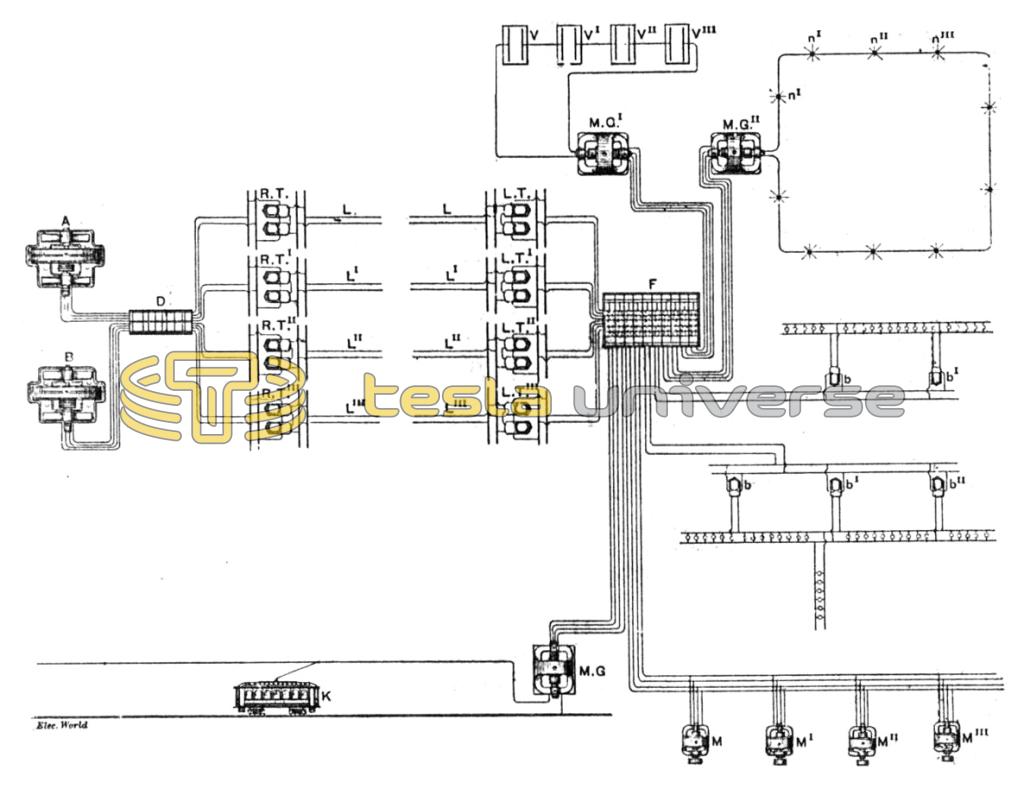
This motor drives a 500-h. p. two-phase alternating current generator. This machine is of the ordinary type of railway generator. There is a field of six poles which is excited by a small direct current machine driven by a 5-h. p. two-phase Tesla motor of the rotary field type. The exciter in general practice would be driven by a water-wheel. The large generator delivers from four collecting rings two currents differing in phase 90 degrees. The number of alternations is about 4,000 per minute, or 33⅓ periods per second at a potential of 860 volts on each circuit. The machine is also provided with a direct current commutator connected with the same winding, delivering current at 500 volts. This commutator would not be used when the machine is intended as an alternating current generator only. The current from this machine is delivered to a marble switchboard, where it is regulated and connected with the various transmission circuits, as desired. This board will afford facilities for connecting various circuits with any one of the several generators which may be placed in a large generating station. The current from the switchboard is received by alternating current converters or transformers by which the potential is raised in the present plant to 1,200 volts. In practice, the transformation would be to a much higher voltage, depending upon the distance of transmission. The transmission circuit conveys the current to the receiving station, where it is reduced by transformers to electromotive forces appropriate to the machines to be supplied. The current passes through a marble switchboard in which there are suitable provisions for operating the various machines in the receiving station.
The largest machine in this station is a 500-h. p. two-phase Tesla motor and rotary transformer. This machine is similar in general construction to the generator above described. The alternating current at 360 volts is passed into four collecting rings on the armature. Special connections of the field circuit are made for starting the machine, and when the motor has attained full speed a switch is turned giving the final connections and running the machine as a self-exciting synchronous motor, which maintains the exact speed of the generator by which it is driven except in cases of extreme overload. The armature of this machine is provided with a double pulley with belts driving a Worthington pump and a 40-light Westinghouse alternating current arc-light dynamo. The armature is supplied with a direct current commutator connected with the same winding which receives the alternating current, and delivers direct current at a potential of 500 volts. This current is utilized for operating two 30-h. p. street railway motors mounted upon a standard Dorner & Dutton truck, and also a 60-h. p. direct current motor mounted upon an Ingersoll-Sergeant air compressor. The direct current also supplies a series of direct current constant potential arc lamps. The current from the switchboard is also carried directly to a 60-h. p. two-phase motor and rotary transformer, which receives the current at 36 volts and delivers direct current at 50 volts adapted to electrolytic work, charging of storage batteries, and is at present used for operating the large Schuckert search light in an adjoining space. The current from the switchboard also operates a 60-h. p. two-phase Tesla motor of the synchronous type, which is adapted for any kind of constant speed work. In the present exhibit it is direct coupled to a 45-kw. slow-speed alternator of the constant potential type used for incandescent lighting. Current from the switchboard is also directly utilized for supplying incandescent lamps. Mr. Scott then called attention to the excellent mechanical design of the machines and the necessity of such work to insure success and economy in the practical operation of a plant. He described briefly the construction of the machines, and showed their fitness for the work for which they were designed. Attention was also called to the simplicity and solidity of the whole system and to its great flexibility. Mention was made of the successful installation and operation of a lighting plant for over 100 h. p. using 10,000 volts over a 28-mile circuit in southern California is an initial step which covers a distance greater than is required in a majority of the cases in which power transmission is proposed.
Mr. W. F. C. Hasson, of San Francisco, was then called upon to continue the discussion. He stated that, as consulting engineer, he represented a variety of companies in California who desired to transmit power electrically to the aggregate amount of some 40,000 h. p. over distances ranging from 10 to 44 miles. Notwithstanding the fact that Mr. Scott had referred to the successful transmission of power for lighting purposes at San Antonio over 28 miles, the transmission of power electrically over long distances in California was a failure. Over a year ago the first contract for a definite transmission of power was closed, and to-day the superintendent of the mine in which the installation was made in eastern California is looking at his burned-out field coils after the generator has been in operation for less than thirteen days. The whole system just described is logical, and very beautiful on paper, but it does not establish the commercial success of long distance transmission of power. The machinery must be so built that it will not run for hours or days, but for weeks and months. Installations of this kind are almost invariably in places which are distant from railways, and where repairs are impossible, and the machinery must be of such a kind that it will be practically impossible for accidents to happen. Mr. Hasson stated that he believed in the transmission of power, and had been an apostle of it for some time in California, but that he was obliged to definitely state that as far as California was concerned the results had been failures, at least from the standpoint of the investor. Some months ago he was called upon to decide upon certain plans for the transmission of 3,000 h. p. for 20 miles; mese elaborate and beautiful descriptions of methods arriving at the results were placed before him, but not a single working drawing of any kind.
Dr. Louis Bell then took up the subject and first expressed satisfaction that a previous speaker had referred to the two-phase system as a polyphase system, because he thought that all which applies to the two-phase system applies in varying degrees to all other numbers of phases. He stated that there are in general three methods which are usually proposed for power transmission - that of the direct current, which Prof. Crocker had been championing in his paper before the Congress; that of single-phase currents and that of polyphase currents. In regard to the first, it could only be said that in this country, at least, it had not been altogether a success; the great difficulty seems to be that when the current increases to any considerable extent difficulties are at once to be met with. As for alternating currents, the reason why they are preferable is that they can be utilized in so many different ways. So long as the direct current had a monopoly of all motor service there was no choice, but at the present day that is changed; the single-phase system is now applicable to motor service, though not as well as the polyphase system, nor is it as well adapted to the operation of the rotary transformer, which is destined to play an important part in the future transmission by polyphase currents. The single-phase motor in its present state of development can be considered as nothing else than a rather poor polyphase motor; it starts on the polyphase principle, but with the objection that the rotary field established is not a circular rotary field but an elliptical one, and, consequently, gives less efficiency in the motor. Coming finally to the polyphase systems, they may be divided into two classes, those having two wires per phase or independent circuits, and those having non-independent circuits. A two-phase system with three wires is somewhat simpler than the two-phase independent circuit system; the three-phase system, operated on separate circuits, requires six wires, but with combined circuits requires only three wires - as few as are required by any polyphase system. Furthermore, in all the polyphase non-independent circuits polyphase systems save copper, as over the direct current, the simple alternating and the polyphase system with separate circuits, and this saving varies in degree from 12 or 13 per cent. in the two-phase to 25 per cent. in the three-phase. Another important feature of the three-phase dependent circuit system is that there is less self-induction and capacity on the line than in single or two-phase systems. For the installation of lights the difference between a dependent circuit system with three wires and an independent circuit system with at least four wires is very little because it is necessary to split the circuits in any case, but in most cases three wires are more convenient than four. The great objection which has been raised against the polyphase system with dependent circuits is that it does not regulate well, but this criticism is ill founded, as we know from experiments. In the first place it is quite possible to arrange such a system so that the difference between the different branches of the circuit will be almost unnoticeable. The means of doing this are simple, and therefore it is well to state as the result of positive experiments that without any complicated means of compensation whatever it is possible to obtain closely concordant voltages in all branches of polyphase system.
In regard to polyphase motors, there is no very wide difference in principle or in operation between two, three, four, or m phase motors or in their action on dependent or independent circuits. When such motors are properly designed there is no doubt that they are decidedly superior to any direct current machine, and that is one of the strong reasons for using the polyphase systems.
Dr. Bell stated that he had been experimenting with motors of this type for a long time, and that he had never yet succeeded, even under the most adverse conditions, in burning out a single machine in any way whatever, a record which could hardly have been made with any kind of a direct current motor. If overloaded they will stop, and not burn out for a pretty long period; they start quite well, as well as any ordinary direct current motor; and in regard to the current required, they start just about as a shunt motor does. It is possible to run a polyphase motor at a widely varying range of speed (say, from 1-10th speed up to full speed), keeping a practically constant torque. Dr. Bell, in closing, defended the polyphase machine against the accusation of a large lagging current.
Prof. S. P. Thompson, first speaking for M. Thury, briefly described the transmission plant at Genoa, where a direct current of 1,200 volts was employed and no difficulties were experienced. Another interesting continuous current plant is that operating between Biberist and Rondchatel, a distance of about 20 miles. Forty amperes of current at 3,500 volts are there transmitted. At Genoa eight dynamos, all joined in series, each running at nominally about 1,000 volts, supply generators. These are all samples of practical installations for which M. Thury makes himself responsible.
In speaking for himself, Prof. Thompson first touched upon the continuous current problem, stating that many continuous current machines of high voltage had been successfully operated, and citing cases as illustrations. Coming to the question of alternating current work, he called particular attention to the installation at Rome, where the source of power was a waterfall some fourteen miles distant. He had studied the polyphase transmission at Frankfort, where there were eight or ten different systems on exhibition, from all the great firms in the world; he did not believe that there was any best system, but that each one was best for its own purposes. He did not care to prophesy, but would give his personal opinion as to what would be the general system in use ten years from date. He did not like the complication of three-phase transformers, and three-phase switchboards and other apparatus, although he did like three-phase and two-phase alternating current dynamos and motors. The system recently described by a previous speaker was very beautiful, but he did not like its complications. In the future he thought that all the applications of polyphase work would be abandoned, and that engineers would return to simple alternating current motors; in other words, that the simple alternating current will be the one thing which ten years hence will be found to be effective for all long distance transmission.
Mr. C. P. Steinmetz remarked that out of justice he would be obliged to take the part of the continuous current; the largest amount of power distributed in the United States to-day is distributed by continuous currents; this shows that the continuous current is not dead yet, and the many references to rotary transformers showed that even the advocates of the polyphase systems still consider that they cannot get along without the old continuous current. With regard to the polyphase and single-phase systems, it makes little difference how many phases there are, because any system of polyphase currents can be transformed into any other system of polyphase currents by using two transformers only; furthermore the motors of the different polyphase systems are essentially the same. Mr. Steinmetz thought that the system of the future would be the single-phase system. There would be no longer any trouble with self-induction or capacity, for proper appliances would eliminate their effects entirely.
Prof. George Forbes stated that he was informed that there had been an organized conspiracy among the American engineers, led by no less a man than Dr. Louis Duncan, to draw out the foreign engineers on the subject of transmission of power and multiphase motors; he did not think that this referred to him, as he has ceased to look upon himself as a foreign engineer. Prof. Forbes then proceeded to outline the methods which had been adopted for the great transmission plant at Niagara Falls. The subject had been investigated most thoroughly by himself and others connected with the enterprise, in order that the best system might be selected. The first step taken was the decision that there should be central stations established at Niagara Falls to transmit power to places at greater or less distances away, as opposed to the proposition of locating all the mills directly at the Falls. It was decided that the whole of the transmission should be done by means of electricity. In 1890 a number of plans were invited from different engineers and engineering firms as to the best means of utilizing the large power of the Falls, and these plans were submitted to an engineering congress, which met in London at the beginning of 1891. Prof. Forbes in his report at that time, stated that he regarded the best means to be that of transmission by means of alternating currents of electricity; that the two-phase system should be employed with two separate circuits of high voltage; that transformers should be used for reducing the pressure down to a safe limit; that in the mills and works synchronizing alternating current motors should be used in some cases, and in others two-phase motors should be employed, and that in cases where direct current was necessary alternating motors should be used to drive continuous current machines. During the three years since that time hardly a change has been made in the system proposed.
After the congress referred to had closed, bids were asked from all the greatest firms in the world. The greatest difficulty was experienced in nearly every case by those who proposed to use continuous currents, and in every case the cost was largely in excess of that of the alternating system. Another thing which had been decided upon was to use the same system for both short and long transmission. The advantages, however, in the use of high potentials for short distances are the same as for long, and it was found that the amount of copper which would be necessary to transmit 50,000 h. p. at a potential of 1,000 volts over even a short distance would almost completely fill a subway large enough for a man to walk through, and the cost would, of course, be prohibitive.
Prof. Forbes hardly agreed with Prof. Thompson that the multiphase motors would disappear from general use, and that single-phase motors with a multiphase means of starting would be more universally adopted; this he regarded as only one of the possibilities of the applicable to almost every class of work.
For continuous work, such as will be found in mills, the synchronous motor would be employed in the Niagara plant, but in all ordinary workshop practice where it is necessary to stop, start and reverse continually, the multiphase motor would be employed. One reason why the two-phase independent circuit transmission was chosen for the Niagara plant was that it was likely to take care of all developments which would be made for the next few years in alternating current apparatus; even if single-phase machines alone should be used the single-phase currents can be developed more cheaply by a two-phase machine than by the ordinary single-phase generator. This was appreciated as early as 1879, when Mr. Gramme built his first alternating current dynamo with two phases, having eight poles, a revolving field and a fixed armature. The water of the Niagara River, as is well known, is taken off one mile above the Falls by a large canal, which has been built; it is then taken by tunnels into the wheel pits and sent down on penstocks to the depth of 140 feet to the turbines below. These turbines have been designed by a firm of Geneva, of world-wide reputation, and have been constructed by the I. P. Morris, of Philadelphia, and will be delivered shortly. The water, after passing through the turbines, is carried down through the tunnels, which have been built to the river below the falls. On the top of the turbines is a vertical shaft coming to the surface of the ground, and rotating at 250 revolutions per minute, which enables the large dynamos to be directly connected to the shaft without gearing. Prof. Forbes then took up the question of whether step-up transformers should be used or dynamos generating a current of very high potential. He estimated that, with a loss of 3 per cent. in the transformers in the 5,000-h. p. units, $3,000 per year would be saved per unit. With stationary armatures it was as easy to build a dynamo for very high potentials, as it was a transformer itself. Overhead lines, subways or conduits were the three means by which the current could be transmitted, and it was a very serious question as to which should be used. The subway was obviously the most satisfactory, but the pole line was the cheapest. It had been decided that the work would be done either by bare overhead conductors or by bare wires carried in a subway. The transmission of power to considerable distances from Niagara Falls would confront the company in the immediate future, and it was possible that electricity would be used to propel the canal boats on the Erie Canal, in which case a line of several hundred miles in length would be required; at any rate the transmission of power to Buffalo was a possibility of the near future; the expense of a subway over such distances would be of course, very large. Experiments would be carried out with the pole system to determine its real merits. In the meantime a subway had been started which would carry conductors from the power station at least as far as the Pittsburgh Reduction Works, about half a mile distant.
Prof. H. A. Rowland did not agree with Prof. Forbes that dynamos of very high potential could be constructed without much difficulty. He was inclined to favor the use of step-up transformers. The small loss would not be of much consequence where the source of energy was a water power of such capacity. The difficulties that would be encountered in the construction of a dynamo of 10,000 to 20,000 volts would be very great. He did not know of any such in the world, and did not believe that it was practicable to build one. In the case of the transformer it was built in sections, so that there might not be more than 1,000 volts difference of potential between any adjacent wires. Then again, as the potential increases, the amount of copper which can be got into the groove in the armature becomes less and less. The matter of frequency was also an important point, and the lower limit has never been thoroughly investigated. The first effect of reducing the frequency is to diminish the poles in the dynamo, and if we go down far enough it is necessary to slow up the machine until we have a dynamo running at a small speed, and its output is not what is desired. Again, if in a multiphase system the two sides are not perfectly balanced with a very low frequency, a tremor occurs which may produce a very great vibration of the machine, and this applies to both dynamos and motors. Further, the decrease of frequency necessitates increasing the size of the transformers in a ratio something like five to one. If it is desired to have motors running at 1,000 revolutions per minute the limit of the number of periods is somewhere about 20.
Dr. Louis Bell then considered some further points in addition to the remarks he had already made. He assured Dr. Duncan that the effects of the wave shape on the operation of single or polyphase motors was an experimental fact, but that in practice the effect on the efficiency was not likely to be great with well designed machines. In regard to the regulation of interconnected circuit polyphase systems, he had found it quite easy to satisfactorily regulate the triphase inter-dependent circuit system. It was much the same question that had arisen when the three-wire direct current system had been introduced, and the same objections were made against it. As to rotary transformers, he was not as hopeful as Prof. Forbes that any more simple form of commutator would come into general use in the near future. The rotary transformer has an efficiency from 90 to 95 or 96 per cent., and is a thoroughly reliable and comparatively simple piece of apparatus. He favored the use of step-up transformers rather than dynamos of very high potential on the ground that there was no experimental knowledge in the latter case; for extremely large machines he thought, however, that they might be built for very high voltages. In considering the line two important factors were the inductance and the frequency. As regards the inductance, the triphase or polyphase interconnected systems, for the same energy transmitted at the same voltages, give a lower induction on the line. With the triphase interconnected system the inductance is a little less than .6 of what it is on the single-phase or independent circuit multiphase system. As to frequency, the upper practical limit would probably be somewhat less than the frequency now ordinarily used, that is, 125 to 130 cycles. The lower limit would be determined in the ordinary distribution plant by the necessities of incandescent lighting; below 30 periods, or, in fact, below 33 periods, incandescent lamps do not work well. Arc lamps with the best soft cored carbons work fairly well at 45 to 50 cycles. The practical limit, then, is probably from 30 to 35 cycles. The keeping up of an overhead line is a most serious problem. The subway is, on the other hand, in most cases absolutely prohibitive from a commercial point of view. He thought that in most of the overhead work bare overhead wires must be employed, and, if they were dangerous, that people must learn to keep away from them. The limit of distance to which power could be transmitted practically depends almost entirely upon the conditions. Given the price of coal high enough power can be transmitted to almost any distance. It is absolutely necessary, however, not to economize in the matter of insulation.
Dr. Louis Duncan, in closing the discussion, stated that the tendency of most of the foreign engineers and those of the American speakers who had had no practical experience was in the direction of the single-phase system; but that those among the Americans who had had considerable experience, and had seen the advantages of the multiphase system, were in favor of it; certainly the multiphase system at present was the only practical system for general distribution. The question of frequency was one of vast importance. If it is intended to do arc or incandescent lighting, then 50 periods per second must be used; if lower periods are used, the lag of the current is greatly increased.
