Nikola Tesla Articles
Tesla's Experiments - Editorial on Lecture
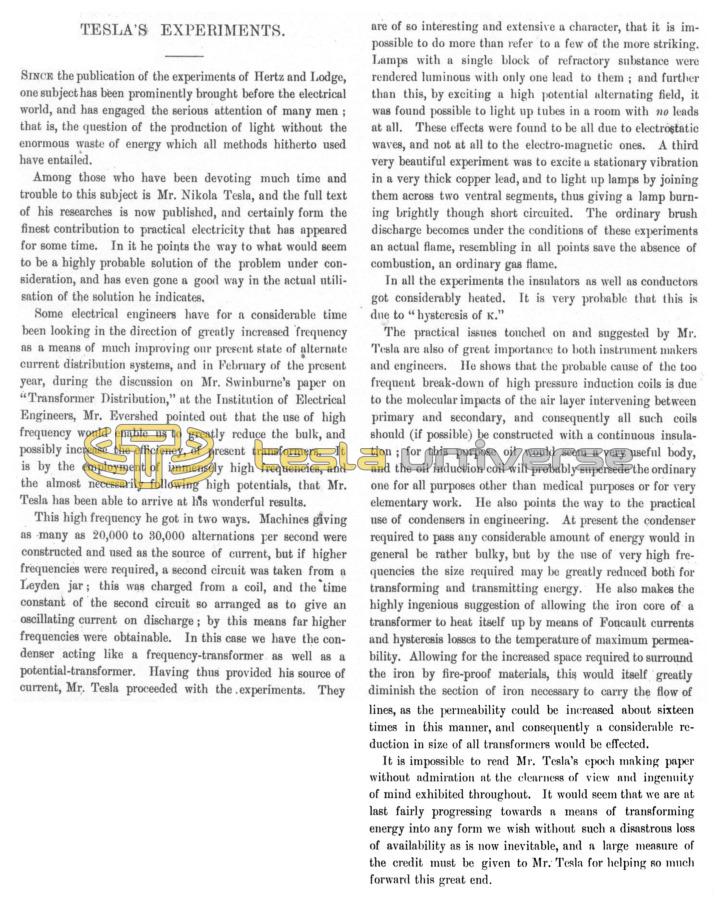
Since the publication of the experiments of Hertz and Lodge, one subject has been prominently brought before the electrical world, and has engaged the serious attention of many men; that is, the question of the production of light without the enormous waste of energy which all methods hitherto used have entailed.
Among those who have been devoting much time and trouble to this subject is Mr. Nikola Tesla, and the full text of his researches is now published, and certainly form the finest contribution to practical electricity that has appeared for some time. In it he points the way to what would seem to be a highly probable solution of the problem under consideration, and has even gone a good way in the actual utilisation of the solution he indicates.
Some electrical engineers have for a considerable time been looking in the direction of greatly increased frequency as a means of much improving our present state of alternate current distribution systems, and in February of the present year, during the discussion on Mr. Swinburne's paper on "Transformer Distribution," at the Institution of Electrical Engineers, Mr. Evershed pointed out that the use of high frequency would enable us to greatly reduce the bulk, and possibly increase the efficiency, of present transformers. It is by the employment of immensely high frequencies, and the almost necessarily following high potentials, that Mr. Tesla has been able to arrive at his wonderful results.
This high frequency he got in two ways. Machines giving as many as 20,000 to 30,000 alternations per second were constructed and used as the source of current, but if higher frequencies were required, a second circuit was taken from a Leyden jar; this was charged from a coil, and the time constant of the second circuit so arranged as to give an oscillating current on discharge; by this means far higher frequencies were obtainable. In this case we have the condenser acting like a frequency-transformer as well as a potential-transformer. Having thus provided his source of current, Mr. Tesla proceeded with the experiments. They are of so interesting and extensive a character, that it is impossible to do more than refer to a few of the more striking. Lamps with a single block of refractory substance were rendered luminous with only one lead to them; and further than this, by exciting a high potential alternating field, it was found possible to light up tubes in a room with no leads at all. These effects were found to be all due to electrostatic waves, and not at all to the electro-magnetic ones. A third very beautiful experiment was to excite a stationary vibration in a very thick copper lead, and to light up lamps by joining them across two ventral segments, thus giving a lamp burning brightly though short circuited. The ordinary brush discharge becomes under the conditions of these experiments an actual flame, resembling in all points save the absence of combustion, an ordinary gas flame.
In all the experiments the insulators as well as conductors got considerably heated. It is very probable that this is due to "hysteresis of K."
The practical issues touched on and suggested by Mr. Tesla are also of great importance to both instrument makers and engineers. He shows that the probable cause of the too frequent break-down of high pressure induction coils is due to the molecular impacts of the air layer intervening between primary and secondary, and consequently all such coils should (if possible) be constructed with a continuous insulation; for this purpose oil would seem a very useful body, and the oil induction coil will probably supersede the ordinary one for all purposes other than medical purposes or for very elementary work. He also points the way to the practical use of condensers in engineering. At present the condenser required to pass any considerable amount of energy would in general be rather bulky, but by the use of very high frequencies the size required may be greatly reduced both for transforming and transmitting energy. He also makes the highly ingenious suggestion of allowing the iron core of a transformer to heat itself up by means of Foucault currents and hysteresis losses to the temperature of maximum permeability. Allowing for the increased space required to surround the iron by fire-proof materials, this would itself greatly diminish the section of iron necessary to carry the flow of lines, as the permeability could be increased about sixteen times in this manner, and consequently a considerable reduction in size of all transformers would be effected.
It is impossible to read Mr. Tesla's epoch making paper without admiration at the clearness of view and ingenuity of mind exhibited throughout. It would seem that we are at last fairly progressing towards a means of transforming energy into any form we wish without such a disastrous loss of availability as is now inevitable, and a large measure of the credit must be given to Mr. Tesla for helping so much forward this great end.