Nikola Tesla Articles
Historic Long Island
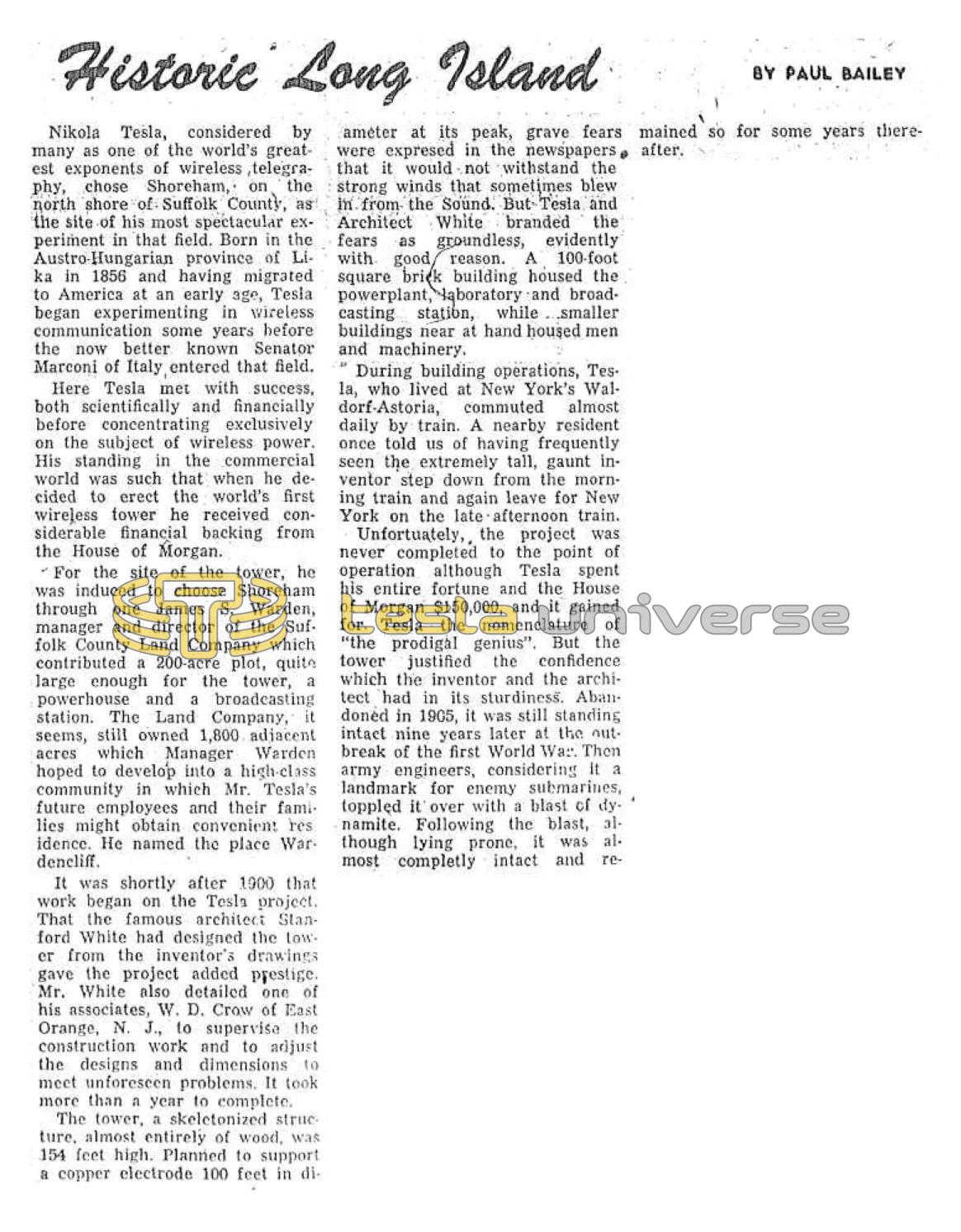
Nikola Tesla, considered by many as one of the world’s greatest exponents of wireless telegraphy, chose Shoreham, on the north shore of Suffolk County, as the site of his most spectacular experiment in that field. Born in the Austro-Hungarian province of Lika in 1856 and having migrated to America at an early age, Tesla began experimenting in wireless communication some years before the now better known Senator Marconi of Italy entered that field.
Here Tesla met with success, both scientifically and financially before concentrating exclusively on the subject of wireless power. His standing in the commercial world was such that when he decided to erect the world’s first wireless tower he received considerable financial backing from the House of Morgan.
For the site of the tower, he was induced to choose Shoreham through one James S. Warden, manager and director of the Suffolk County Land Company which contributed a 200-acre plot, quite large enough for the tower, a powerhouse and a broadcasting station. The Land Company, it seems, still owned 1,800 adjacent acres which Manager Warden hoped to develop into a high-class community in which Mr. Tesla’s future employees and their families might obtain convenient residence. He named the place Wardencliff.
It was shortly after 1900 that work began on the Tesla project. That the famous architect Stanford White had designed the tower from the inventor’s drawings gave the project added prestige. Mr. White also detailed one of his associates, W. D. Crow of East Orange, N. J., to supervise the construction work and to adjust the designs and dimensions to meet unforeseen problems. It took more than a year to complete.
The tower, a skeletonized structure, almost entirely of wood, was 154 feet high. Planned to support a copper electrode 100 feet in diameter at its peak, grave fears were expressed in the newspapers that it would not withstand the strong winds that sometimes blew in from the Sound. But Tesla and Architect White branded the fears as groundless, evidently with good reason. A 100-foot square brick building housed the powerplant, laboratory and broadcasting station, while smaller buildings near at hand housed men and machinery.
During building operations, Tesla, who lived at New York’s Waldorf-Astoria, commuted almost daily by train. A nearby resident once told us of having frequently seen the extremely tall, gaunt inventor step down from the morning train and again leave for New York on the late afternoon train.
Unfortunately, the project was never completed to the point of operation although Tesla spent his entire fortune and the House of Morgan $150,000, and it gained for. Tesla the nomenclature of “the prodigal genius.” But the tower justified the confidence which the inventor and the architect had in its sturdiness. Abandoned in 1905, it was still standing intact nine years later at the outbreak of the first World War. Then army engineers, considering it a landmark for enemy submarines, toppled it over with a blast of dynamite. Following the blast, although lying prone, it was almost completely intact and remained so for some years thereafter.