
Nikola Tesla Articles
Nikola Tesla - Editorial and Condensed Reprint of "Our Foremost Electrician" Article
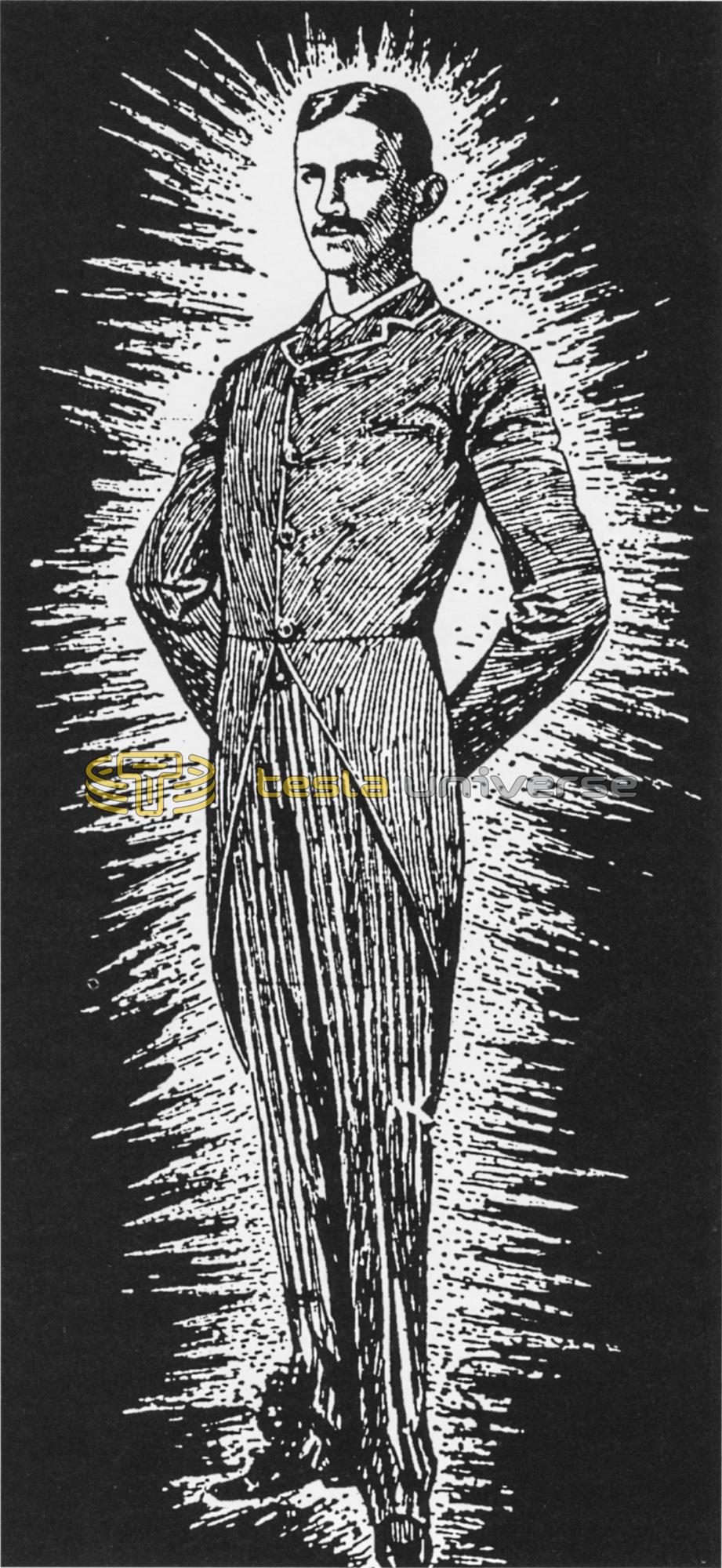
The Sunday World of July 22 prints an interesting half-page article on Nikola Tesla, written by Mr. Arthur Brisbane, and accompanied by a portrait which we reproduce, without, however, the full caption which was as follows: "Nikola Tesla. Showing the Inventor in the Effulgent Glory of Myriad Tongues of Electric Flame After He Has Saturated Himself with Electricity." In deference to the well-known modesty of Mr. Tesla, we will not reproduce the newspaper writer's highly complimentary description of his personality and achievements, but confine ourselves to the following extracts, containing his remarks on the future of electricity and on the effects on the human body of high voltages coupled with high frequencies.
In answer to a question from the interviewer as to what he hoped to see accomplished by means of electricity, Mr. Tesla replied: "You would think me a dreamer and very far gone if I should tell you what I really hope for. But I can tell you that I look forward with absolute confidence to sending messages through the earth without any wires. I have also great hopes of transmitting electric force in the same way without waste. Concerning the transmission of messages through the earth, I have no hesitation in predicting success. I must first ascertain exactly how many vibrations to the second are caused by disturbing the mass of electricity which the earth contains. My machine for transmitting must vibrate as often to put itself in accord with the electricity in the earth."
When asked if he did not feel a little worried about taking a current of a quarter of a million volts, Mr. Tesla said. "I did at first feel apprehensive. I had reasoned the thing out absolutely; nevertheless, there is always a certain doubt about the practical demonstration of a perfectly satisfactory theory. My idea of letting this current go through me was to demonstrate conclusively the folly of popular impressions concerning the alternating current. The experiment had no value for scientific men. A great deal of nonsense is talked and believed about 'volts,' etc. A million volts would not kill you or hurt you if the current vibrated quickly enough - say half a million times to the second. Under such conditions the nerves wouldn't respond quickly enough to feel pain. You see, voltage has nothing to do with the size and power of the current. It is simply the calculation of the force applied at a given point. It corresponds to the actual pressure per square inch at the end of a water pipe, whether the volume of the water be great or small. A million volts going through you doesn't mean much under proper conditions. Imagine a needle so small that the hole it would make in going through your body would not allow the blood to escape. Imagine it so small that you couldn't even feel it. If you had it put through your arm slowly, that would be, electrically speaking, a very small voltage. If you had it stuck through your arm with great rapidity, going, say, at the rate of a hundred miles a second, that would be very high voltage. Voltage is speed pressure at a given point. It wouldn't do you any more harm to have a needle shot through your arm very rapidly — that is to say, with high voltage — than it would to put it through slowly. In fact, if it hurt you at all, the slow operation would probably hurt more than the other. The question of danger is simply the size of current, and yet if a big enough current should be turned against you and broken with sufficient rapidity — if it should, so to speak, jerk back and forth an inconceivable number of times to the second — it wouldn't kill you. Whereas, if applied continuously, it would simply burn you up."
