Plans
Interesting Information on Tesla Coil Experiments
TO THE EDITOR OF ELECTRICAL REVIEW:
Since the publication in a previous number of the Electrical Review, of some suggestions I made to a subscriber of your journal relative to the construction of a Tesla, coil, or high-frequency transformer, of small dimensions, a large number of inquiries have been addressed to me, which I have been unable to answer owing to lack of opportunity. As these inquiries have been made evidently by persons in possession of ordinary induction coils, of moderate power, I propose to help them in a measure by giving, through the medium of the Electrical Review, the benefit of my experience.
In the first place I desire to state that my results have been attained largely through the extreme kindness of Messrs. Tesla and Thomson, both of whom have been generous enough to respond to early correspondence on the subject of high-frequency coils.
Of course the best effects have been produced by specially constructed transformers. At the same time the ordinary induction coil, if it possess the efficiency claimed for it, in modern construction can be made to do good work in connection with a suitable condenser and high-frequency transformer. When properly built these small transformers make excellent exciters for the double-focus type X-ray tubes. The present suggestions are for a high-frequency transformer operated by ordinary induction coils from three-inch spark upward.
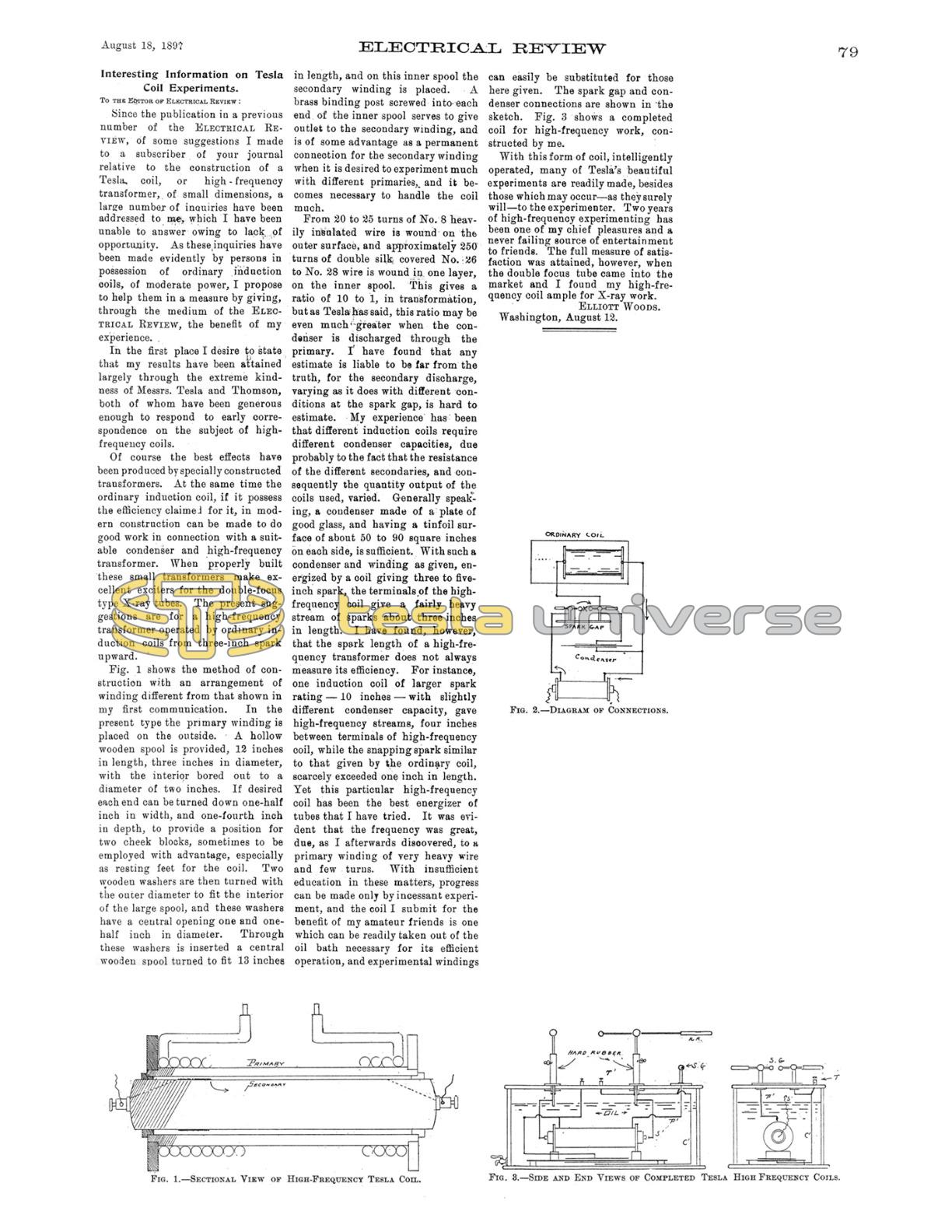
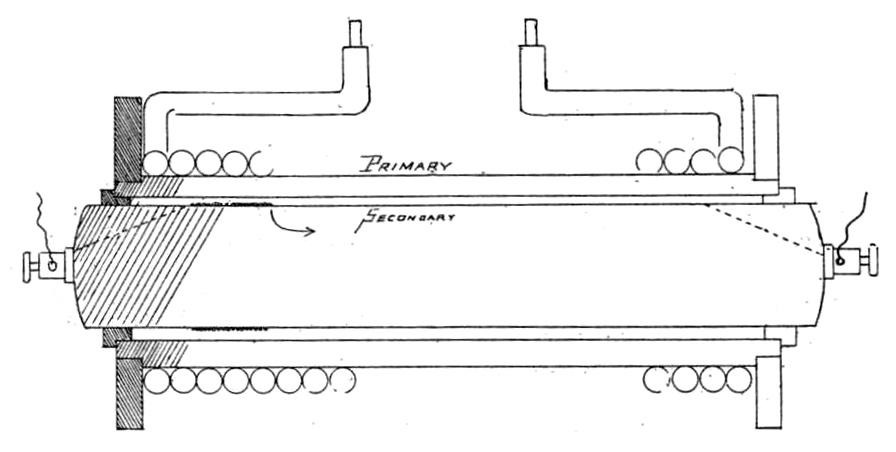
Fig. 1 shows the method of construction with an arrangement of winding different from that shown in my first communication. In the present type the primary winding is placed on the outside. A hollow wooden spool is provided, 12 inches in length, three inches in diameter, with the interior bored out to a diameter of two inches. If desired each end can be turned down one-half inch in width, and one-fourth inch in depth, to provide a position for two cheek blocks, sometimes to be employed with advantage, especially as resting feet for the coil. Two wooden washers are then turned with the outer diameter to fit the interior of the large spool, and these washers have a central opening one and one- half inch in diameter. Through these washers is inserted a central wooden spool turned to fit 13 inches in length, and on this inner spool the secondary winding is placed. A brass binding post screwed into each end of the inner spool serves to give outlet to the secondary winding, and is of some advantage as a permanent connection for the secondary winding when it is desired to experiment much with different primaries, and it becomes necessary to handle the coil much.
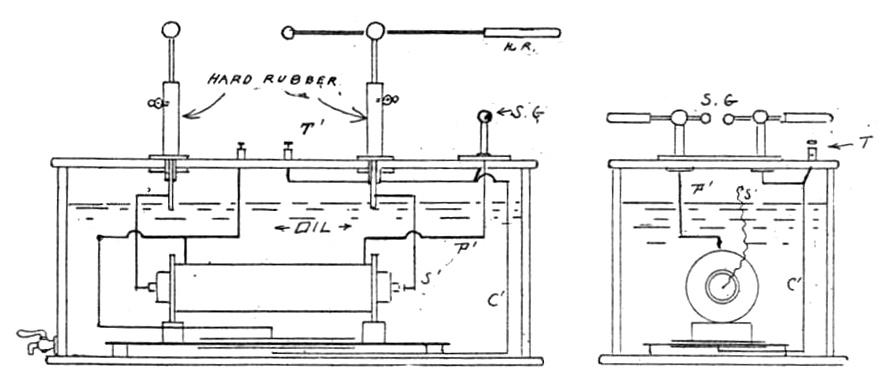
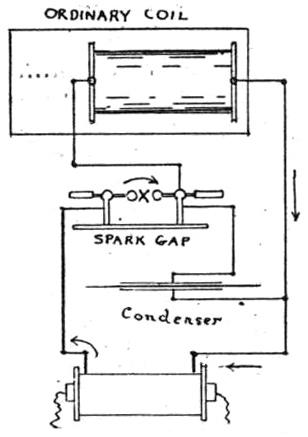
From 20 to 25 turns of No. 8 heavily insulated wire is wound on the outer surface, and approximately 250 turns of double silk covered No. 26 to No. 28 wire is wound in one layer, on the inner spool. This gives a ratio of 10 to 1, in transformation, but as Tesla has said, this ratio may be even much greater when the condenser is discharged through the primary. I have found that any estimate is liable to be far from the truth, for the secondary discharge, varying as it does with different conditions at the spark gap, is hard to estimate. My experience has been that different induction coils require different condenser capacities, due probably to the fact that the resistance of the different secondaries, and consequently the quantity output of the coils used, varied. Generally speak- ing, a condenser made of a plate of good glass, and having a tinfoil sur- face of about 50 to 90 square inches on each side, is sufficient. With such a condenser and winding as given, energized by a coil giving three to five-inch spark, the terminals of the high-frequency coil give a fairly heavy stream of sparks about three inches in length. I have found, however, that the spark length of a high-frequency transformer does not always measure its efficiency. For instance, one induction coil of larger spark rating — 10 inches — with slightly different condenser capacity, gave high-frequency streams, four inches between terminals of high-frequency coil, while the snapping spark similar to that given by the ordinary coil, scarcely exceeded one inch in length. Yet this particular high-frequency coil has been the best energizer of tubes that I have tried. It was evident that the frequency was great, due, as I afterwards discovered, to a primary winding of very heavy wire and few turns. With insufficient education in these matters, progress can be made only by incessant experiment, and the coil I submit for the benefit of my amateur friends is one which can be readily taken out of the oil bath necessary for its efficient operation, and experimental windings can easily be substituted for those here given. The spark gap and condenser connections are shown in the sketch. Fig. 3 shows a completed coil for high-frequency work, constructed by me.
With this form of coil, intelligently operated, many of Tesla's beautiful experiments are readily made, besides those which may occur — as they surely will — to the experimenter. Two years of high-frequency experimenting has been one of my chief pleasures and a never failing source of entertainment to friends. The full measure of satisfaction was attained, however, when the double focus tube came into the market and I found my high-frequency coil ample for X-ray work.
ELLIOTT WOODS.
Washington, August 12.