Nikola Tesla Articles
They Believed in Their Ideas
VISIONS OF COMMERCIAL PROJECTS AND SCIENTIFIC DEVELOPMENT MADE REAL BY FAITH AND PERSEVERANCE — BUILDING A RAILROAD TO NOWHERE TO PRODUCE TRAFFIC — SOME OF THE MEN
Abiding faith and vision are forces whose operation is generally associated with the spiritual, intellectual or artistic spheres of life, rather than with the everyday world of material things. But it is none the less true that in the everyday material world, the world of business, of commerce and industry, they constitute a power the results of which are to be seen in some of the greatest achievements of modern times. Faith and vision have built the wonders of science; the ready and ubiquitous servants of the people; they have built great industries, have peopled wildernesses and have reared cities. That we owe, possibly many of the great practical achievements of science, many of the great utilities of today, so familiar that they are commonplace, existence of many years ago only as a vision in the mind of one man.
The faith and vision that have accomplished such great things in the material world are as far removed as possible from the spirit of the speculator. Nevertheless, the stories of the business men who have had visions and who have succeeded because they had faith are not without a certain romantic interest.
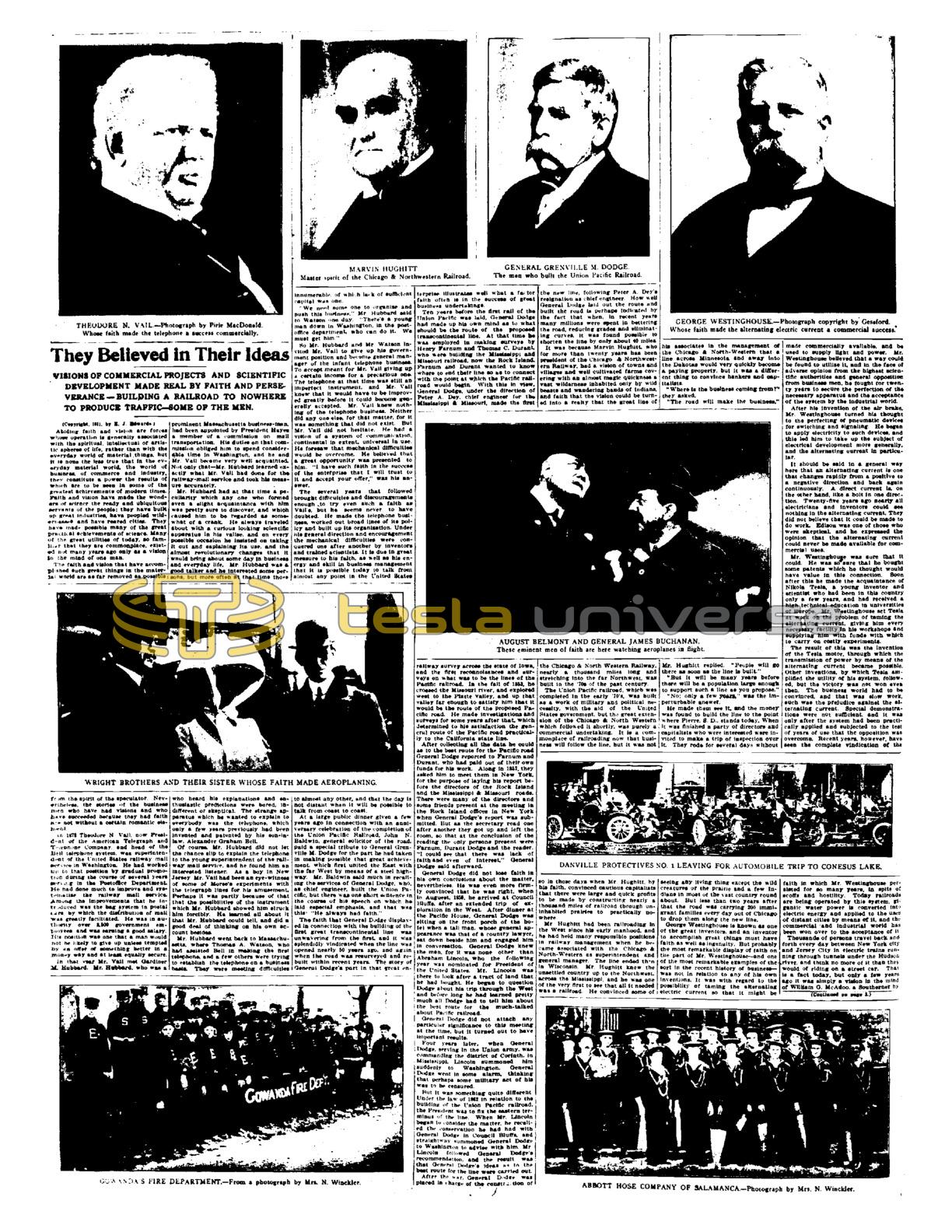
In 1879 Theodore N. Vail was President of the American Telegraph and Telephone Company and head of the Bell telephone system, was superintendant of the United States railway mail service in Washington. He had worked up to that position by gradual promotion during the course of several years service in the Postoffice Department. He had done much to improve and systematize the railway mail service. Among the improvements that he introduced was the bag system in postal cars by which the distribution of mail was greatly facilitated. He was an authority over 3,000 government employees and was earning a good salary. His position was one that a man would not be likely to give up unless tempted by an offer of something better in a money way and at least equally secure. In that year Mr. Vail met Gardiner G. Hubbard. Mr. Hubbard, who was a prominent Massachusetts business man, had been appointed by President Hayes a member of a commission on mail transportation. His duties on that commission obliged him to spend considerable time in Washington, and he and Mr. Vail became very well acquainted. Not only was Mr. Hubbard learned on the subject of mail transportation, but he was also very well acquainted with the railway mail service and took his measure accurately.
Mr. Hubbard had at that time a peculiarity which any one who formed even a slight acquaintance with him was pretty sure to discover, and which caused him to be regarded as something of a crank. He always traveled about with a curious looking scientific apparatus in his valise, and on every possible occasion he insisted on taking it out and explaining its use, and the almost revolutionary changes that it would bring about some day in business and everyday life. Mr. Hubbard was a good talker and he interested some persons, but more often at that time those who heard his explanations and enthusiastic predictions were bored, if not somewhat skeptical. The strange apparatus which he wanted to explain to everybody was the telephone, which only a few years previously had been invented and patented by his son-in-law, Alexander Graham Bell.
Of course, Mr. Hubbard did not in this way mean only to explain the telephone to the young superintendent of the railway mail service, and he found him an interested listener. As a boy in New Jersey Mr. Vail had been an eye-witness of some of Morse’s experiments with the telegraph lines for his amusement. Perhaps it was partly because of this that the possibilities of the instrument which Mr. Hubbard showed him struck him forcibly. He learned all about it that Mr. Hubbard could tell, and did a good deal of thinking on his own account besides.
Mr. Hubbard went back to Massachusetts, where Thomas A. Watson, who had assisted Bell in making the first telephone, and a few others were trying to establish the telephone on a business basis. They were meeting difficulties innumerable, of which lack of sufficient capital was one.
“We need some one to organize and push this business,” Mr. Hubbard said to Watson one day. “There is a young man down in Washington, in the post-office department, who can do it. We must get him.”
So Mr. Hubbard and Mr. Watson invited Mr. Vail to give up his government position and become general manager of the infant telephone business. To accept meant for Mr. Vail giving up a certain income for a precarious one. The telephone at that time was still an imperfect instrument, and Mr. Vail knew that it would have to be improved greatly before it could become generally accepted. Mr. Vail knew nothing of the telephone business. Neither did any one else, for that matter, for it was something that did not exist. But Mr. Vail did not hesitate. He had a vision of a system of communication, continental in extent, universal in use. He foresaw that mechanical difficulties would be overcome. He believed that a great opportunity was presented to him. “I have such faith in the success of the enterprise that I will trust to it and accept your offer,” was his answer.
The several years that followed brought difficulties and discouragements enough to try even such a faith as Vail’s, but he seems never to have doubted. He made his headquarters in Boston, worked out broad lines of his policy and built up his organization. Under his general direction and encouragement the mechanical difficulties were conquered one after another by inventors and trained scientists. It is due in great measure to his faith, as well as his energy and skill in business management, that it is possible today to talk from almost any point in the United States to almost any other, and that the day is not distant when it will be possible to talk from coast to coast.
At a large public dinner given a few years ago in connection with an anniversary celebration of the completion of the Union Pacific Railroad, John Baldwin, general solicitor of the road, paid a special tribute to General Grenville M. Dodge for the part he had taken in making possible that great achievement, which first united the East with the far West by means of a steel highway. Mr. Baldwin said much in recalling the services of General Dodge, who, as chief engineer, built the Union Pacific, but there was one short sentence in the course of his speech on which he laid especial emphasis, and that was this: “He always had faith.”
The faith that General Dodge displayed in connection with the building of the first great transcontinental line was unwavering from the first, and it was splendidly vindicated when the line was opened nearly 40 years ago, and again when the road was reorganized and rebuilt within recent years. The story of General Dodge’s part in that great enterprise illustrates well what a factor faith often is in the success of great business undertakings.
Two years before the first rail of the Union Pacific was laid, General Dodge had made up his own mind as to what should be the route of the proposed transcontinental line. At that time he was employed in making surveys by Henry Farnum and Thomas C. Durant, who were building the Mississippi and Missouri Railroad, now the Rock Island. Farnum and Durant wanted to know what route their line was to take to connect with the point at which the Pacific railroad would begin. With this in view, General Dodge, under the direction of Peter A. Dey, chief engineer for the Mississippi & Missouri, made the first general survey, following Peter A. Dey’s resignation as chief engineer. How well General Dodge laid out the route and built the road is perhaps indicated by the fact that when, in recent years, many millions were spent in bettering the road, reducing grades and eliminating curves, it was found impossible to shorten the line by more than 40 miles.
It was because Marvin Hughitt, who for more than twenty years has been president of the Chicago & Northwestern Railway, had a vision of towns and villages and well cultivated farms covering with an almost magic quickness a vast wilderness inhabited only by wild beasts and wandering bands of Indians, and faith that the vision could be turned into a reality that the great line of the Chicago & Northwestern, nearly a thousand miles long and stretching into the far Northwest, was built in the ’70s of the past century.
The Union Pacific Railroad, which was completed in the early ’70s, was built as a work of military and political necessity, with the aid of the United States government, but the great extension of the Chicago & Northwestern which followed it shortly, was purely a commercial undertaking. It was a commonplace of railroad men that business would follow the line, but it was not so in those days when Mr. Hughitt, by his faith, convinced cautious capitalists that there were large and quick profits to be made by constructing nearly a thousand miles of railroad through uninhabited prairies to practically nowhere.
Mr. Hughitt had been railroading in the West since his early manhood, and he had held many responsible positions in railway management when he became associated with the Chicago & Northwestern as superintendent and later general manager. The line ended then in Wisconsin. Mr. Hughitt knew the unsettled country up to the Northwest, beyond the Mississippi, and he was one of the very first to see that all it needed was a railroad. He convinced some of his associates in the management of the Chicago & Northwestern that a line across Minnesota and away into the Dakotas would very quickly become a paying property. But it was a different thing to convince bankers and capitalists.
“Where is the business coming from?” they asked.
“The road will make the business,” he replied. “People will go there as soon as the line is built.”
“But it will be many years before there will be a population large enough to support such a line as you propose.”
“No; only a few years,” was the imperturbable answer.
He made them see it, and the money was found to build the line to the point where Pierre, S. D., stands today. When it was finished a party of directors and capitalists who were interested went out over it to make a trip of inspection over it. They rode for several days without seeing any living thing except the wild creatures of the prairie and a few Indians in most of the vast country round about. But less than two years after the road was built it was carrying 100 immigrant families every day out of Chicago to drop them along the new line.
George Westinghouse is known as one of the great inventors, and as inventor of the air brake and of electrical apparatus. But probably of the most remarkable display of faith on the part of Mr. Westinghouse and one of the most remarkable examples of the best in the recent history of business was not in relation to any of his own inventions. It was with regard to the possibility of taming the alternating current of electricity so that it might be made commercially available, and be used to supply light and power. Mr. Westinghouse believed that it was could be found to utilize it, and in the face of adverse opinion from the highest scientific authorities and general opposition from business men, he fought for twenty years to secure the perfection of the necessary apparatus and the acceptance of the system by the industrial world.
After the invention of the air brake, Mr. Westinghouse turned his thoughts to the perfecting of pneumatic devices for switching and signaling. He began to apply electricity to such devices, and this led him to take up the subject of electrical development more generally, and the alternating current in particular.
It should be said in a general way here that an alternating current is one that changes rapidly from a positive to a negative direction and back again continuously. A direct current is, on the other hand, like a bolt in one direction. Twenty-five years ago nearly all electricians and inventors could see nothing in the alternating current. They did not believe that it could be made to do work. Edison was one of those who were incredulous, and he expressed the opinion that the alternating current could never be made available for commercial uses.
Mr. Westinghouse was sure that it could. He was no more ready to accept some patents which he thought would have value in this connection. Soon after this he made the acquaintance of Nikola Tesla, a young inventor and scientist who had been in this country only a few years, and had received a high technical education in Europe. He studied the utility of the alternating current at work on the problem of taming the alternating current, giving him every necessary facility and supplying him with funds with which to carry on costly experiments.
The result of this was the invention of the Tesla motor, through which the transmission of power by means of the alternating current was made possible. Other inventions by which Tesla amplified the utility of the system followed, but the victory was not won even then. The apparatus would had to be constructed, and that was slow work. Such was the prejudice against the alternating current. Special demonstrations were not sufficient, and it was only after the system had been practically applied and subjected to the test of years of use that the opposition was overcome. Recent years, however, have seen the complete vindication of the faith in which Mr. Westinghouse persisted for so many years, in spite of scoffs and incredulity. The railroads are being operated by this system, gigantic electric power is generated by the electric energy and applied to the uses of distant cities by means of it, and the commercial and industrial world has been won over to the acceptance of it.
Thousands of persons travel back and forth every day between New York city and Jersey City in electric trains running through tunnels under the Hudson river, and think no more of it than they would of riding on a street car. That is a fact today, but only a few years ago the idea of a steam tunnel in the mind of William G. McAdoo, a Southerner by birth and training, but then regarded in the practice of the law in New York, Mr. McAdoo had faith that the great engineering problems that the realization of his vision involved could be solved, and that the public would be quick to avail itself of a rapid transit line under the big river. He made capitalists see what he saw and raised the millions necessary to put through the enterprise. He not only started the undertaking, but directed it to completion, and it is no a tribute to his faith and vision, quite as much as to his energy and business management, that the system of tunnels, familiarly designated by the name of the Hudson & Manhattan Railroad Company, of which Mr. McAdoo is president, are popularly known as the McAdoo tubes.
August Belmont, head of the New York banking-house of August Belmont & Co., stood practically alone among the great financiers of New York in having faith in the success of the rapid-transit subway railroad at the time when the city was about to let the contract for the construction of that big work. Some of the big financiers openly scoffed and said that the people would never ride in a hole in the ground. But Mr. Belmont had visions of an immense and ever-growing traffic on that line. The late John B. McDonald, the successful bidder for the contract to build and operate the subway, found it impossible to get sureties for the big bond required of him, and he was therefore on the verge of forfeiting his right to the contract. Mr. Belmont went to his rescue and financed the companies to construct and operate the line. The subway railroad was an immense and tremendous success and today the city of New York is preparing to spend about $200,000,000 for more subways.
Faith and vision have gained scientific as well as industrial and commercial successes. It was because they had faith and vision, as well as mechanical skill, ingenuity and physical daring, that Wilbur and Orville Wright solved the problem of flight. For years they put everything they could earn into their experiments. They were sure that a heavier-than-air machine could be made to fly under control. The only question with them was how. And with slow and patient steps they proceeded to find the answer.
In the same way Peary set about reaching the north pole. He was confident that it could be reached. So, undiscouraged by failures, but rather regarding them as steps toward the goal, he repeated his attempts year after year, until finally he succeeded.
The city of Newport News, Va., was created by faith. The late C. P. Huntington had a vision of a great port, city and railway terminal at that point when the physical eye could see there only a few running factories. Other railroad men regarded the idea as wild and foolish, but Mr. Huntington went ahead, and the day came when he saw his vision a reality.
The story of Cyrus W. Field and the Atlantic cable is the story of the faith of one man and how it triumphed. The failure of repeated attempts to lay the cable could not shake Mr. Field’s conviction that it would be laid, and he lived to see the ocean telegraph an accomplished fact.
In the early days of the last century De Witt Clinton saw with prophetic eye a canal connecting the Great Lakes with the great Atlantic seaport, and creating untold wealth through the promotion of trade. His faith, more than any one thing, probably, made the world-famous Erie canal. His faith was vindicated many years ago; but if any further vindication were needed, it could be found in the fact that the state of New York is now building a new canal, over practically the same route as the Erie canal, but on a much grander scale and at a cost of more than a hundred million dollars.
The Brooklyn bridge is a monument to the faith of John A. Roebling. A suspension bridge of such great proportions was not deemed possible when Roebling submitted his plan for the great span over the East river at New York. Roebling died before the construction of the bridge had been begun, but firm in the faith that the great structure would rise just as he had planned. His faith was shared by his son, Washington Augustus Roebling, who took charge of the construction of the bridge and carried it to completion.
E. J. EDWARDS (HOLLAND.)