Nikola Tesla Articles
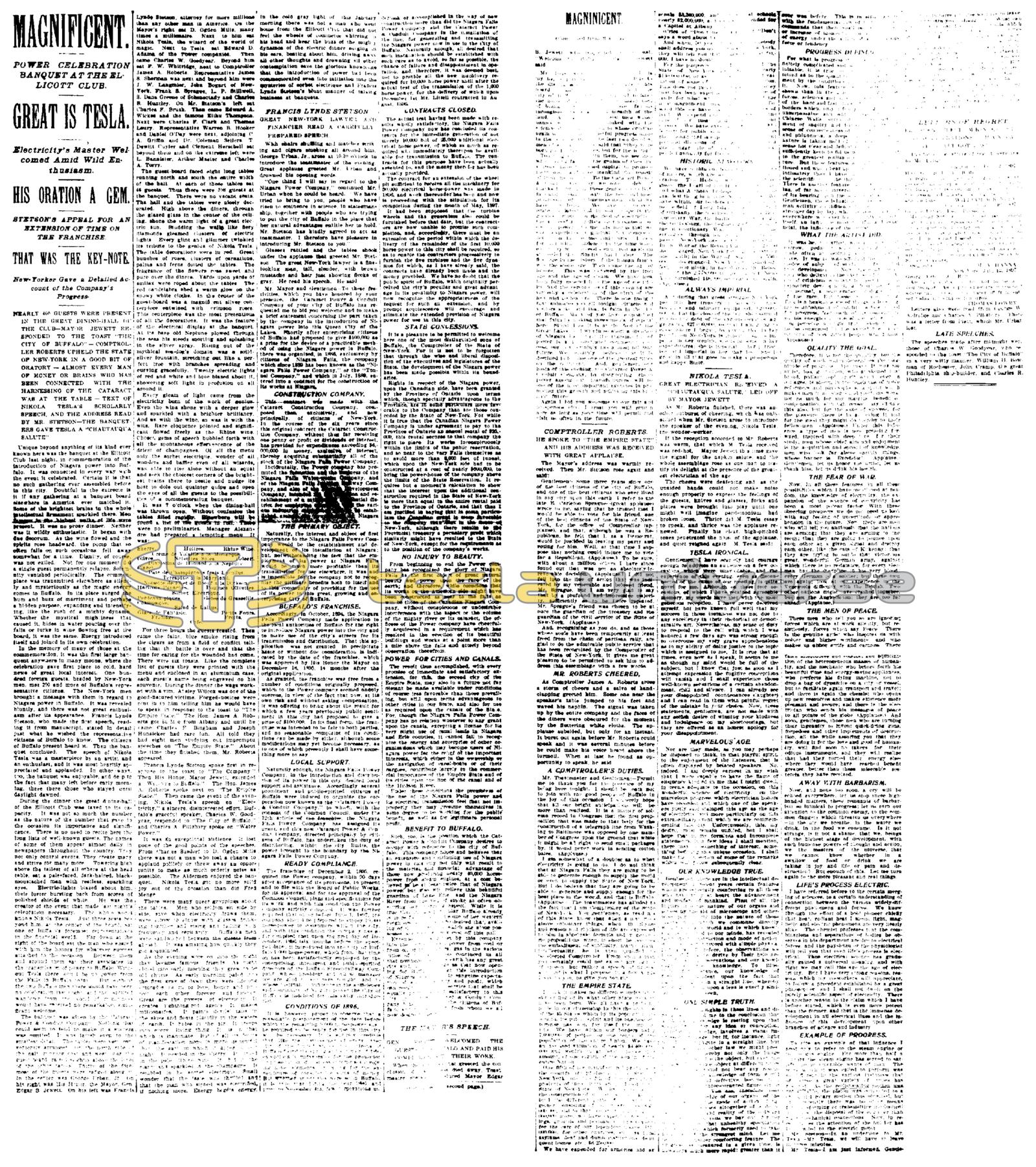
Magnificent
POWER CELEBRATION BANQUET AT THE ELLICOTT CLUB.
GREAT IS TESLA.
Electricity’s Master Welcomed Amid Wild Enthusiasm.
HIS ORATION A GEM.
STETSON’S APPEAL FOR AN EXTENSION OF TIME ON THE FRANCHISE.
THAT WAS THE KEY-NOTE.
New-Yorker Gave a Detailed Account of the Company’s Progress.
NEARLY 400 GUESTS WERE PRESENT IN THE GREAT DINING-HALL OF THE CLUB—MAYOR JEWETT RESPONDED TO THE TOAST “THE CITY OF BUFFALO”—COMPTROLLER ROBERTS UPHELD THE STATE OF NEW-YORK IN A GOOD BIT OF ORATORY — ALMOST EVERY MAN OF MONEY OR BRAINS WHO HAS BEEN CONNECTED WITH THE HARNESSING OF THE CATARACT WAS AT THE TABLE — TEXT OF NIKOLA TESLA’S SCHOLARLY SPEECH, AND THE ADDRESS READ BY MR. STETSON — THE BANQUETERS GAVE TESLA A “CHAUTAUQUA SALUTE”
Editorial note:
This transcription of the Buffalo Express, January 13, 1897, report on the Ellicott Club power banquet was prepared from a damaged two-page scan. Large stretches of type are washed out, splotched, or broken at column edges.
Where the print could be read letter by letter, the wording, punctuation, and period spellings were kept as they appear.
Where the scan failed, the missing lines were restored by: reading adjacent columns and matching wrap-around sentences; comparing the Tesla address with the text printed as “On Electricity” in Electrical Review, January 27, 1897 (the same speech given that night); checking contemporary Niagara / Cataract company histories for franchise dates, guest names, and corporate relationships (Stetson, Adams, Urban, Huntley, the Tunnel Company, the December 1895 Buffalo franchise).
Bold type indicates reconstructed or inferred wording.
Menu lines, Mayor Jewett’s welcome, Comptroller Roberts’s closing statistics, the U-shaped table description, the “energy begets energy” passage, and the Hanna/Lockhart regret notes are the least certain blocks.
The washed paragraphs regarding Tesla are the most certain, because we were able to compare the same content from another source.
Treat bold passages as working restorations for research use, not as a substitute for the original sheet.
Unique beyond anything of its kind ever known here was the banquet at the Ellicott Club last night, in commemoration of the introduction of Niagara power into Buffalo. It was connected in every way with the event it celebrated. Certain it is that no such gathering ever assembled before in this city. Doubtful to the extreme is it if any gathering at a banquet board elsewhere in America ever matched it. Some of the brightest brains in the whole intellectual armament sparkled there. Men famous in the highest walks of life were present. It was no prosy dinner. Neither was it wildly enthusiastic. It began with due decorum. As the wine flowed and the spirits rose headward, the pomp that so often falls on such occasions fell away somewhat for a time. Dignity, of course, was not exiled. Not for one moment did a single guest permanently relapse. Solemnity vanished periodically. The commonplace was transmitted elsewhere as silently and mysteriously as the magic energy comes to Buffalo. In its place surged the hum and buzz of merriment and perhaps a hidden purpose, expanding and intensifying, like the rush of a mighty dynamo. Whether the mystical mightiness that caused it, hidden in water pouring over the falls or lurks in wine flowing free at the board, it was the same. Energy introduced itself and joined in its own celebration.
In the memory of many of those at the commemoration, it was the first large banquet anywhere in many moons, where the celebration gave first place to cold, hard news of great local interest. One hundred foreign guests, headed by New-York men, met 300 and more of Buffalo’s representative citizens. The New-York men brought a message with them in regard to Niagara power in Buffalo. It was revealed bluntly, and there was not great enthusiasm after its appearance. Francis Lynde Stetson, who made the first speech, reading it from manuscript, stated in detail just what he wished the representative citizens of Buffalo to know. The citizens of Buffalo present heard it. Then the banquet continued. The speech of Nikola Tesla was a masterpiece by an artist and an enthusiast, and it was most heartily appreciated and applauded. In other ways, too, the banquet was enjoyable, and despite the fact that many left before early morning, there were those who stayed until daylight dawned.
During the dinner the great dining-hall of the Ellicott Club was taxed to its capacity. It was not so much the number as the nature of the number that gave to the occasion its importance and significance. There is no need to recite here the long lists of well-known guests. The names of some of them appear almost daily in newspapers throughout the country. They not only control events. They create many and strive for many more. Towering high above the tallest of all others at the head table, sat a pale-faced, dark-haired, black-moustached man with restless, sparkling eyes. Electric-lights blazed about him, their luster burning back from scores of polished shields of white. He was the creator of the event that made last night’s celebration necessary. The world-renowned Nikola Tesla. Just there were beyond him, at the center of the board, sat one of America’s foremost representatives in the financial world. Far down at the right of the board sat the man who shared with him the honors for whatever success attached to the occasion. Between them and around them sat their associates in the transmission of power to Buffalo. Without Tesla there would be no power from the Falls in Buffalo today. But without the two Buffalo men there would have been no reception last night and the visitors would have received no remarkable, enthusiastic welcome.
The banquet was given by the Cataract Power & Conduit Company. Nothing that could seem to tend to make it a success was omitted. It was lavish even to the smallest detail. The tables were one continuous arrangement in the form of the letter U, the hall running east and west. Along the outer board ran a chain of the other tables. Thirty of the foremost of the guests were seated along it.
In the center was George Urban, Jr. On his right was His Honor, the Mayor, Gen. Edgar B. Jewett. On his left was Francis Lynde Stetson, attorney for more millions than any other man in America. On the Mayor’s right sat D. Ogden Mills, many times a millionaire. Next to Mills sat Nikola Tesla, the wizard of the world of magic. Next to Tesla sat Edward D. Adams of the Power companies. Then came Charles W. Goodyear. Beyond him sat F. W. Whitridge, next to Comptroller James A. Roberts. Representative James S. Sherman was next and beyond him were J. W. Langcaster, John Bogart of New-York, Frank S. Sprague, L. B. Stillwell, S. Dana Greene of Schenectady and Charles R. Huntley. On Mr. Stetson’s left sat Charles F. Brush. Then came Edward A. Wickes and the famous Elihu Thompson. Next were Charles F. Clark and Thomas Lowry. Representative Warren B. Hooker and Daniel O’Day were next, adjoining C. A. Grimm and Dr. Coleman Sellers. T. DeWitt Cuyler and Clement Herschell sat beyond them and on the extreme left were L. Bannister, Arthur Masten and Charles A. Torry.
The guest-board faced eight long tables running north and south the entire width of the hall. At each of these tables sat 44 guests. Thus there were 396 guests at the banquet. There were no vacant seats. The hall and the tables were nicely decorated. High above the diners, through the glazed glass in the center of the ceiling, shone the warm light of a great electric sun. Studding the walls like fiery diamonds gleamed clusters of electric lights. Every glint and glimmer twinkled its tribute to the genius of Nikola Tesla. The table decorations were in red. Great bunches of roses, clusters of carnations, palms and ferns dotted the tables. The fragrance of the flowers rose sweet and pure over the diners. Yards upon yards of smilax were roped about the tables. The red candelabra shed a warm glow on the snowy white cloths. In the center of the guest-board was a magnificent silver centerpiece entwined with crimson roses. This centerpiece was the most pretentious of all the decorations. It was the feature of the electrical display at the banquet. At its base old Neptune plowed through the seas his steeds snorting and splashing in the silver spray. Rising out of the mythical sea-dog’s domain was a solid silver fountain, stretching out like a perfect tree with branches spreading and curving gracefully. Twenty electric lights of red and white and blue blazed about it, showering soft light in profusion on all around it.
Every gleam of light came from the electricity born of the work of genius. Even the wine shone with a deeper glow and sparkled with a brighter brilliancy. And as with the wine, so was it with the wits. Rare eloquence pointed and significant flowed freely as the Rhine wine. Choicest gems of speech bubbled forth with all the spontaneous effervescence of the driest of champagnes. Of all the menu only the sorbet electrique, wonder of all wonders and banter even of all wizards, was able to rise alone without an equal and seek the choicest corners of the brightest brains there to nestle and nudge its host to dole out quaintest quips and open the eyes of all the guests to the possibilities of a commemorative banquet.
It was 7 o’clock when the dining-hall was thrown open. Without confusion the tables filled rapidly. Elsewhere will be found a list of the guests to-night. There were no preliminaries. Manager Alexandre had prepared a tempting menu. It was:
Sherry. Huitres. Rhine Wine.
Creme de Volaille a la Monarque.
Olives. Noisettes Sautes. Celery.
Brochette de Homard a la Neptune.
Pate de Champignons frais Lucullus.
Terrapin a la Maryland.
Noisette de Filet de Boeuf a la Turque.
Haricots Flamands. Tournedos Oillettes.
Sorbet Electrique.
Perdreaux piques. Gelee de Groseille.
Champagne.
Salad de Laitue.
Glace de Fantaisie. Petits Fours.
Fromage. Fruits. Cafe.
For three hours the guests feasted. Then came the faint, blue smoke rising from the cigars as from a field of conflict telling that the battle is over and that the time for caring for the wounded had come. There were six toasts. Like the complete list of guests they were printed with the menu and enclosed in an aluminum case, each guest’s name being engraved on his souvenir. During the dinner the wags worked with a vim. Ansley Wilcox was one of the good-natured victims. Forged notices were sent in to him telling him he would have to speak in response to the toast to “The Empire State.” The Hon. James A. Roberts got in late from Albany and until he came Charles F. Bingham and Joseph Hunsicker had rare fun. All told they had eight men standing out impromptu speeches on “The Empire State.” About the time they finished them, Mr. Roberts appeared.
Francis Lynde Stetson spoke first in response to the toast to “The Company.” Then His Honor, Mayor Jewett, extended a Welcome to Buffalo. The Hon. James A. Roberts spoke next on “The Empire State.” Then came the event of the evening. Nikola Tesla’s speech on “Electricity,” a sincere, disinterested effort. Buffalo’s graceful speaker, Charles W. Goodyear, responded to “The City of Buffalo,” and Charles A. Pillsbury spoke on “Water Power.”
It was an exceptional audience; it lost none of the good points of the speeches. From Charles Bissell to D. Ogden Mills there was not a man who lost a chance to applaud politely or throw away an opportunity to make as much orderly noise as possible. The Aldermen enjoyed the banquet. Nikola Tesla got no more solid joy out of the occasion than did Fred Menger.
There were many queer groupings about the tables. Men who seldom sit side by side, save when electricity draws them, were thrown to elbow with a man from another city and rank and calling. Buffalo men were sandwiched between the guests from abroad. It was amazing how quickly they got acquainted.
As the evening wore on into the night they became famous friends. As early as midnight they grew to old chums. As early morning paled into the first gray of dawn they were inseparable, pledged each to love, honor and protect each other forever and forever. Great are the powers of electricity. It creates lightning and again it makes millionaires. It paints white light in the skies and floats placidly in the waters of earth. It hides in the air. It enters every living thing. It is in that which is inanimate. It is all things of transformation now so much demanded of the age in which we live. It is in the air. It is nested in the cherry. It is in the pale throat of the lily. It is in the sparkle of the champagne. Small wonder that the last man present said that the man who started was electrified, if nothing more. Energy begets energy.
In the cold gray light of this January morning there was not a man who went home from the Ellicott Club that did not feel the wheels of commerce whirring in his head and hear the buzz of the mighty dynamo of the electric dinner singing in his ears, beating about him, driving away all other thoughts and drowning all other contemplation save the glorious knowledge that the introduction of power had been commemorated even into initiation into the mysteries of sorbet electrique and Francis Lynde Stetson’s blunt manner of talking business at banquets.
FRANCIS LYNDE STETSON
GREAT NEW-YORK LAWYER AND FINANCIER READ A CAREFULLY PREPARED SPEECH.
With chairs shuffling and matches striking and cigars snapping all around him, George Urban, Jr., arose at 10.30 o’clock to introduce the toastmaster of the evening. Great applause greeted Mr. Urban and drowned his opening words.
“One thing I will say in regard to the Niagara Power Company,” continued Mr. Urban when he could be heard. “We have tried to bring to you, people who have risen to eminence in science, in statesmanship, together with people who are trying to put the city of Buffalo in the place that her natural advantages entitle her to hold. Mr. Stetson has kindly agreed to act as toastmaster. I therefore have pleasure in introducing Mr. Stetson to you.”
Glasses rattled and the tables shook under the applause that greeted Mr. Stetson. The great New-York lawyer is a fine-looking man, tall, slender, with brown mustache and hair just showing flecks of gray. He read his speech. He said:
Mr. Mayor and Gentlemen — To these festivities, which you have honored by your presence, the Cataract Power & Conduit Company of your city of Buffalo has requested me to bid you welcome and to make a brief statement concerning the part taken by the company in the introduction of Niagara power into this Queen City of the Lakes. Shortly after enterprising citizens of Buffalo had proposed to give $100,000 as a prize for the device of a practicable method of using the Niagara power in Buffalo, there was organized, in 1886, exclusively by citizens of Niagara Falls, the company which since 1889 has been known as the “Niagara Falls Power Company,” or the “Tunnel Company,” and which in July, 1890, entered into a contract for the construction of its works at Niagara.
CONSTRUCTION COMPANY.
This contract was made with the Cataract Construction Company, composed then exclusively, and now principally, of citizens of New-York. In the course of the six years since this original contract the Cataract Construction Company, without thus far receiving one penny of profit or dividends or interest, has provided for expenditures exceeding $6,000,000 in money, exclusive of interest, thereby acquiring substantially all of the stock of the Niagara Falls Power Company. Incidentally, the Power company has promoted the formation and the business of the Niagara Falls Water-works Company, and of the Niagara Falls & Lewiston Railway Company, and also of the Niagara Development Company, intended to provide sites and establishment of a manufacturing industrial district for manufacturers using the various industrial processes to be established along the Niagara.
THE PRIMARY OBJECT.
Naturally, the interest and object of first importance to the Niagara Falls Power Company would be the establishment and development of its installation at Niagara; but, notwithstanding the fact that the employment of its power at Niagara Falls would be much more profitable than its transmission for use elsewhere, it was and is impossible for the company not to recognize the ultimate benefits both to itself and to this community of providing for the use of its power in this great, growing and enterprising City of Buffalo.
BUFFALO’S FRANCHISE.
Accordingly, in October, 1894, the Niagara Falls Power Company made application to the local authorities of Buffalo for the right to introduce Niagara power into the city and to make use of the city’s streets for its transmission and distribution. That this application was not granted in precipitate haste or without due consideration is indicated by the date of the franchise, which was approved by His Honor the Mayor on December 14, 1895, 14 months after the original application.
As granted, the franchise was free from a number of conditions originally proposed, which to the Power company seemed unduly onerous, in view of the fact that now, at its own risk and without asking compensation, it was offering to bring about the result for which a few years previously public sentiment in this city had proposed to give a prize of $100,000. In its final form, the franchise was intended to be fair to both parties, and no reasonable complaint of its conditions can be made by either, although some modifications may yet become necessary, as to one of which presently I shall have something more to say.
LOCAL SUPPORT.
Naturally enough, the Niagara Falls Power Company, in the introduction and distribution of its power in this city, desired local support and assistance. Accordingly several prominent and public-spirited citizens of Buffalo were induced to organize the corporation now known as the “Cataract Power & Conduit Company,” to which, with the consent of the Common Council, under the 12th article of the franchise, the Niagara Falls Power Company has assigned its grant, and this new Cataract Power & Conduit Company, directed principally by citizens of Buffalo, has undertaken the duty of distributing, within the city limits, the power brought to the boundary by the Niagara Falls Power Company.
READY COMPLIANCE.
The franchise of December 2, 1895, required the Power company, within 90 days after acceptance of its provisions, to present and to file with the Board of Public Works, for its approval and for the approval of the Common Council, plans and specifications for its work, and with this condition the Power company strictly complied. It was further required that on or before June 1, 1896, the company should be prepared to supply 1,000 horse-power to consumers within the city, and with this condition the company complied. For completion of the first day of December, 1896, two months before the specified date, it delivered into the city of Buffalo 1,000 horse-power, which from that time on has been satisfactorily employed by the enterprising, intelligent and public-spirited directors of the Buffalo Street Railway Company, whose presidents are also our own, and whose electrical engineers are the same, and whose original influence in the authorization of the franchise of 1895 put the City of Buffalo in the forefront of the power cities of the world.
CONDITIONS OF 1896.
It is, however, proper to observe that a reasonable interpretation of the date before which the remaining 9,000 horse-power can be required is not early for use in this city. The company is to be ready to furnish that like amount of additional power in each successive year. The franchise, as it now stands, requires the company to be prepared to furnish 10,000 horse-power by December 31, 1897, and 10,000 additional horse-power in each year thereafter. But even that provision is more than Buffalo can now absorb in its operations as much as has been accomplished in the way of new construction more than did the Niagara Falls Power Company and the Cataract Power & Conduit Company in the installation of the line, for generating and transmitting the Niagara power now in use in the City of Buffalo. Naturally enough, all desired that such installation should be established with such care as to avoid, so far as possible, the chance of failure and disappointment in operation, and, therefore, it was deemed best not to provide all the new machinery required for 10,000 horse power until after the actual test of the transmission of the 1,000 horse power, for the delivery of which upon November 1st Mr. Littell contracted in August, 1896.
CONTRACTS CLOSED.
The actual test having been made with results wholly satisfactory, the Niagara Falls Power Company now has concluded its contracts for the immediate generation of not merely 10,000 but of 25,000 additional electrical horse-power, of which as much as required will immediately thereupon be available for transmission to Buffalo. The contracts for this purpose have been actually executed to, and the money therefor has been actually provided.
The contract for an extension of the wheel pit sufficient to receive all the machinery for 50,000 electrical horse-power was made in 1896, and work thereunder has been and now is proceeding with the stipulation for its completion during the month of May, 1897.
It had been supposed that the turbine wheels and the generators also could be furnished before that date, but the contractors are now unable to promise such completion, and, accordingly, there must be an extension of the period within which the delivery of the remainder of the first 10,000 horse-power to this city shall be required, so as to enable the contractors progressively to furnish the five turbines and the five dynamos for which, as I have already said, the contracts have already been made and the money provided. We have no doubt that the public spirit of Buffalo, which originally perceived the city’s peculiar and great advantage in its proximity to Niagara power, will now recognize the appropriateness of the request for such an extension, and by prompt acquiescence will encourage and stimulate the extended provision of Niagara power for use in this city.
STATE CONCESSIONS.
It is a pleasure to be permitted to welcome here one of the most distinguished sons of Buffalo, the Comptroller of the State of New-York. For it is not to be forgotten that through the wise and liberal disposition of the executives and legislatures of the State, the development of the Niagara power has been made possible within its boundaries.
Rights in respect of the Niagara power, upon the Canadian side, have been granted by the Province of Ontario upon terms which, though specially advantageous to the Province, are in some particulars more favorable to the Company than are those conceded by the State of New-York. For while it is true that the Canadian Niagara Power Company is under agreement to pay to the Province of Ontario an annual rental of $25,000, this rental secures to that company the right to place its works inconspicuously within the limits of the public reservation, and so near to the very Falls themselves as to avoid more than 6,000 feet of tunnel, which upon the New-York side had to be constructed at a cost of nearly $500,000 to bring the power-house of the company above the limits of the State Reservation. It requires but a moment’s calculation to show that the interest upon the additional construction required in the State of New-York is more than equal to the entire rental paid to the Province of Ontario, and that thus I am justified in saying that in some particulars the Canadian grant is more favorable to the company than is the franchise of New-York, although there remains to the Provincial treasury a pecuniary profit which similarly might have resulted to the State of New-York, except for the requirements as to the position of the company’s works.
NO INJURY TO BEAUTY.
From beginning to end the Power company has recognized the glory of Niagara Falls as the first object of great natural beauty and power upon the face of the earth; and therefore, while conscious that its works on the American side might have been constructed as near to the falls as will be those of the Canadian Niagara Company, without conspicuous or undesirable interference with the aspect or the volume of the mighty river or its cataract, the officers of the Power company have cheerfully acquiesced in a requirement which has resulted in the erection of its beautiful buildings and works at a point more than a mile above the falls and entirely beyond observation therefrom.
POWER FOR CITIES AND CANALS.
The result thus accomplished, with every promise of immediate and satisfactory extension, for this, the second city of the Empire State, may also in a future not far distant be made available under conditions of course less favorable than those prevailing, but still upon terms advantageous to other cities in our State, and also for use as required upon the canals of the State. For, though the Niagara Falls Power Company has no relation whatever to any grant upon the canals, excepting a license for its very slight use of canal lands in Niagara and Erie counties, it cannot fail to recognize the energy and enterprise of other organizations which may become users of Niagara power for the relief of the important interests, which either in the ownership or the navigation of canal-boats or of their cargoes, contribute largely to the commercial importance of the Empire State and of its cities upon the line of the canal and of the Hudson River.
Under these conditions the promoters of the use of the Niagara Falls power and its electrical transmission feel that not improperly they may presume themselves in some degree to be working for the public interest, as well as for legitimate personal profit.
BENEFIT TO BUFFALO.
Such, too, is the position which the Cataract Power & Conduit Company desires to occupy with reference to the city of Buffalo. This company hopes and believes that an extensive and continuing use of Niagara power in this city not only will result in the material and financial advantage of those now producing nearly 10,000 horse-power from steam engines, at a cost believed to be at least twice that of Niagara power, but also will relieve this beautiful shoreline of Lake Erie and the Niagara River from the smoke, if smoke so often so offends the senses of visitors. While it is true that in this respect Buffalo already feels the benefit of the lessening of her western winds of the smoke that drained the atmosphere of the city, and she alone possesses the opportunity to take this path.
Power furnished by this company from the Falls is as cheap as gas in the earths that now consume it, as compared with all that another city can obtain from any great city east. It is an act now opening for the first time the introduction of Niagara power in handsome expectation and profit, which we believe will be so satisfactory to the public as to be a source of pride to the citizens of Buffalo, from whom we ask only a fair trial.
THE MAYOR’S SPEECH.
GEN. JEWETT FOLLOWED THE TOASTMASTER AND PAID HIS COMPLIMENTS TO THEIR WORK.
When the toastmaster greeted the conclusion of Mr. Stetson’s address with hearty applause, Toastmaster Stetson introduced Mayor Edgar B. Jewett, who said:
Mr. Toastmaster and Gentlemen — In the name of the City of Buffalo I bid you welcome. We are proud of this occasion and of the men who have made it possible. Buffalo has been favored by nature beyond most cities of the land. A city linked with the great waterways of the continent, she has made wonderful progress in the last two decades. There is no reason why she should not now take her place in the first rank of American cities.
To the men who have brought to us the genius of science and the capital of the East we are thankful. To the State of New-York we are indebted for the wise laws that have made this development possible. To the Cataract companies we are indebted for the energy that has turned the dream of years into a fact.
The power of Niagara is such that we can expect it to do more for this city than any other single force has done in our time. I welcome you not only as guests but as partners. The future of this city is bound up with the success of the Niagara power. This was created by the courage and the genius of men. We have lived to find ourselves at the age of electricity, and the creation of this power is already a chapter in the story of the last nine years. There is now that rare circumstance which is brought about only by such an event as this, a faith in the city of Buffalo that is of the same quality as the faith of those who first dreamed of Niagara. I was glad to know a dreamer of Niagara in the days when the dream of power was a dream and nothing more. Today that dream is a fact. We can only conjecture what the future will be. We can only welcome you as I do, and predict that one of the greatest cities on the continent will grow here. And, gentlemen, the hosts of this evening, the Cataract Power & Conduit Company, by delivering this power among us, have done what will be one of the most important events in promoting this growth not only for this city but for the entire nation.
Again I bid you welcome to our city and I trust you will remain with us as long as your time will permit and visit us often in the future.
COMPTROLLER ROBERTS.
HE SPOKE TO “THE EMPIRE STATE” AND HIS ADDRESS WAS RECEIVED WITH GREAT APPLAUSE.
The Mayor’s address was warmly received. Then Mr. Stetson rose again and said:
Gentlemen — Some three years since one of the best citizens of the city of Buffalo, and one of the best citizens who ever lived in any city upon this earth (I refer to the late E. Carleton Sprague — great applause) wrote to me, saying that he trusted that I would be able to vote for his friend, one of the best citizens of the State of New-York, for the office of Comptroller (applause), and that, although he was a Republican, he felt that I, as a Democrat, would be justified in leaving my party and voting for him. Well, at that time I suppose that nothing could induce me to vote for a Republican. (Applause.) To be sure, with about a million others I have since found out that was not an absolutely irrevocable decision. (Applause.) I did not fall into the line of action that was indicated by my venerable and beloved friend, Mr. Sprague, but I am very glad to say that by a profound and impressive majority, sufficiently so to be twice repeated, Mr. Sprague’s friend was chosen to be at once the guardian of the treasury and the guardian of the civil service of the State of New-York. (Applause.)
And recognizing as you do, and as those whose words have been temporarily at least freed from the chain of partisan rally, are glad to do the admirable public service that has been recognized by the Comptroller of the State of New-York, it gives me great pleasure to be permitted to ask him to address this assemblage with a few words.
MR. ROBERTS CHEERED.
As Comptroller James A. Roberts arose a storm of cheers and a salvo of hand-clapping greeted him. Some one near the speaker’s table jumped to his feet and waved his napkin. The signal was taken up by the entire company and the faces of the diners were obscured for the moment by the fluttering white cloths. The applause subsided, but only for an instant. It burst out again before Mr. Roberts could speak and it was several minutes before he could make his voice heard above the turmoil. When at last he found an opportunity to speak, he said:
A COMPTROLLER’S DUTIES.
Mr. Toastmaster and Gentlemen: — Permit me to thank you for the pleasure of my being here tonight. I should be rash not to join with the good people of Buffalo in the joy of this occasion. I sincerely hope that all our bright anticipations will be more than realized. It is a matter of solemn record in Congress that the first proposition that was made to that body for the construction of a telegraph line from Washington to Baltimore was opposed by one member of Congress upon the ground that while it might be all right to send small packages by it, it would never work in sending cotton bales. (Applause.)
I am somewhat of a doubter as to what electricity is going to do. I do not think that at Niagara Falls they are going to be able to generate enough to supply the world or even to supply the State of New-York. But I do believe that they are going to be able to generate and supply enough for the best place in the world, and that is Buffalo. (Applause.) The toastmaster has alluded to the fact that I am Comptroller of the State of New-York. You gentlemen, as residents of this State, know that aside from the more ordinary things, when the State and counties need a man of life and experience to raise its surplus funds and to execute the propositions when, in short, there is the establishment of something that requires personality, he is sent for. And if the elected Comptroller knows what a man of action but rather a speech of the kind that is what I propose in a few words to try to give you tonight.
THE EMPIRE STATE.
It is asked in different ways why it is that of all the other States we are so much better. We all know the answer. It is not chemistry, it is that the soil of the Empire State by the providence of God is so well fitted and its people so industrious that it is the first of the Empire States. We have within our borders not a proposition of prosperity or even of power; we have an assessed valuation of nearly $4,000,000,000 and we stand first among the States of the nation.
One fifth of the entire population of the country is within the borders of New York. The commercial pre-eminence of the State of New-York is not due to the construction of canals alone. It is due to the energy of its people. We have expended for armories and asylums, for the care of the unfortunate, for hospitals and other public buildings, for subsequent homes, etc., $47,000,000. We have expended for armories and asylums nearly $8,200,000, and for the common schools nearly $2,000,000, and we have provided for a capital at Albany.
HISTORIC ACHIEVEMENTS.
We have within our borders the Hudson. The Hudson is the great artery of the nation. We have within our borders the battlefield of Saratoga, the battle of Plattsburg, the battle of the Revolutionary War. New York stood first in the War of the Revolution, first in the War of 1812, first in the Civil War; she furnished the men, the money and the munitions.
ALWAYS IMPERIAL.
And during that great struggle New York put her treasury and military resources at the disposal of the nation, and at the close of the war she assumed a greater debt of the nation than any other State, $27,000,000. That is the later proof of New York in honor. She is larger than any other State; she is imperial. Her future is still imperial in her make-up. She is great in all that goes to make a prosperous and happy State.
NIKOLA TESLA.
GREAT ELECTRICIAN RECEIVED A “CHAUTAUQUA SALUTE,” LED OFF BY MAYOR JEWETT.
As Mr. Roberts finished, there was another outburst of cheering, which was only stilled when Mr. Stetson arose to introduce the speaker of the evening, Nikola Tesla, the wonder-worker.
If the reception accorded to Mr. Roberts was warm, that which Mr. Tesla received was red-hot. Mayor Jewett in a sense gave the signal for the napkin salute, and the whole assemblage rose as one man to testify its delight at the presence of the greatest electrician of the age.
The cheers were deafening and as the unaided hands could not make noise enough properly to express the feelings of the guests, knives and glasses, forks and plates were brought into play until one might well imagine pandemonium had broken loose. Thrice did Mr. Tesla essay to speak, and thrice was the applause renewed. Finally his clear, high-pitched tones penetrated the din of the applause, and quiet reigned again. Mr. Tesla said:
TESLA IRONICAL.
Gentlemen, I have scarcely had courage enough to address an audience on a few occasions which were unavoidable, and the experience of this evening, even as disconnected of the cause of our meeting, is quite novel for me. Although on those few occasions, of which I have retained agreeable memory, my words have met with the most generous reception, I have never deceived myself, but have known full well that my success in those instances was not due to any excellency in their rhetorical or demonstrative art. Nevertheless, my sense of duty to respond to the call with which I was honored a few days ago was strong enough to overcome my very grave apprehensions as to my ability of doing justice to the topic which is assigned to me. It is true that at times, even now as I speak, it seems to me as though my mind would be full of the subject, but I know that just as soon as I attempt expression the fugitive conceptions will vanish and I shall experience those well-known sensations of a certain abandonment, chill and silence. I can already see your disappointed countenances (laughter) and I can read in them with painful regret of the mistake in your choice. Now, these statements, gentlemen, are not made with any selfish desire of winning your kindness and indulgence on my shortcomings, but they are offered as an honest apology for your disappointment.
MARVELOUS AGE.
Nor are they made, as you may perhaps be disposed to think in that playful spirit, to the enjoyment of the listeners, that is often displayed by belated speakers. No, indeed. I am deeply earnest in my wish that I were capable to have the flame of eloquence kindled in me that I might dwell, in terms adequate to the occasion, on this wonderful science of electricity, on the marvelous progress which electrical annals have recorded, and which one of the speakers justly said stamped this age as the age of electricity, and more particularly on this extraordinary event which we are commemorating this day. Unfortunately, this, my desire, must remain unfilled, but I shall hope that in my formless and incomplete statements, a few ideas I shall mention, there may be something of interest, something befitting this unique occasion. I shall make the discussion of some of the remarks which I hope subsequently clear.
OUR KNOWLEDGE TRUE.
Gentlemen, there are in the intellectual development of recent years certain features which are extremely comforting to all those who have at heart the advancement and welfare of mankind. First of all, the inquiry into the nature of our organs and senses by the aid of microscope and other instruments of precision into the nature of those through which we commune directly with the outside world and to which knowledge is conveyed to our minds, has revealed their exact construction and mode of action, which is in accord with simple physical principles and laws. Hence the observations we make and the facts we derive by their help are real facts and observations and our knowledge is true knowledge. To illustrate: our knowledge of form is dependent upon the fact that light propagates in a straight line, whereby the image formed upon a lens is exactly similar to the object seen.
ONE SIMPLE TRUTH.
My thoughts in these lines and directions have led me to the conclusion that most all human knowledge is resting upon that simple truth. Practically every idea or conception, and therefore all knowledge, presupposes visual impressions. But if, for instance, light would not propagate in a straight line, but in conformity with any other law we might presently conceive, whereby not only the image might not bear any likeness to the object, but even the images of the same object at different times or distances might not resemble each other, then our knowledge of form would be very defective, because we might see, for example, a three-cornered figure as a six or twelve-cornered one. With this clear understanding of the mechanism of our organs we remove all doubts as to the reality of the impressions received, and thus we bar out forever that unhealthy speculation into which formerly even strong minds were apt to fall. Let me tell you of another comforting feature. The progress in a measured time is nowadays more rapid; greater than it ever was before. This is in accordance with the fundamental law of motion, which commands that there shall be acceleration or increase of momentum or accumulation of energy under the action of a continuously acting force or tendency.
PROGRESS IN UNITY.
For what is progress, or more correctly development or evolution, if not a movement, infinitely complicated and often unscrutinizable, it is true, but nevertheless exactly determined in quantity as well as in quality of motion by the physical conditions and laws governing it. Now, this feature of more recent development is best shown in the rapid merging together of the various arts and sciences, by the obliteration of the hard and fast lines of separation, of borders, some of which only a few years ago seemed unsurpassable, and which, like veritable Chinese walls, surrounded every department of inquiry and barred progress. A sense of connectedness of the various apparently widely different forces and phenomena we observe is taking possession of our minds, a sense of deeper understanding of nature as a whole, which, though not yet quite clear and defined, is keen enough to inspire us with the confidence of vast realizations in the near future. But these features chiefly interest the scientific man, the thinker and reasoner. There is another feature which affords us still more satisfaction and enjoyment, and which is of still more universal interest, chiefly because of its bearing upon the welfare of mankind.
WHAT THE ARTIST DID.
It was a happy day for the mass of humanity when the artist felt the desire of becoming a physician, an electrician, an engineer or mechanician or — whatnot — a mathematician or a financier; for it was he who wrought all these wonders and grandeur we are witnessing. It was he who abolished that small, pedantic, narrow-grooved school teaching which made of an aspiring student a galley-slave, and he who allowed freedom in the choice of subject of study according to one’s pleasure and inclination, and so facilitated development.
Some, who delight in the exercise of the powers of criticism, call this an asymmetrical development, a degeneration or departure from the normal, or even a degradation of the race. But they are mistaken. This is a welcome state of things, a blessing, a wise subdivision of labors, the establishment of conditions most favorable to progress. Let one concentrate all his energies in one single great effort, let him perceive a single truth, even though he be consumed by the sacred fire, then millions of less gifted men can easily follow. (Applause.)
QUALITY THE GOAL.
Therefore it is not as much quantity but the quality of work which determines the magnitude of the progress. It was the artist, too, who awakened that broad philanthropic spirit which, even in old ages, shone in the teachings of noble reformers and philosophers, that spirit which makes men in all departments and positions work not as much for any material benefit or compensation — though reason may command this also — but for the sake of success, for the pleasure there is in achieving it and for the good they might be able to do thereby to their fellow-men. (Applause.) It was this influence a type of men is now pressing forward, inspired with deep love for their study, men whose chief aim and enjoyment is the acquisition and spread of knowledge, men who look far above earthly things, whose banner is Excelsior. (Applause.) Gentlemen, let us honor the artist, let us thank him, let us drink his health.
THE FEAR OF WAR.
Now, in all these features, in all these possibilities which I have mentioned, as wisdom, the knowledge of electricity, the expansion of the science of electricity, has been a most potent factor. With these cheering prospects we do not need to look with any feeling of incertitude or apprehension into the future. Nor there are men who will tell you continually that the nations are arming; that they are arming to the teeth; that they are going to pounce upon each other at a given signal and destroy each other, like the cats of Kilkenny; that they are trying to outdo that victorious, great, wonderful German army, against which there is no resistance, for every German has the discipline in his very blood; every German is a soldier; but these men are agots; look at our experience in the Venezuela difficulty with the British. Two other nations might have crashed together, but not the Anglo-Saxon; they are too far ahead. (Applause.)
THE MEN OF PEACE.
These men who tell you so are ignoring forces which are at work silently, but resistlessly, forces which say Peace. There is the genuine artist who inspires us with nobler and higher sentiments and who makes us abhor strife and carnage. There is the manufacturer and inventor, and education of the heterogeneous masses of humanity, and the mechanic who brings forth his beautiful tools and labor-saving appliances, who perfects his flying-machine, not to drop a bag of dynamite on a city or vessel, but to facilitate again transport and travel; and there is again the chemist who opens up new resources and makes existence more pleasant and secure; and there is the electrician who sends his messages of peace to all points of the globe. (Applause.) And soon, gentlemen, those men who are turning their ingenuity to invent quick-firing guns, torpedoes and other implements of destruction, all the while assuring you that they are doing it for the love and good of humanity, will find soon no takers for their odious instruments, and they will realize that had they turned their energy elsewhere they would have reached benefit greater, better than these miserable substitutes they have received.
AWAY WITH BARBARISM.
Now, and none too soon, a cry will be echoed everywhere, let us stop these high-handed matters, these remnants of barbarism so inimical to progress; let us turn our attention to the common enemy, to the common dangers which threaten us everywhere — in the air we breathe, in the water we drink, in the food we consume. Is it not strange, is it not a shame, that we, beings of the highest stage of development, with such immense powers of thought and action, we the masters of the universe, that we cannot know whether in a mouthful of food or drink we are taking in joy and life or pain and destruction? But enough of this. Let me turn again to the more pleasant and real things.
LIFE’S PROCESS ELECTRIC.
I have referred before to the certain merging of sciences, to a certain understanding of connection between the various widely-different phenomena and forces. We know through the effort of a bold pioneer chiefly that heat, radiant heat, is simply light, magnetic and electric phenomena are very nearly alike. The chemist professes that the combinations and separations of bodies he observes in his department are due to electrical forces, and the physician or the physiologist will tell you that even life’s processes are electrical. Thus electricity science has gradually gained a universal meaning, and with right we may call this era the age of electricity. But I have very strong reasons, reasons which my co-workers will appreciate, to found a principle established by a great philosopher, and I shall now dwell on the purely scientific aspect of electricity. There is another reason to the claim which I have before stated, which is even more potent than the former, and that is the immense development in all electrical lines and the influence of this development upon other branches of science and industry.
EXAMPLE OF PROGRESS.
To give an example of that influence I need only to refer to the steam engine. For more than half a century the steam engine has served to satisfy the terrible waste of fuel. The work which it was called to perform was very great; in the engine in motion that of doing a great variety of things has been used. As the mechanical problem was one of great difficulty the steam was confined in a cylinder, and every machine thus constructed, but no matter whether there was two or three, four or five cylinders or transmitters or condensers, the disposal of the power was such that the mechanical requirements failed to receive the attention of the builder as compared to the electric motor.
Toastmaster — In an undertone to Mr. Tesla — Mr. Tesla, we will have to leave in a few minutes.
Mr. Tesla — I am just informed, gentlemen, that we have only a few minutes more.
But we shall not satisfy ourselves simply with improving steam and explosive engines or inventing new batteries; we have something much better to work for, a greater task to fulfill. We have to evolve means for obtaining energy from stores which are forever inexhaustible, to perfect methods which do not imply consumption and waste of any material whatever. Upon this great possibility I have myself concentrated my efforts since a number of years. Nearly six years ago my confidence had become strong enough to prompt me to an expression of hope in the ultimate solution of this all-dominating problem. I have made progress since. I now feel sure that the realization of that idea is not far off. But precisely for this reason I feel impelled to point out here an important fact. Even under the theoretically best conditions such a method of obtaining power from the medium can not equal in economy, simplicity and many other features the present method, involving a conversion of the mechanical energy of running water into electrical energy and the transmission of the latter in the form of currents of very high tension to great distances. Provided, therefore, that we can avail ourselves of currents of sufficiently high tension, a waterfall affords us the most advantageous means of getting power from the sun sufficient for all our wants.
I am glad to say that also in this latter direction my efforts have not been unsuccessful, for I have devised means which will allow us the use in power transmission of electromotive forces much higher than those practicable with ordinary apparatus. In fact, progress in this field has given me fresh hope that I shall see the fulfillment of one of my fondest dreams; namely, the transmission of power from station to station without the employment of any connecting wire. Still, whatever method of transmission be ultimately adopted, nearness to the source of power will remain an important advantage.
Gentlemen, some of the ideas I have expressed may appear to many of you hardly realizable; nevertheless, they are the result of long-continued thought and work. I have attempted to speak to you on “Electricity,” but I fear that I have done it much like a boy who tries to draw a likeness with a few straight lines. But I have endeavored to bring out one feature, the only one worthy of this occasion — the humanitarian. In the great enterprise at Niagara we see not only a bold engineering and commercial feat, but far more, a giant stride in the right direction. Its success is a signal for the utilization of water powers all over the world. We must all rejoice in the great achievement and congratulate the intrepid pioneers who have joined their efforts and means to bring it about. It is a pleasure to learn of the friendly attitude of the citizens of Buffalo and of the encouragement given to the enterprise by the Canadian authorities. We shall hope that other cities, like Rochester on this side and Hamilton and Toronto in Canada, will soon follow Buffalo’s lead. This fortunate city herself is to be congratulated. With resources now unequaled, with commercial facilities and advantages such as few cities in the world possess, and with the enthusiasm and progressive spirit of its citizens, it is sure to become one of the greatest industrial centers of the globe.
LETTERS AND REGRETS.
Letters of regret were read from a number of invited guests who were unable to be present.
MARK HANNA.
NEW YORK, Jan. 12, 1897.
George Urban, Jr.:
I regret that I cannot be with you tonight. Accept my congratulations upon the great work you have accomplished.
CHARLES LOCKHART.
Letters also were read from George W. Aldridge and Charles A. Pillsbury. There was a letter from Platt, which Mr. Urban read.
LATE SPEECHES.
The speeches made after midnight were those of Charles W. Goodyear, who responded to the toast “The City of Buffalo” in a very witty manner. William H. Gowman of Rochester, John Cramp, the great Philadelphia ship-builder, and Charles R. Huntley.