Plans
Cardboard Blower Works Like Tesla's Lost Turbine
Decades before skin friction began to pester airplane designers, Nikola Tesla harnessed it to produce power. Tesla, the Croatian-born engineer who gave us alternating current and the induction motor, was after a more efficient engine to spin his generators.
The Tesla turbine had no buckets or vanes on its rotor, but only a number of smooth disks closely spaced on a shaft.

The power jet was directed against the edges of the disks, exhausting through holes in them near the shaft.
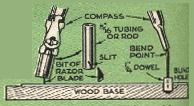
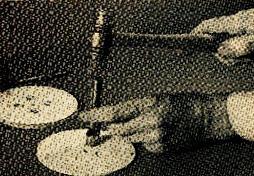
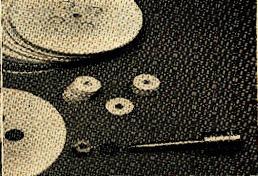
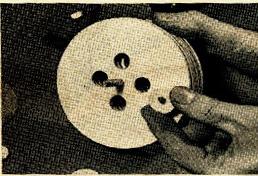
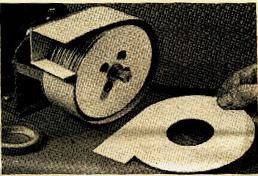
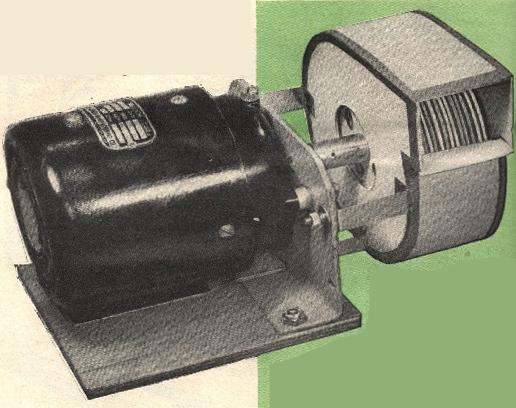
It works as a blower. Using the same disk rotor, you can build a quiet, effective little blower. It will ventilate a darkroom, cool electronic or projection equipment, or dry negatives, photo prints, or painted objects.
Made of cardboard, the blower shown produced a moderately strong breeze when mounted on a 1/30-hp. motor that runs at 1,525 r.p.m. It hurls air off the rims of its blades, drawing it in through the holes that serve as exhaust ports.
Powerhouse in a hat. Tesla's first model was so small and light for its output as to be a "powerhouse in a hat." Built in Long Island in 1906, it weighed less than 10 lbs., was about six inches in its greatest dimension, and developed 30 hp. when connected to a source of compressed air.
Its rotor consisted of eight flat metal disks 6" in diameter, spaced 1/32" apart on a 1" shaft. The housing had to be 1/64" bigger inside than the disks, for they expanded almost that much at their top speed of 35,000 r.p.m.
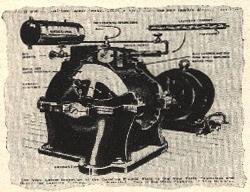
Blowtorch turbine. To dispense with the boiler, Tesla adapted his idea to an internal-combustion turbine, shown in the drawing on page 230 from a 35-year-old contemporary magazine. By the use of one-way conduits of his own design, Tesla achieved a pulse-jet effect fast enough to produce continuous rotation.
Bigger Tesla steam turbines were also built. One made in 1911 turned up 110 hp. with disks only 10" in diameter. But a 500-kw. generating unit with 60" disks suffered from metal fatigue and other ills that beset all turbines.
Because other turbines were already highly developed, it was bypassed. Except for use in an early auto speedometer, in which a driven disk partly rotated a spring-loaded one placed close to it, the principle has lain dormant.