Nikola Tesla Articles
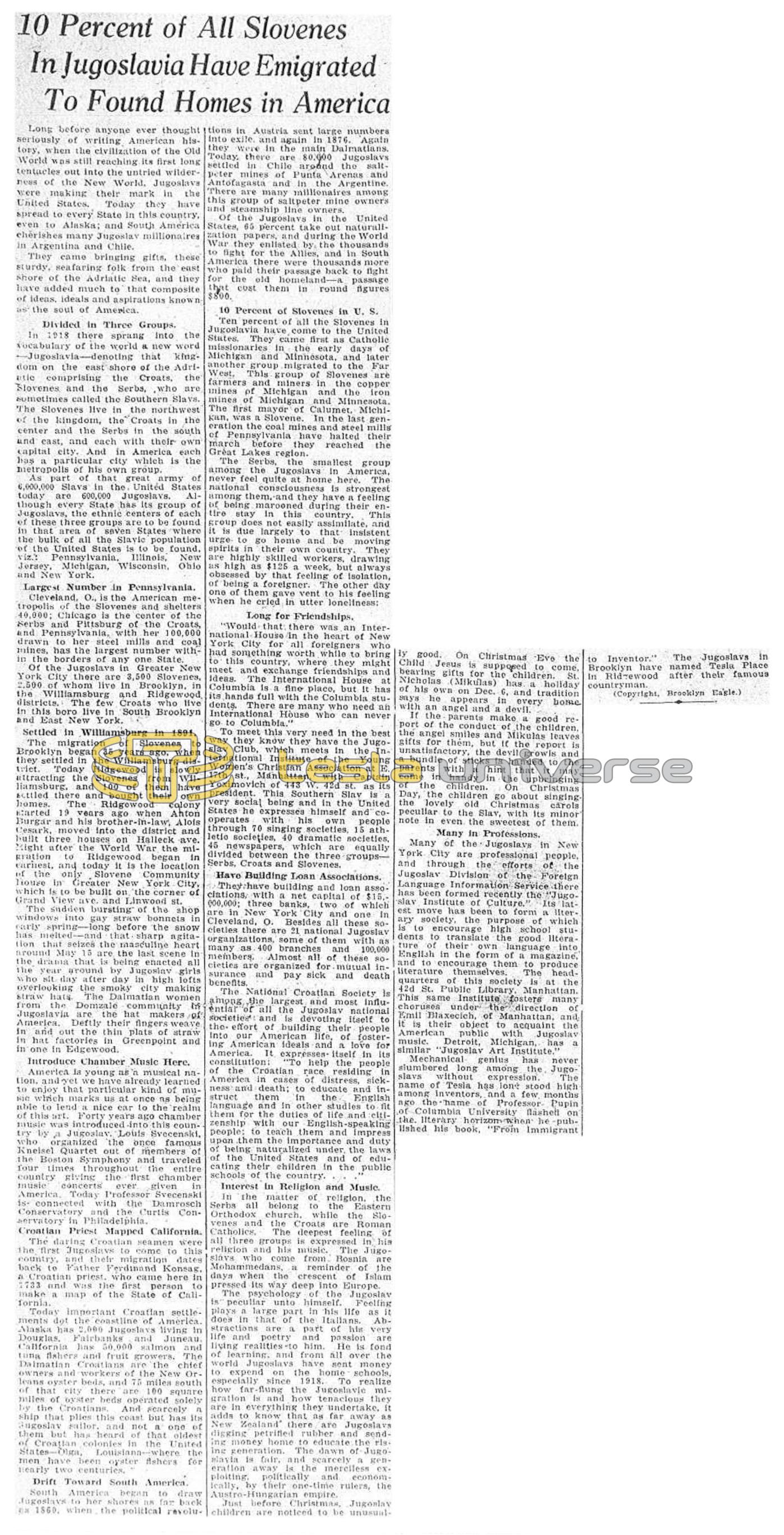
10 Percent of All Slovenes in Yugoslavia Have Emigrated to Found Homes in America
Long before anyone ever thought seriously of writing American history, when the civilization of the Old World was still reaching its first long tentacles out into the untried wilderness of the New World, Yugoslavs were making their mark in the United States. Today they have spread to every State in this country, even to Alaska; and South America cherishes many Yugoslav millionaires in Argentina and Chile.
They came bringing gifts, these sturdy, seafaring folk from the east shore of the Adriatic Sea, and they have added much to that composite of ideas, ideals and aspirations known as the soul of America.
Divided in Three Groups.
In 1918 there sprang into the vocabulary of the world a new word — Yugoslavia — denoting that kingdom on the east shore of the Adriatic comprising the Croats, the Slovenes and the Serbs, who are sometimes called the Southern Slavs. The Slovenes live in the northwest of the kingdom, the Croats in the center and the Serbs in the south and east, and each with their own capital city. And in America each has a particular city which is the metropolis of his own group.
As part of that great army of 6,000,000 Slavs in the United States today are 600,000 Yugoslavs. Although every State has its group of Yugoslavs, the ethnic centers of each of these three groups are to be found in that area of seven States where the bulk of all the Slavic population of the United States is to be found, viz.: Pennsylvania, Illinois, New Jersey, Michigan, Wisconsin, Ohio and New York.
Largest Number in Pennsylvania.
Cleveland, O., is the American metropolis of the Slovenes and shelters 40,000; Chicago is the center of the Serbs and Pittsburg of the Croats, and Pennsylvania, with her 100,000 drawn to her steel mills and coal mines, has the largest number within the borders of any one State.
Of the Yugoslavs in Greater New York City there are 3,500 Slovenes, 2,500 of whom live in Brooklyn, in the Williamsburg and Ridgewood districts. The few Croats who live in this boro live in South Brooklyn and East New York.
Settled in Williamsburg in 1891.
The migration of Slovenes to Brooklyn began 35 years ago, when they settled in the Williamsburg district. Today Ridgewood is slowly attracting the Slovenes from Williamsburg, and 100 of them have settled there and bought their own homes. The Ridgewood colony started 19 years ago when Ahton Burger and his brother-in-law, Alois Cesark, moved into the district and built three houses on Halleck ave. Right after the World War the migration to Ridgewood began in earnest, and today it is the location of the only Slovene Community House in Greater New York City, which is to be built on the corner of Grand View ave. and Linwood st.
The sudden bursting of the shop windows into gay straw bonnets in early spring — long before the snow has melted — and that sharp agitation that seizes the masculine heart around May 15 are the last scene in the drama that is being enacted all the year around by Yugoslav girls who sit day after day in high lofts overlooking the smoky city making straw hats. The Dalmatian women from the Domzale community of Yugoslavia are the hat makers of America. Deftly their fingers weave in and out the thin plats of straw in hat factories in Greenpoint and in one in Edgewood.
Introduce Chamber Music Here.
America is young as a musical nation, and yet we have already learned to enjoy that particular kind of music which marks us at once as being able to lend a nice ear to the realm of this art. Forty years ago chamber music was introduced into this country by a Yugoslav, Louis Svecenski, who organized the once famous Kneisel Quartet out of members of the Boston Symphony and traveled four times throughout the entire country giving the first chamber music concerts ever given in America. Today Professor Svecenski is connected with the Damrosch Conservatory and the Curtis Conservatory in Philadelphia.
Croatian Priest Mapped California.
The daring Croatian seamen were the first Yugoslavs to come to this country, and their migration dates back to Father Ferdinand Konsag, a Croatian priest, who came here in 1733 and was the first person to make a map of the State of California.
Today important Croatian settlements dot the coastline of America. Alaska has 2,000 Yugoslavs living in Douglas, Fairbanks and Juneau. California has 30,000 salmon and tuna fishers and fruit growers. The Dalmatian Croatians are the chief owners and workers of the New Orleans oyster beds, and 75 miles south of that city there are 100 square miles of oyster beds operated solely by the Croatians. And scarcely a ship that plies this coast but has its Yugoslav sailor, and not a one of them but has heard of that oldest of Croatian colonies in the United States — Olga, Louisiana — where the men have been oyster fishers for nearly two centuries.
Drift Toward South America.
South America began to draw Yugoslavs to her shores as far back as 1869, when the political revolutions in Austria sent large numbers into exile, and again in 1876. Again they were in the main Dalmatians. Today there are 80,000 Yugoslavs settled in Chile around the saltpeter mines of Punta Arenas and Antofagasta and in the Argentine. There are many millionaires among this group of saltpeter mine owners and steamship line owners.
Of the Yugoslavs in the United States, 65 percent take out naturalization papers, and during the World War they enlisted by the thousands to fight for the Allies, and in South America there were thousands more who paid their passage back to fight for the old homeland — a passage that cost them in round figures $800.
10 Percent of Slovenes in U. S.
Ten percent of all the Slovenes in Yugoslavia have come to the United States. They came first as Catholic missionaries in the early days of Michigan and Minnesota, and later another group migrated to the Far West. This group of Slovenes are farmers and miners in the copper mines of Michigan and the iron mines of Michigan and Minnesota. The first mayor of Calumet, Michigan, was a Slovene. In the last generation the coal mines and steel mills of Pennsylvania have halted their march before they reached the Great Lakes region.
The Serbs, the smallest group among the Yugoslavs in America, never feel quite at home here. The national consciousness is strongest among them, and they have a feeling of being marooned during their entire stay in this country. This group does not easily assimilate, and it is due largely to that insistent urge to go home and be moving spirits in their own country. They are highly skilled workers, drawing as high as $125 a week, but always obsessed by that feeling of isolation, of being a foreigner. The other day one of them gave vent to his feeling when he cried in utter loneliness:
Long for Friendships.
“Would that there was an International House in the heart of New York City for all foreigners who had something worth while to bring to this country, where they might meet and exchange friendships and ideas. The International House at Columbia is a fine place, but it has its hands full with the Columbia students. There are many who need an International House who can never go to Columbia.”
To meet this very need in the best way they know they have the Yugoslav Club, which meets in the International Institute of the Young Women’s Christian Association at E. 17th st., Manhattan, with Captain Yoximovich of 443 W. 42d st. as its president. This Southern Slav is a very social being and in the United States he expresses himself and cooperates with his own people through 70 singing societies, 15 athletic societies, 40 dramatic societies, 45 newspapers, which are equally divided between the three groups — Serbs, Croats and Slovenes.
Have Building Loan Associations.
They have building and loan associations, with a net capital of $15,000,000; three banks, two of which are in New York City and one in Cleveland, O. Besides all these societies there are 21 national Yugoslav organizations, some of them with as many as 400 branches and 100,000 members. Almost all of these societies are organized for mutual insurance and pay sick and death benefits.
The National Croatian Society is among the largest and most influential of all the Yugoslav national societies and is devoting itself to the effort of building their people into our American life, of fostering American ideals and a love for America. It expresses itself in its constitution: “To help the people of the Croatian race residing in America in cases of distress, sickness and death; to educate and instruct them in the English language and in other studies to fit them for the duties of life and citizenship with our English-speaking people; to teach them and impress upon them the importance and duty of being naturalized under the laws of the United States and of educating their children in the public schools of the country.”
Interest in Religion and Music.
In the matter of religion, the Serbs all belong to the Eastern Orthodox church, while the Slovenes and the Croats are Roman Catholics. The deepest feeling of all three groups is expressed in his religion and his music. The Yugoslavs who come from Bosnia are Mohammedans, a reminder of the days when the crescent of Islam pressed its way deep into Europe.
The psychology of the Yugoslav is peculiar unto himself. Feeling plays a large part in his life as it does in that of the Italians. Abstractions are a part of his very life and poetry and passion are living realities to him. He is fond of learning, and from all over the world Yugoslavs have sent money to expend on the home schools, especially since 1918. To realize how far-flung the Yugoslavic migration is and how tenacious they are in everything they undertake, it adds to know that as far away as New Zealand there are Yugoslavs digging petrified rubber and sending money home to educate the rising generation. The dawn of Yugoslavia is fair, and scarcely a generation away is the merciless exploiting, politically and economically, by their one-time rulers, the Austro-Hungarian empire.
Just before Christmas, Yugoslav children are noticed to be unusually good. On Christmas Eve the Child Jesus is supposed to come, bearing gifts for the children. St. Nicholas (Mikulas) has a holiday of his own on Dec. 6, and tradition says he appears in every home with an angel and a devil.
If the parents make a good report of the conduct of the children, the angel smiles and Mikulas leaves gifts for them, but if the report is unsatisfactory, the devil growls and a bundle of sticks is handed to the parents with a hint that it may come in handy in the upbringing of the children. On Christmas Day, the children go about singing the lovely old Christmas carols peculiar to the Slav, with its minor note in even the sweetest of them.
Many in Professions.
Many of the Yugoslavs in New York City are professional people, and through the efforts of the Yugoslav Division of the Foreign Language Information Service there has been formed recently the “Yugoslav Institute of Culture.” Its latest move has been to form a literary society, the purpose of which is to encourage high school students to translate the good literature of their own language into English in the form of a magazine, and to encourage them to produce literature themselves. The headquarters of this society is at the 42d St. Public Library, Manhattan. This same Institute fosters many choruses under the direction of Emil Blaxceich, of Manhattan, and it is their object to acquaint the American public with Yugoslav music. Detroit, Michigan, has a similar “Yugoslav Art Institute.”
Mechanical genius has never slumbered long among the Yugoslavs without expression. The name of Tesla has long stood high among inventors, and a few months ago the name of Professor Pupin of Columbia University flashed on the literary horizon when he published his book, “From Immigrant to Inventor.” The Yugoslavs in Brooklyn have named Tesla Place in Ridgewood after their famous countryman.
(Copyright, Brooklyn Eagle.)