Nikola Tesla Articles
Are Fathers of Industry
Men Whose Discoveries Have Created New Fields of Business.
MANY GREAT NAMES
Edison, Westinghouse, Tesla, Fritz, Acheson and Others.
(Copyright, 1911, by E. J. Edwards.)
There is a considerable company of men living today to whom the title of father of industry may be accorded — men who by their inventions and discoveries and their practical application of these have created new fields of business.
Thomas A. Edison, the father of the electric-lighting industry and the phonograph business, to mention only two of his industrial creations, is undoubtedly the most illustrious of these.
Alexander Graham Bell, the inventor of the telephone, is one of the most distinguished, although with regard to the telephone business it may be said that Theodore N. Vail, a business-man rather than a man of science, is the father of it as a great unified system.
To William Marconi belongs the honor of being the father of wireless telegraphy, only a few years ago a scientific curiosity, now a regular business.
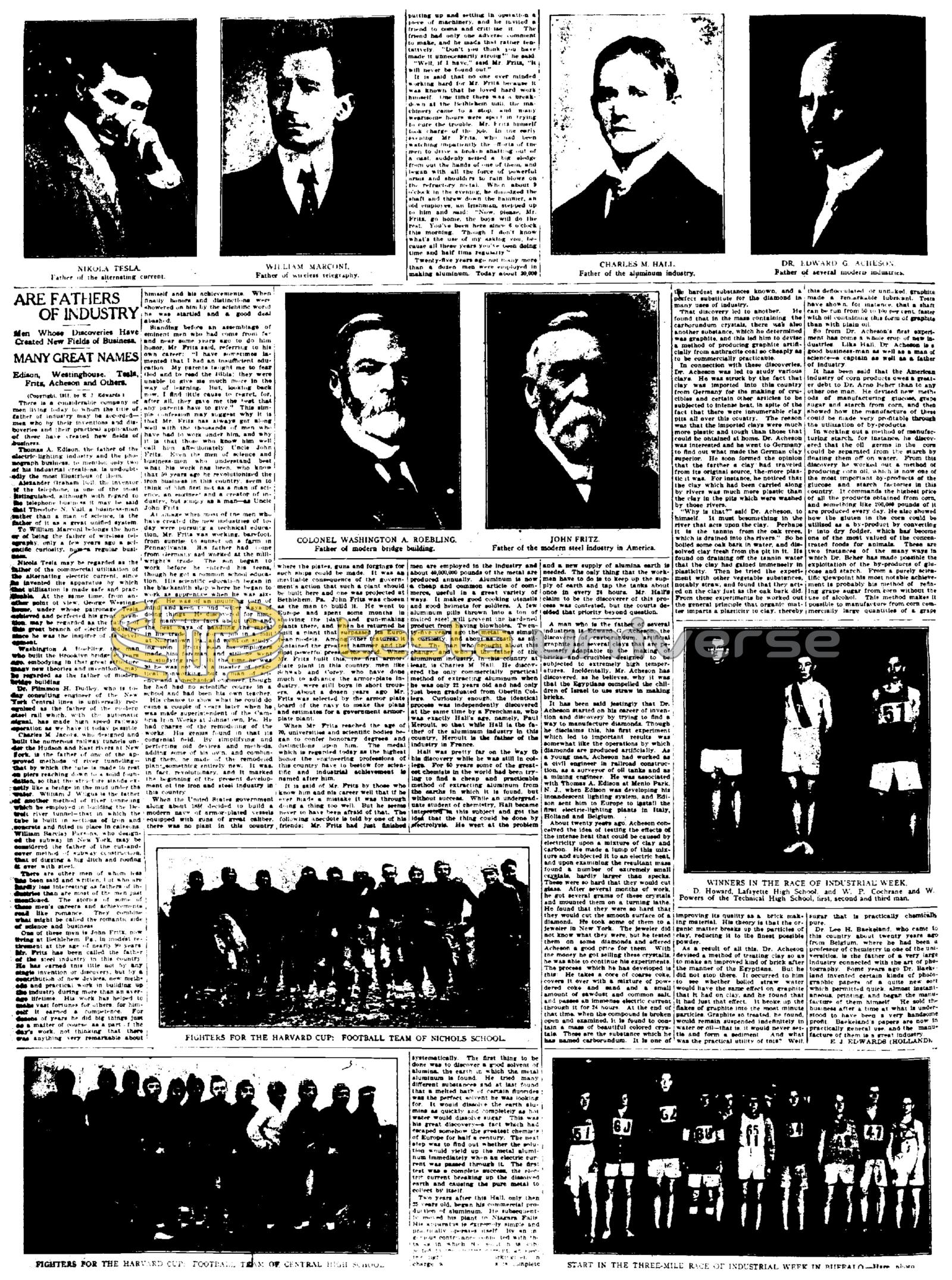
Nicola Tesla may be regarded as the father of the commercial utilization of the alternating electric current, since he invented the apparatus by which that utilization is made safe and practicable. At the same time, from another point of view, George Westinghouse, under whose patronage Tesla labored and perfected his great invention, may be regarded as the father of this great branch of electric industry, since he was the inspirer of its development.
Washington A. Roebling, the man who built the Brooklyn bridge 40 years ago, embodying in that great structure many new theories and inventions, may be regarded as the father of modern bridge building.
Dr. Plimmon H. Dudley, who is today consulting engineer of the New York Central lines, is universally recognized as the father of the modern steel rail which, with its automatic signal, has made high speed railway operation as we have it today possible.
Charles M. Jacobs, who designed and built the numerous railway tunnels under the Hudson and East rivers at New York, is the father of one of the approved methods of river tunnelling — that by which the tube is made to rest on piers reaching down to a solid foundation, so that the structure stands exactly like a bridge in the mud under the water. William J. Wilgus is the father of another method of river tunnelling which he employed in building the Detroit river tunnel — that in which the tube is built in sections of iron and concrete and tiled in place in caissons.
William Barclay Parsons, who designed the subway in New York, may be considered the father of the cut-and-cover method of subway construction, that of digging a big ditch and roofing it over with steel.
There are other men of whom less has been said and written, but who are hardly less interesting as fathers of industries than are most of the men just mentioned. The stories of some of these men’s careers and achievements read like romance. They combine what might be called the romantic side of science and business.
One of these men is John Fritz, now living at Bethlehem, Pa., in modest retirement at the age of nearly 90 years. Mr. Fritz has been called the father of the steel industry in this country. He has earned this title not by any single invention or discovery, but by a contribution of new devices, new methods and practical work in building up the industry during more than an average lifetime. His work has helped to make vast fortunes for others, for himself it earned a competence. For dozens of years he did big things just as a matter of course, as a part of the day’s work, not thinking that there was anything very remarkable about himself and his achievements. When finally honors and distinctions were showered on him by the scientific world he was startled and a good deal abashed.
Standing before an assemblage of eminent men who had come from far and near some years ago to do him honor, Mr. Fritz said, referring to his own career: “I have sometimes lamented that I had an insufficient education. My parents taught me to fear God and to read the Bible; they were unable to give me much more in the way of learning. But, looking back now, I find little cause to regret, for, after all, they gave me the best that any parents have to give.” This simple confession may suggest why it is that Mr. Fritz has always got along well with the thousands of men who have had to work under him, and why it is that those who know him well call him affectionately Uncle John Fritz. Even the men of science and business-men who understand best what his work has been, who know that 50 years ago he revolutionized the iron business in this country, seem to think of him first not as a man of science, an engineer and a creator of industry, but simply as a man — as Uncle John Fritz.
At an age when most of the men who have created the new industries of today were pursuing a technical education, Mr. Fritz was working, barefoot, from sunrise to sunset on a farm in Pennsylvania. His father had come from Germany and worked at the millwright’s trade. The son began to work before he entered his teens, though he got a common school education. His scientific education began in the blacksmith shop where he began to work as apprentice when he was sixteen. He was of an inquiring turn of mind and keen to find better ways of doing things. He discovered for himself many of the facts about iron and the best ways of handling the metal in his trade. He got a job in a mill at Norristown, Pa., and went on studying iron. Pretty soon his employers made him foreman, and still he went on studying iron. By the time he was 30 he was not only a master of practical ironworking, but a man of science and a mechanical engineer, though he had had no scientific course in a school and had been his own teacher.
His chance to show what he could do came a couple of years later when he was made superintendent of the Cambria Iron Works at Johnstown, Pa. He had charge of the remodelling of the works. His genius found in that its congenial field. By simplifying and perfecting old devices and methods, adding some of his own, and combining them, he made of the remodeled plant something entirely new. It was, in fact, revolutionary, and it marked the beginning of the present development of the iron and steel industry in this country.
When the United States government along about 1885 decided to build a modern navy of armor-plated vessels equipped with guns of great caliber, there was no plant in this country where the plates, guns and forgings for such ships could be made. It was an inevitable consequence of the government’s action that such a plant should be built here and one was projected at Bethlehem, Pa. John Fritz was chosen as the man to build it. He went to Europe and spent some months in studying the plate and gun-making plants there, and when he returned he built a plant that surpassed its European models. Among other features, it contained the greatest hammer and the most powerful presses in the world. When Mr. Fritz built this, the first armor-plate plant in this country, men like Schwab and Corey, who have done much to advance the armor-plate industry, were still boys in short trousers. About a dozen years ago Mr. Fritz was selected by the armor plate board of the navy to make the plans and estimates for a government armor-plate plant.
When Mr. Fritz reached the age of 70, universities and scientific bodies began to confer honorary degrees and distinctions upon him. The medal which is regarded today as the highest honor the engineering professions of this country have to bestow for scientific and industrial achievement is named after him.
It is said of Mr. Fritz by those who know him and his career well that if he ever made a mistake it was through doing a thing too well. But he seems never to have been afraid of that. The following anecdote is told by one of his friends: Mr. Fritz had just finished putting up and setting in operation a piece of machinery, and he invited a friend to come and criticise it. The friend had only one adverse comment to make, and he made that rather hesitatively. “Don’t you think you have made it unnecessarily strong?” he said. “Well, if I have,” said Mr. Fritz, “it will never be found out.”
It is said that no one ever minded working hard for Mr. Fritz because it was known that he loved hard work himself. One time there was a breakdown at the Bethlehem mill, the machinery came to a stop, and many wearisome hours were spent in trying to cure the trouble. Mr. Fritz himself took charge of the job. In the early evening Mr. Fritz, who had been watching impatiently the efforts of the men to drive a broken shafting out of a cast, suddenly seized a big sledge from out the hands of one of them, and began with all the force of powerful arms and shoulders to rain blows on the refractory metal. When about 9 o’clock in the evening, he dislodged the shaft and threw down the hammer, an old employee, an Irishman, stepped up to him and said: “Now, please, Mr. Fritz, go home, the boys will do the rest. You’ve been here since 6 o’clock this morning. Though I don’t know what’s the use of my asking you, because all these years you’ve been doing time and half time regularly.”
Twenty-five years ago not many more than a dozen men were employed in making aluminum. Today about 30,000 men are employed in the industry and about 40,000,000 pounds of the metal are produced annually. Aluminum is now a cheap and common article of commerce, useful in a great variety of ways. It makes good cooking utensils and good helmets for soldiers. A few aluminum pills thrown into a ton of melted steel will prevent the hardened product from having blowholes. Twenty-five years ago the metal was simply a curiosity, and about as costly as silver. The man who brought about this change, and who is the father of the aluminum industry, in this country at least, is Charles M. Hall. He discovered the only commercially practical method of extracting aluminum when he was only 22 years old and had only just been graduated from Oberlin College. Curiously enough, the identical process was independently discovered at the same time by a Frenchman, who was exactly Hall’s age, namely, Paul Heroult, so that while Hall is the father of the aluminum industry in this country, Heroult is the father of the industry in France.
Hall was pretty far on the way to his discovery while he was still in college. For 60 years some of the greatest chemists in the world had been trying to find a cheap and practicable method of extracting aluminum from the earths in which it is found, but without success. While an undergraduate student of chemistry, Hall became interested in this subject and got the idea that the thing could be done by electrolysis. He went at the problem systematically. The first thing to be done was to discover a good solvent of alumina, the earth in which the metal aluminum is found. He tried many different substances and at last found that a melted bath of certain fluorides was the perfect solvent he was looking for. It would dissolve the earth alumina as quickly and completely as hot water would dissolve sugar. This was his great discovery — a fact which had escaped somehow the greatest chemists of Europe for half a century. The next step was to find out whether the solution would yield up the metal aluminum immediately when an electric current was passed through it. The first test was a complete success, the electric current breaking up the dissolved earth and causing the pure metal to collect by itself.
Two years after this Hall, only then 25 years old, began his commercial production of aluminum. He subsequently moved his plant to Niagara Falls. His apparatus is extremely simple and practically operates itself. By an ingenious contrivance connected with the tanks in which ... is complete and a new supply of alumina earth is needed. The only thing that the workmen have to do is to keep up the supply of earth and tap the tanks about once in every 24 hours. Mr. Hall’s claim to be the discoverer of this process was contested, but the courts decided that priority beyond question.
A man who is the father of several industries is Edward G. Acheson, the discoverer of carborundum, artificial graphite and several clays that are peculiarly adaptable to the making of bricks and crucibles designed to be subjected to extremely high temperatures. Incidentally, Mr. Acheson has discovered, as he believes, why it was that the Egyptians compelled the children of Israel to use straw in making bricks.
It has been said jestingly that Dr. Acheson started on his career of invention and discovery by trying to find a way to manufacture diamonds. Though he disclaims this, his first experiment which led to important results was somewhat like the operations by which diamonds are produced artificially. As a young man, Acheson had worked as a civil engineer in railroad construction, as a surveyor of oil tanks and as a mining engineer. He was associated with Thomas A. Edison at Menlo Park, N. J., when Edison was developing his incandescent lighting system, and Edison sent him to Europe to install the first electric-lighting plants in Italy, Holland and Belgium.
About twenty years ago, Acheson conceived the idea of testing the effects of the intense heat that could be caused by electricity upon a mixture of clay and carbon. He made a lump of this mixture and subjected it to an electric heat, and upon examining the resultant mass found a number of extremely small crystals, hardly larger than specks. These were so hard that they would cut glass. After several months of work, he got several grams of these crystals and mounted them on a turning lathe. He found that they were so hard that they would cut the smooth surface of a diamond. He took some of them to a jeweler in New York. The jeweler did not know what they were, but he tested them on some diamonds and offered Acheson a good price for them. With the money he got selling these crystals, he was able to continue his experiments. The process which he has developed is this: He takes a core of coarse coke, covers it over with a mixture of powdered coke and sand and a small amount of sawdust and common salt, and passes an immense electric current through it for 24 hours. At the end of that time, when the compound is broken open and examined, it is found to contain a mass of beautiful colored crystals. These are the substance which he has named carborundum. It is one of the hardest substances known, and a perfect substitute for the diamond in many uses of industry.
That discovery led to another. He found that in the mass containing the carborundum crystals, there was also another substance, which he determined was graphite, and this led him to devise a method of producing graphite artificially from anthracite coal so cheaply as to be commercially practicable.
In connection with these discoveries, Dr. Acheson was led to study various clays. He was struck by the fact that clay was imported into this country from Germany for the making of crucibles and certain other articles to be subjected to intense heat, in spite of the fact that there were innumerable clay pits all over this country. The reason was that the imported clays were much more plastic and tough than those that could be obtained at home. Dr. Acheson was interested and he went to Germany to find out what made the German clay superior. He soon formed the opinion that the farther a clay had traveled from its original source, the more plastic it was. For instance, he noticed that the clay which had been carried along by rivers was much more plastic than the clay in the pits which were washed by those rivers.
“Why is that?” said Dr. Acheson, to himself. “It must be something in the river that acts upon the clay. Perhaps it is the tannin from the oak trees, which is drained into the rivers.” So he boiled some oak bark in water, and dissolved clay fresh from the pit in it. He found on draining off the tannin water that the clay had gained immensely in plasticity. Then he tried the experiment with other vegetable substances, notably straw, and found that they acted on the clay just as the oak bark did. From these experiments he worked out the general principle that organic matter imparts a plasticity to clay, thereby improving its quality as a brick making material. His theory is that the organic matter breaks up the particles of clay, reducing it to the finest possible powder.
As a result of all this, Dr. Acheson devised a method of treating clay so as to make an improved kind of brick after the manner of the Egyptians. But he did not stop there. It occurred to him to see whether boiled straw water would have the same effect on graphite that it had on clay, and he found that it had just that effect. It broke up the flakes of graphite into the most minute particles. Graphite so treated, he found, would remain suspended indefinitely in water or oil — that is, it would never settle and form a sediment. And what was the practical utility of this? Well, this deflocculated or unflaked graphite made a remarkable lubricant. Tests have shown, for instance, that a shaft can be run from 50 to 100 per cent. faster with oil containing this form of graphite than with plain oil.
So from Dr. Acheson’s first experiment has come a whole crop of new industries. Like Hall, Dr. Acheson is a good business-man as well as a man of science — a captain as well as a father of industry.
It has been said that the American industry of corn products owes a greater debt to Dr. Arno Behr than to any other one man. He devised new methods of manufacturing glucose, grape sugar and starch from corn, and then showed how the manufacture of these could be made very profitable through the utilization of by-products.
In working out a method of manufacturing starch, for instance, he discovered that the oil germs in the corn could be separated from the starch by floating them off on water. From this discovery he worked out a method of producing corn oil, which is now one of the most important by-products of the glucose and starch factories in this country. It commands the highest price of all the products obtained from corn, and something like 200,000 pounds of it are produced every day. He also showed how the gluten in the corn could be utilized as a by-product by converting it into dry fodder, which has become one of the most valued of the concentrated foods for animals. These are two instances of the many ways in which Dr. Behr has made possible the exploitation of the by-products of glucose and starch. From a purely scientific viewpoint his most notable achievement is probably his method of refining grape sugar from corn without the use of alcohol. This method makes it possible to manufacture from corn commercially large quantities of a grape sugar that is practically chemically pure.
Dr. Leo H. Baekeland, who came to this country about twenty years ago from Belgium, where he had been a professor of chemistry in one of the universities, is the father of a very large industry connected with the art of photography. Some years ago Dr. Baekeland invented certain kinds of photographic papers of a quite new sort which permitted quick, almost instantaneous, printing, and began the manufacture of them himself. He sold the business after a time at what is understood to have been a very handsome profit. Baekeland’s papers are now in practically general use, and the manufacture of them is a great industry.
E. J. EDWARDS (HOLLAND).