Nikola Tesla Articles
Chroniclings
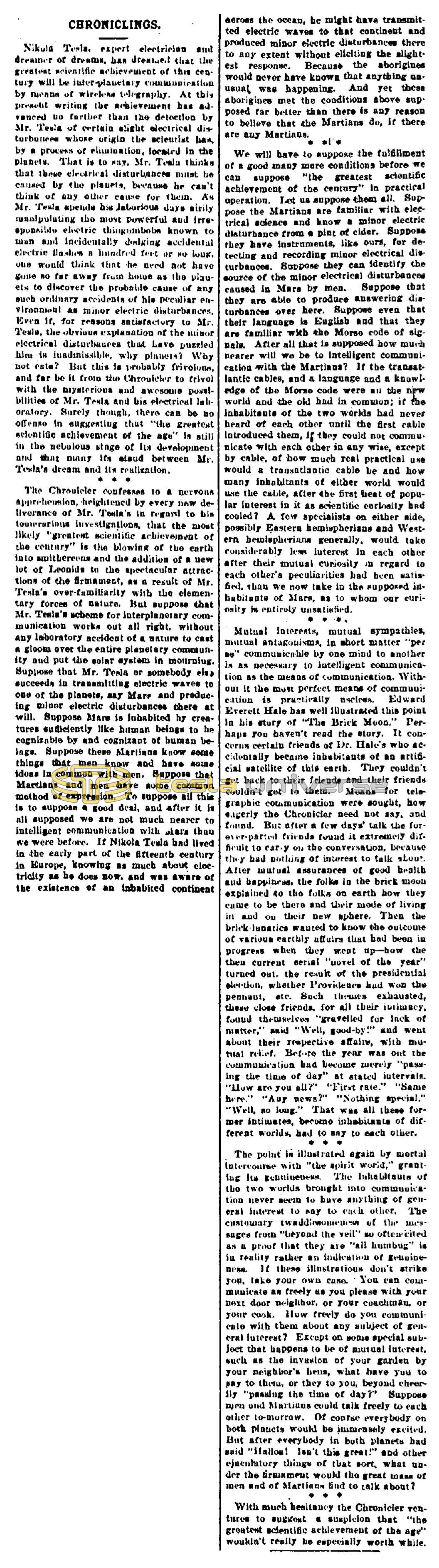
Nikola Tesla, expert electrician and dreamer of dreams, has dreamed that the greatest scientific achievement of this century will be inter-planetary communication by means of wireless telegraphy. At this present writing the achievement has advanced no farther than the detection by Mr. Tesla of certain slight electrical disturbances whose origin the scientist has, by a process of elimination, located in the planets. That is to say, Mr. Tesla thinks that these electrical disturbances must be caused by the planets, because he can’t think of any other cause for them. As Mr. Tesla spends his laborious days nimbly manipulating the most powerful and irresponsible electric thingumbobs known to man and incidentally dodging accidental electric flashes a hundred feet or so long, one would think that he need not have gone so far away from home as the planets to discover the probable cause of any such ordinary accidents of his peculiar environment as minor electric disturbances. Even if, for reasons satisfactory to Mr. Tesla, the obvious explanation of the minor electrical disturbances that have puzzled him is inadmissible, why planets? Why not cats? But this is probably frivolous, and far be it from the Chronicler to trivol with the mysterious and awesome possibilities of Mr. Tesla and his electrical laboratory. Surely though, there can be no offense in suggesting that “the greatest scientific achievement of the age” is still in the nebulous stage of its development and that many ifs stand between Mr. Tesla’s dream and its realization.
The Chronicler confesses to a nervous apprehension, heightened by every new deliverance of Mr. Tesla’s in regard to his temerarious investigations, that the most likely “greatest scientific achievement of the century” is the blowing of the earth into smithereens and the addition of a new lot of Leonids to the spectacular attractions of the firmament, as a result of Mr. Tesla’s over-familiarity with the elementary forces of nature. But suppose that Mr. Tesla’s scheme for interplanetary communication works out all right, without any laboratory accident of a nature to cast a gloom over the entire planetary community and put the solar system in mourning. Suppose that Mr. Tesla or somebody else succeeds in transmitting electric waves to one of the planets, say Mars, and producing minor electric disturbances there at will. Suppose Mars is inhabited by creatures sufficiently like human beings to be cognizable by and cognizant of human beings. Suppose these Martians know some things that men know and have some ideas in common with men. Suppose that Martians and men have some common method of expression. To suppose all this is to suppose a good deal, and after it is all supposed we are not much nearer to intelligent communication with Mars than we were before. If Nikola Tesla had lived in the early part of the fifteenth century in Europe, knowing as much about electricity as he does now, and was aware of the existence of an inhabited continent across the ocean, he might have transmitted electric waves to that continent and produced minor electric disturbances there to any extent without eliciting the slightest response. Because the aborigines would never have known that anything unusual was happening. And yet these aborigines met the conditions above supposed far better than there is any reason to believe that the Martians do, if there are any Martians.
We will have to suppose the fulfillment of a good many more conditions before we can suppose “the greatest scientific achievement of the century” in practical operation. Let us suppose them all. Suppose the Martians are familiar with electrical science and know a minor electric disturbance from a pint of cider. Suppose they have instruments, like ours, for detecting and recording minor electrical disturbances. Suppose they can identify the source of the minor electrical disturbances caused in Mars by men. Suppose that they are able to produce answering disturbances over here. Suppose even that their language is English and that they are familiar with the Morse code of signals. After all that is supposed how much nearer will we be to intelligent communication with the Martians? If the transatlantic cables, and a language and a knowledge of the Morse code were all the new world and the old had in common; if the inhabitants of the two worlds had never heard of each other until the first cable introduced them, if they could not communicate with each other in any wise, except by cable, of how much real practical use would a transatlantic cable be and how many inhabitants of either world would use the cable, after the first heat of popular interest in it as scientific curiosity had cooled? A few specialists on either side, possibly Eastern hemispherians and Western hemispherians generally, would take considerably less interest in each other after their mutual curiosity in regard to each other’s peculiarities had been satisfied, than we now take in the supposed inhabitants of Mars, as to whom our curiosity is entirely unsatisfied.
Mutual interests, mutual sympathies, mutual antagonisms, in short matter “per se” communicable by one mind to another is as necessary to intelligent communication as the means of communication. Without it the most perfect means of communication is practically useless. Edward Everett Hale has well illustrated this point in his story of “The Brick Moon.” Perhaps you haven’t read the story. It concerns certain friends of Dr. Hale’s who accidentally became inhabitants of an artificial satellite of this earth. They couldn’t get back to their friends and their friends couldn’t get to them. Means for telegraphic communication were sought, how eagerly the Chronicler need not say, and found. But after a few days’ talk the forever-parted friends found it extremely difficult to carry on the conversation, because they had nothing of interest to talk about. After mutual assurances of good health and happiness, the folks in the brick moon explained to the folks on earth how they came to be there and their mode of living in and on their new sphere. Then the brick-lunatics wanted to know the outcome of various earthly affairs that had been in progress when they went up—how the then current serial “novel of the year” turned out, the result of the presidential election, whether Providence had won the pennant, etc. Such themes exhausted, these close friends, for all their intimacy, found themselves “gravelled for lack of matter,” said “Well, good-by” and went about their respective affairs, with mutual relief. Before the year was out the communication had become merely “passing the time of day” at stated intervals. “How are you all?” “First rate.” “Same here.” “Any news?” “Nothing special.” “Well, so long.” That was all these former intimates, become inhabitants of different worlds, had to say to each other.
The point is illustrated again by mortal intercourse with “the spirit world,” granting its genuineness. The inhabitants of the two worlds brought into communication never seem to have anything of general interest to say to each other. The customary twaddlesomeness of the messages from “beyond the veil” so often cited as a proof that they are “all humbug” is in reality rather an indication of genuineness. If these illustrations don’t strike you, take your own case. You can communicate as freely as you please with your next door neighbor, or your coachman, or your cook. How freely do you communicate with them about any subject of general interest? Except on some special subject that happens to be of mutual interest, such as the invasion of your garden by your neighbor’s hens, what have you to say to them, or they to you, beyond cheerily “passing the time of day?” Suppose men and Martians could talk freely to each other to-morrow. Of course everybody on both planets would be immensely excited. But after everybody on both planets had said “Hallo! Isn’t this great!” and other ejaculatory things of that sort, what under the firmament would the great mass of men and of Martians find to talk about?
With much hesitancy the Chronicler ventures to suggest a suspicion that “the greatest scientific achievement of the age” wouldn’t really be especially worth while.