Nikola Tesla Articles
In the Footsteps of Genius Page 10
Galaxy - September 1st, 1984
precious time. He considered, and so he announced, that an electric train, on suitable rails, would attain speeds of over 300 kilometers an hour.
His idea was realized in Japan, and then in France only two or three years ago.
While Tesla was making great strides, the Americans carefully followed the events in Cuba, where the Spaniards were committing “unprecedented torture upon the friendly Cuban people.” Thanks to the “sensationalistic exaggeration” of American reports from Cuba, the Congress of the United States, by a narrow majority, decided to declare war on Spain.
The first automaton
The day for which Tesla had long prepared and worked came in the midst of wartime neurosis. The first exhibition of electronics at the New York Madison Square Garden was already delayed, and some of the exhibits could not arrive because the roads were blocked by military convoys. Despite the shadow of a great event and the rainy weather, about 15,000 people came to the exhibition.
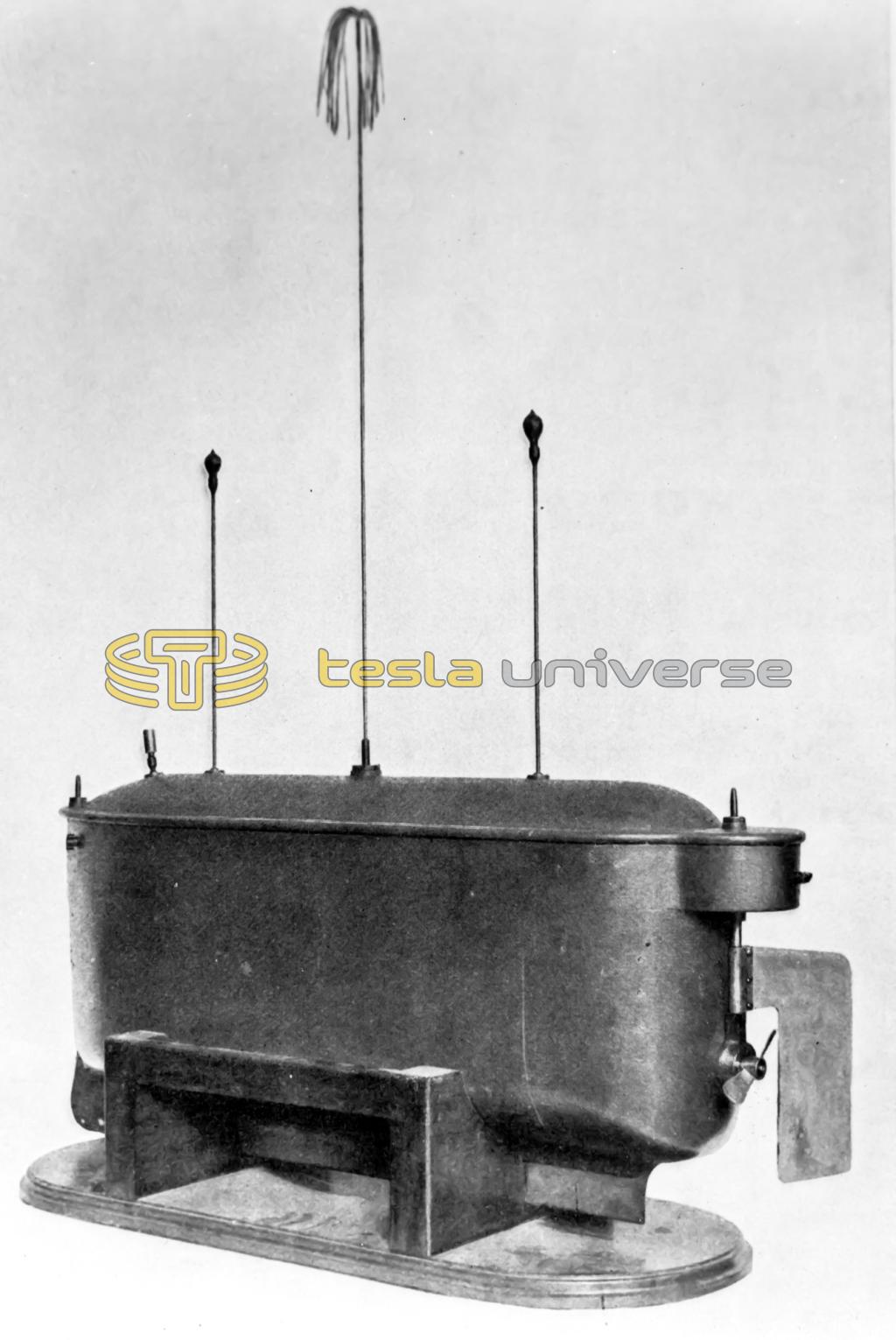
The demonstration of the first radio-controlled boat-robot, Tesla’s latest achievement, did not attract the attention it deserved, not only because of the wartime circumstances but also through his own fault. If he had shown only the wireless method of control, which surpassed modern radio, it would have been quite sufficient, but Tesla at the same time wanted to show a ship-robot as well. It was too great an undertaking. On that day, in 1898, by the demonstration of a forerunner of modern remote-controlled weapons and vehicles, of the automatic industry and robotics, he announced ideas which the world would not be ready to hear for years to come.
By this same principle of Tesla, the explorers of extraterrestrial space today control space vehicles.
Inventors against war
Tesla had by then already completed another school and patented the basic principle for a boat-robot under the number 613,809. The visitors to the first demonstration did not know that in the patent application the possibility of the development of a torpedo-boat without a human crew, with battery-powered motors, was also foreseen. The boat-robot could carry six torpedoes of 4 meters, set vertically in two rows. In the negotiations with the navy for the building of such boats, Tesla calculated that each of them would cost $50,000. He claimed that several boat-robots, if they floated like submarines, could destroy a whole fleet in only one hour.
Mark Twain, then on his way to Austria, wrote him that this invention of his was received with great interest. “When I was among my acquaintances,” Twain wrote, “we talked about it, and we came to the idea that we should gather all the great inventors and set them the task of inventing something against which fleets and armies would be completely helpless. Then warfare would become senseless. I have no doubt that you too, with your invention, had a similar idea. In that way, I am sure, lasting peace and complete disarmament could be established in the world.”15
Tesla’s concept, however, was judged even in American military circles as still another unrealizable dream.
Machines with reason
Tesla’s invention aroused suspicion among the scientists as well. In the magazine Public Opinion they criticized his work and method in an article under the title “Science and Sensationalism.”16
Nothing more favorable was written even by his acquaintance N. G. Worth, in the article “The Domestic Possibilities of Tesla’s Electrically Controlled Vehicle,” in the magazine Electrical Review.17 Tesla, however, was deeply convinced of his conception and did not even try to answer the critics.
He considered the first robots, he wrote in 1919, as forerunners of the development of teleautomatics. “The next logical improvement is their application in automatic mechanisms which would function at great distances from a control center. For example, an airplane could be launched, sent on a determined course to a task, and carry out predicted operations hundreds of kilometers away from the base.”18
Of such an airplane Tesla dreamed even in his student days. His airplane of the future, to which he later devoted much more attention, would have no propellers, wings, or any other external mechanism. It would be driven mechanically or with the help of energy which it would receive by wireless.
They thought I was mad
In 1898 he proposed the production of an automatic automobile. “The cars could carry out a series of usual and some new operations, but at the time when I advocated this they considered me a madman, and nothing came of it.”
Reflecting on robots, he believed that their greatest possible significance lay in their peaceful service to humanity. “I have tried to look at the whole field as broadly as possible, not limiting myself only to remote control but also to the development of such a kind of robot which would operate independently, relying on its own intelligence. I have devoted much time to this, and now I believe that the day is not far when I shall be able to show machines which, left to themselves, will behave as if they possess their own power of understanding. Regardless of the practical possibilities of such an achievement, it would mark the beginning of a new epoch in mechanics.”19
Tesla, creator of the computer?
The explorers of modern computer technology in the second half of the twentieth century were often, wishing to patent patents in this field, unpleasantly surprised when they established that Tesla had already patented many inventions. Although Tesla contributed first to the development of computer technology in many ways, much less is known of it today than of Brattain, Bardeen and Shockley, who with the invention of the transistor made electronic computers possible. It is true, however, that their efforts led to the creation of computer systems with elements for logical reasoning only on the basis of Tesla’s patents. In 1903 Tesla’s patents 723,188 and 725,605 contain the basic principles of the logical AND gate. Although in Tesla’s application alternating current was foreseen, while today’s computers use pulses of direct current, the principle has remained the same.
Yet the Nobel Prize of 1956 was awarded to Bardeen, Brattain and Shockley for their work on the development of the transistor, which has in many fields replaced the electronic tubes. Only recently, and timidly, has Tesla been
