Nikola Tesla Articles
In the Footsteps of Genius Page 8
Galaxy - September 1st, 1984
work in this field has successfully passed through the phase of laboratory experiments and that he is ready for a practical test in production. The realization of his ideas would mean that energy from sources of power such as Niagara Falls will one day be able to be used in any part of the world, regardless of the distance.”10
Pupin’s disbelief
In the newspapers, reports of Tesla’s intention were published on all sides. For the journalists everything was already finished, and so headlines swarmed such as “Tesla will illuminate the whole world.”
Mihajlo Pupin too, then also in America, was convinced of the possibility of Tesla’s reports. Like the other scientists, his colleagues, he asked himself what was next in order. Many years earlier, while as a boy he was herding cattle in the Banat, he had learned the practical importance of the Earth as a conductor of sound signals. He and the other boys at night would stick a knife into the ground and take up a position for sleeping with an ear turned to the blade. In this way they could hear even the least stir and the arrival of unwelcome visitors who stole the herd at night.
Later Pupin established that with an oscillator for the production of electrical waves, with one side connected to the Earth, the waves can be transmitted over greater distances. However, to speak of sending signals by wireless to Mars — that seemed senseless to Pupin too, “for that is possible only if the acoustic resonance of the Earth is used for transmission over greater distances.”
Such and similar objections did not discourage Tesla. He was aware that he was building something which surpassed everything created up to then, and he could expect disbelief and doubt, even from his closest collaborators and friends. At that time he was persistently building “Tesla” transformers of various forms and sizes. Thus he also came to the resonant transformer, with which he produced an electromotive force of several million volts.
This transformer became the backbone of the whole idea, for it was so made that it drastically reduced the loss of energy.
The Martians statistically exist
For the application of such a device, he believed, there were no limits; a message could be sent to Mars with the same ease as to Chicago. In the Electrical Review he wrote: “Investigating in this field, I also came to the discovery of several exceptionally important facts. Atmospheric air, for example, although it is usually a perfect insulator, freely conducts a current of enormous electromotive force created in my new transformer… I also came to the conclusion that the conductivity of the air increases the more rapidly as the rarefaction of the atmosphere and the electrical pressure are greater. The conductivity reaches a level at which it becomes entirely equal to the conductivity of a copper wire.”11
Occupying himself with the conductivity of the air, Tesla came to still another, secondary discovery. He noticed that “the creation of an electromotive force of several million volts causes changes in the structure of atmospheric nitrogen so that it combines with oxygen and other elements. The changes are so dynamic and unusual,” he said, “that I often feared that it might happen that the atmosphere would suddenly ignite, which would indeed be terrible.”
The magic with which he occupied himself completely absorbed Tesla, but he was, nevertheless, always ready to answer those too who said that he was always more interested in the effects than in practical application. With the help of electrical resonance and the precise synchronization of the electrical circuit, he explained, nitrogen could be extracted from the air and a rich nitrogen fertilizer produced. Light could also be produced, “diffuse as sunlight is,” and at far less cost, with “lamps” which would never burn out.
His dreams seemed copied from Utopia: the Earth freed from hunger and thirst; communication in the world made easy; control of the climate; abundance of energy; unlimited sources of light; and last, but not least important, Tesla’s dream, a connection with the life which he believed existed on other planets. He considered that the existence of Martians “cannot statistically be called in question.”
“I am sorry, gentlemen”
In those years Tesla was investigating in the field of mechanical vibrations with the same ardor. One day in 1898, while he was testing an electromechanical oscillator, he connected it, without any previous idea, to an iron pillar which beside his window in the hotel room had been set along the whole building. He switched on the oscillator and sat down to note everything he observed. These devices always amused him, for with the increase of the frequency of the vibrations resonance would come about, first in one, and then in other objects in the workshop.
While he was noting his observations, Tesla was not aware that the vibrations were spreading through the pillar fixed in the sandy soil throughout Manhattan in all directions. (Earthquakes, usually, are always stronger farther from the epicenter.) Buildings began to sway, windows to shake, and crowds of people ran out into the streets.
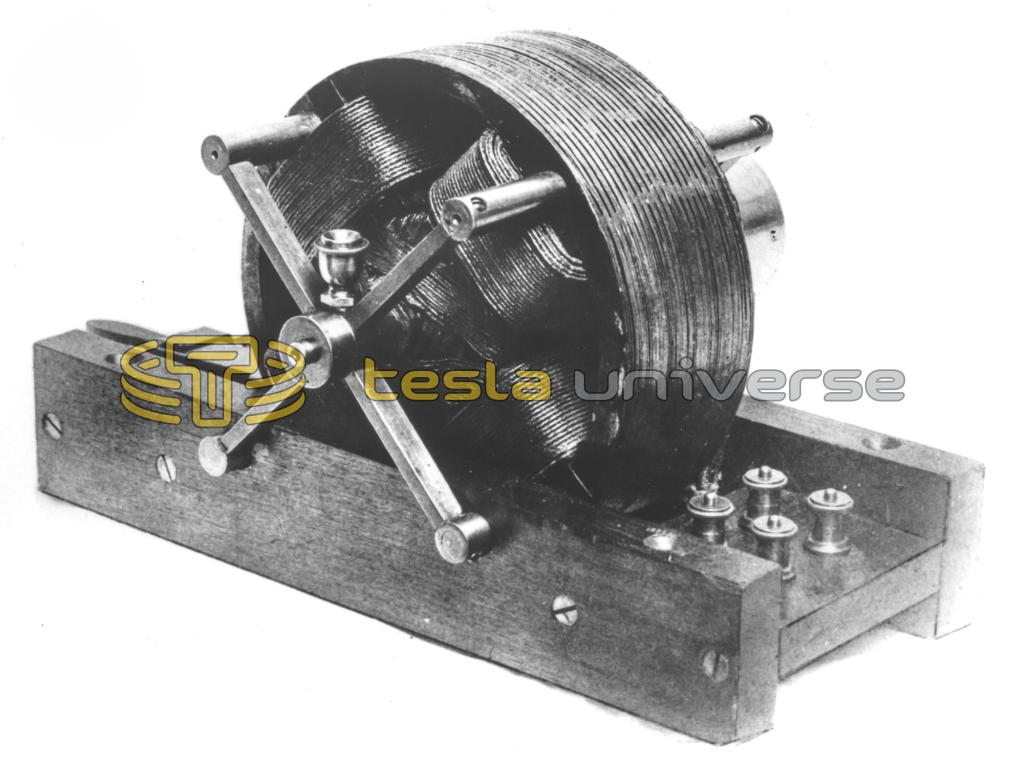
At the police station, where Tesla had already acquired the reputation of a suspicious person, they immediately realized that the “earthquake” had seized only this part of the city. Two policemen, of course, went straight to Tesla. He himself noticed that something was not in order and quickly smashed the oscillator with a hammer. At the same moment when the policemen entered his hotel room, the earthquake stopped too.
How to break a planet
“Gentlemen, I am sorry,” Tesla greeted them. “It wanted but little for you to be present at my experiment. I had to break it off suddenly in an unusual way. However, if you wish you may come this evening and I will connect the oscillators to two platforms on which you may shake to your heart’s content. Now you must leave, for I have still much to do. Good-bye, gentlemen.”12
After the policemen the journalists arrived. He told them that in a moment he could bring down the Brooklyn Bridge whenever he wished.
He really could. Encouraged by his first “success,” he made an oscillator the size of an alarm clock, put it in his pocket and went to look for a half-finished building. He found
