Nikola Tesla Articles
Great Electrical Display
(Copyright, 1896.)
TESLA, Edison, Westinghouse, Thompson, the giants of the electrical world, beside scores of others, drawn from the ranks of those who have contributed most freely to modern electrical science, are all working earnestly and harmoniously together to make the coming show of electrical appliances, to be held in New York next month, the most extraordinary scientific exhibition on record. Success will undoubtedly crown their efforts, and the fact that this will largely be due to the circumstance that there are now more wonderful things to show than ever before should not detract one whit from the praise to be awarded for the thoroughness of plan and detail and the keen appreciation of the effective that have been evinced in every step taken since the enterprise was first seriously considered.
In the matter of expense the coming show will greatly exceed all its predecessors. It will cost $150,000 to install the various machines and apparatus exhibited, and the total value of the exhibits will not be far from a half million — rather over than under. The total cost of the show, then, will be nearly $700,000, including the rent of the building.
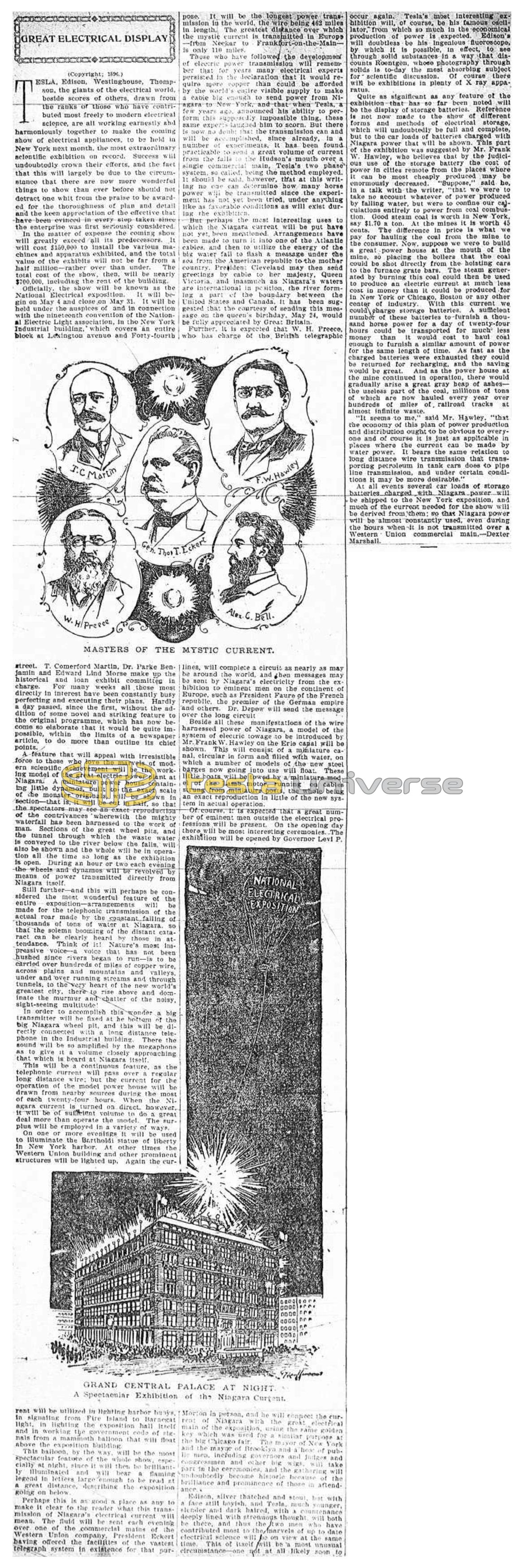
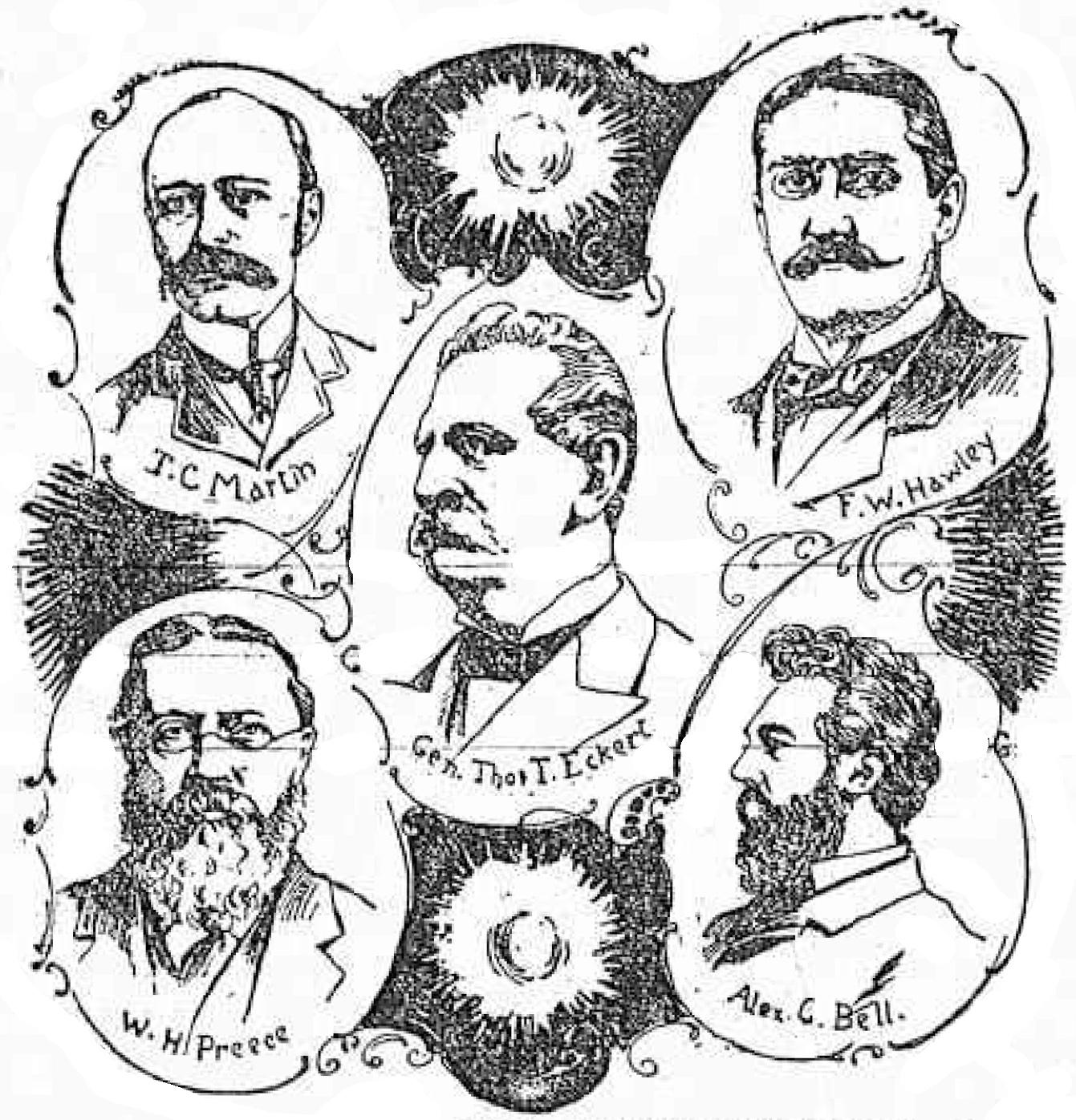
Officially, the show will be known as the National Electrical exposition. It will begin on May 4 and close on May 31. It will be held under the auspices of and in connection with the nineteenth convention of the National Electric Light association, in the New York Industrial building, which covers an entire block at Lexington avenue and Forty-fourth street. T. Comerford Martin, Dr. Parke Benjamin and Edward Lind Morse make up the historical and loan exhibit committee in charge. For many weeks all those most directly in interest have been constantly busy perfecting and executing their plans. Hardly a day passed, since the first, without the addition of some novel and striking feature to the original programme, which has now become so elaborate that it will be quite impossible, within the limits of a newspaper article, to do more than outline its chief points.
A feature that will appeal with irresistible force to those who love the marvels of modern scientific achievement will be the working model of the great electric power plant at Niagara. A miniature power house containing little dynamos, built to the exact scale of the monster originals, will be shown in section — that is, it will be cut in half, so that the spectators may see an exact reproduction of the contrivances wherewith the mighty waterfall has been harnessed to the work of man. Sections of the great wheel pits, and the tunnel through which the waste water is conveyed to the river below the falls, will also be shown and the whole will be in operation all the time so long as the exhibition is open. During an hour or two each evening the wheels and dynamos will be revolved by means of power transmitted directly from Niagara itself.
Still further — and this will perhaps be considered the most wonderful feature of the entire exposition — arrangements will be made for the telephonic transmission of the actual roar made by the constant falling of thousands of tons of water at Niagara, so that the solemn booming of the distant cataract can be clearly heard by those in attendance. Think of it! Nature’s most impressive voice — a voice that has not been hushed since rivers began to run — is to be carried over hundreds of miles of copper wire, across plains and mountains and valleys, under and over running streams and through tunnels, to the very heart of the new world’s greatest city, there to rise above and dominate the murmur and chatter of the noisy, sight-seeing multitude!
In order to accomplish this wonder a big transmitter will be fixed at the bottom of the big Niagara wheel pit, and this will be directly connected with a long distance telephone in the Industrial building. There the sound will be so amplified by the megaphone as to give it a volume closely approaching that which is heard at Niagara itself.
This will be a continuous feature, as the telephonic current will pass over a regular long distance wire; but the current for the operation of the model power house will be drawn from nearby sources during the most of each twenty-four hours. When the Niagara current is turned on direct, however, it will be of sufficient volume to do a great deal more than operate the model. The surplus will be employed in a variety of ways.
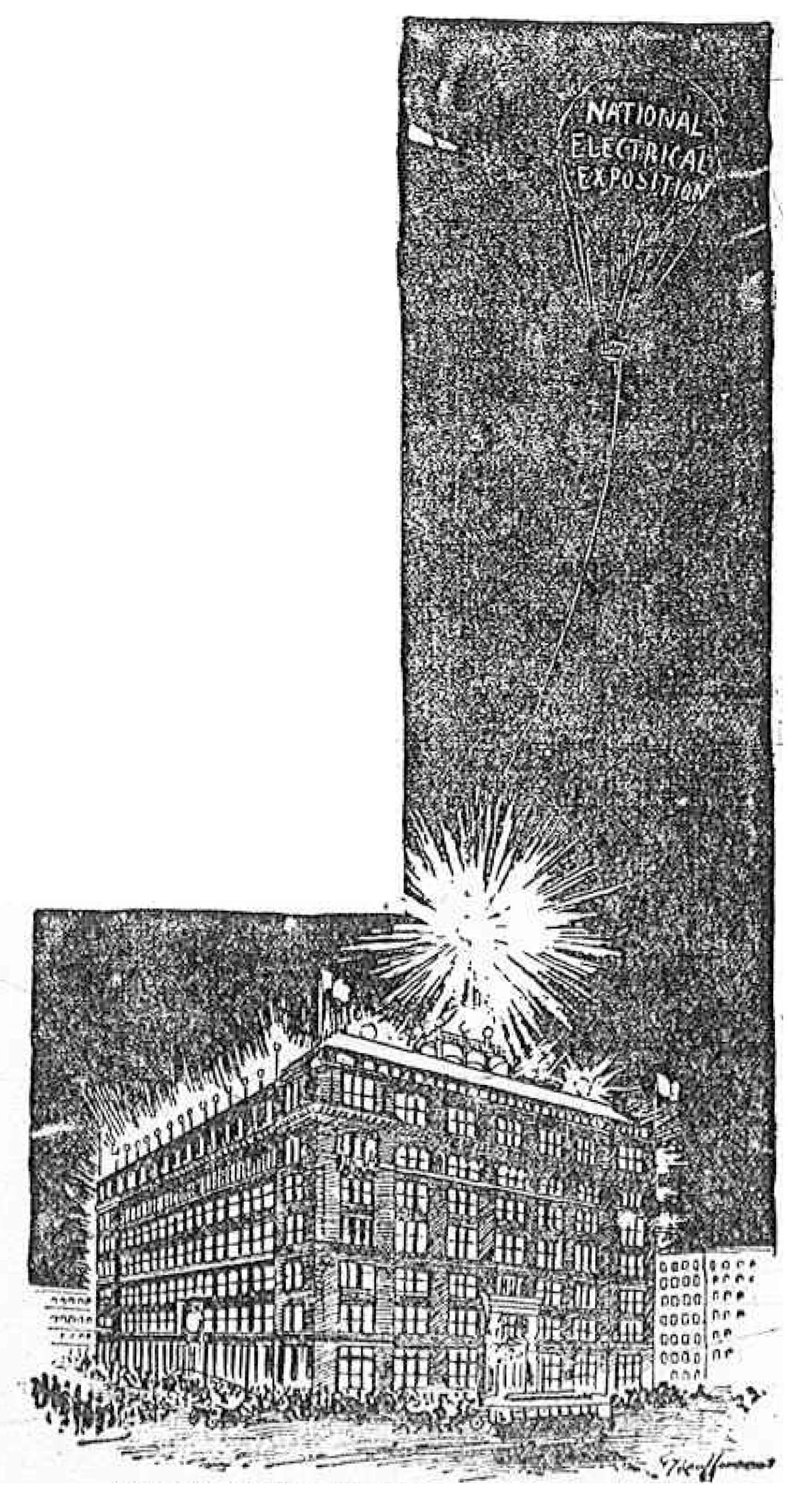
On one or more evenings it will be used to illuminate the Bartholdi statue of liberty in New York harbor. At other times the Western Union building and other prominent structures will be lighted up. Again the current will be utilized in lighting harbor buoys, in signaling from Fire Island to Barnegat light, in lighting the exposition hall itself and in working the government code of signals from a mammoth balloon that will float above the exposition building.
This balloon, by the way, will be the most spectacular feature of the whole show, especially at night, since it will then be brilliantly illuminated and will bear a flaming legend in letters large enough to be read at a great distance, describing the exposition going on below.
Perhaps this is as good a place as any to make it clear to the reader what this transmission of Niagara’s electrical current will mean. The fluid will be sent each evening over one of the commercial mains of the Western Union company, President Eckert having offered the facilities of the vastest telegraph system in existence for that purpose. It will be the longest power transmission in the world, the wire being 462 miles in length. The greatest distance over which the mystic current is transmitted in Europe — from Neckar to Frankfort-on-the-Main — is only 110 miles.
Those who have followed the development of electric power transmission will remember that for years many electrical experts persisted in the declaration that it would require more copper than could be afforded by the world’s entire visible supply to make a cable big enough to send power from Niagara to New York, and that when Tesla, a few years ago, announced his ability to perform this supposedly impossible thing, these same experts laughed him to scorn. But there is now no doubt that the transmission can and will be accomplished, since already, in a number of experiments, it has been found practicable to send a great volume of current from the falls to the Hudson’s mouth over a single commercial main, Tesla’s two phase system, so called, being the method employed. It should be said, however, that at this writing no one can determine how many horse power will be transmitted since the experiment has not yet been tried, under anything like as favorable conditions as will exist during the exhibition.
But perhaps the most interesting uses to which the Niagara current will be put have not yet been mentioned. Arrangements have been made to turn it into one of the Atlantic cables, and then to utilize the energy of the big water fall to flash a message under the sea from the American republic to the mother country. President Cleveland may then send greetings by cable to her majesty, Queen Victoria, and inasmuch as Niagara’s waters are international in position, the river forming a part of the boundary between the United States and Canada, it has been suggested that the courtesy of sending this message on the queen’s birthday, May 24, would be fully appreciated by Great Britain.
Further, it is expected that W. H. Preece, who has charge of the British telegraphic lines, will complete a circuit as nearly as may be around the world, and then messages may be sent by Niagara’s electricity from the exhibition to eminent men on the continent of Europe, such as President Faure of the French republic, the premier of the German empire and others. Dr. Depew will send the message over the long circuit.
Beside all these manifestations of the wire harnessed power of Niagara, a model of the system of electric towage to be introduced by Mr. Frank W. Hawley on the Erie canal will be shown. This will consist of a miniature canal, circular in form and filled with water, on which a number of models of the new steel barges now going into use will float. These little boats will be towed by a miniature model of the Lamb motor, running on cables strung from miniature posts, the whole being an exact reproduction in little of the new system in actual operation.
Of course, it is expected that a great number of eminent men outside the electrical professions will be present. On the opening day there will be most interesting ceremonies. The exhibition will be opened by Governor Levi P. Morton in person, and he will respect the current of Niagara with the great electrical main of the exposition, using the same golden key which was used for a similar purpose at the big Chicago fair. The mayor of New York and the mayor of Brooklyn and a host of public men, including governors and judges and congressmen and other big wigs, will take part in the ceremonies, and the gathering will undoubtedly become historic because of the brilliance and prominence of those in attendance.
Edison, silver thatched and stout, but with a face still boyish, and Tesla, much younger, slender and dark haired, with a countenance deeply lined with strenuous thought, will both be there, and thus the two men who have contributed most to the marvels of up to date electrical science will be on view at the same time. This of itself will be a most unusual circumstance — one not at all likely soon to occur again. Tesla’s most interesting exhibition will, of course, be his famous oscillator, from which so much in the economical production of power is expected. Edison’s will doubtless be his ingenious fluoroscope, by which it is possible, in effect, to see through solid substances in a way that discounts Roentgen, whose photography through solids is to-day the most absorbing subject for scientific discussion. Of course there will be exhibitions in plenty of X ray apparatus.
Quite as significant as any feature of the exhibition that has so far been noted will be the display of storage batteries. Reference is not now made to the show of different forms and methods of electrical storage, which will undoubtedly be full and complete, but to the car loads of batteries charged with Niagara power that will be shown. This part of the exhibition was suggested by Mr. Frank W. Hawley, who believes that by the judicious use of the storage battery the cost of power in cities remote from the places where it can be most cheaply produced may be enormously decreased. “Suppose,” said he, in a talk with the writer, “that we were to take no account whatever of power produced by falling water, but were to confine our calculations entirely to power produced from coal combustion. Good steam coal is worth in New York, say $1.70 a ton. At the mines it is worth 45 cents. The difference in price is what we pay for hauling the coal from the mine to the consumer. Now, suppose we were to build a great power house at the mouth of the mine, so placing the boilers that the coal could be shot directly from the hoisting cars to the furnace grate bars. The steam generated by burning this coal could then be used to produce an electric current at much less cost in money than it could be produced for in New York or Chicago, Boston or any other center of industry. With this current we could charge storage batteries. A sufficient number of these batteries to furnish a thousand horse power for a day of twenty-four hours could be transported for much less money than it would cost to haul coal enough to furnish a similar amount of power for the same length of time. As fast as the charged batteries were exhausted they could be returned for recharging, and the saving would be great. And as the power house at the mine continued in operation, there would gradually arise a great gray heap of ashes—the useless part of the coal, millions of tons of which are now hauled every year over hundreds of miles of railroad tracks at almost infinite waste.
“It seems to me,” said Mr. Hawley, “that the economy of this plan of power production and distribution ought to be obvious to everyone, and of course it is just as applicable in places where the current can be made by water power. It bears the same relation to long distance wire transmission that transporting petroleum in tank cars does to pipe line transmission, and under certain conditions it may be more desirable.”
At all events several car loads of storage batteries charged with Niagara power will be shipped to the New York exposition, and much of the current needed for the show will be derived from them, so that Niagara power will be almost constantly used, even during the hours when it is not transmitted over a Western Union commercial main. — Dexter Marshall.