Nikola Tesla Articles
The Latest Tributes to the Genius Nikola Tesla - Part 3
— Continuation —
III
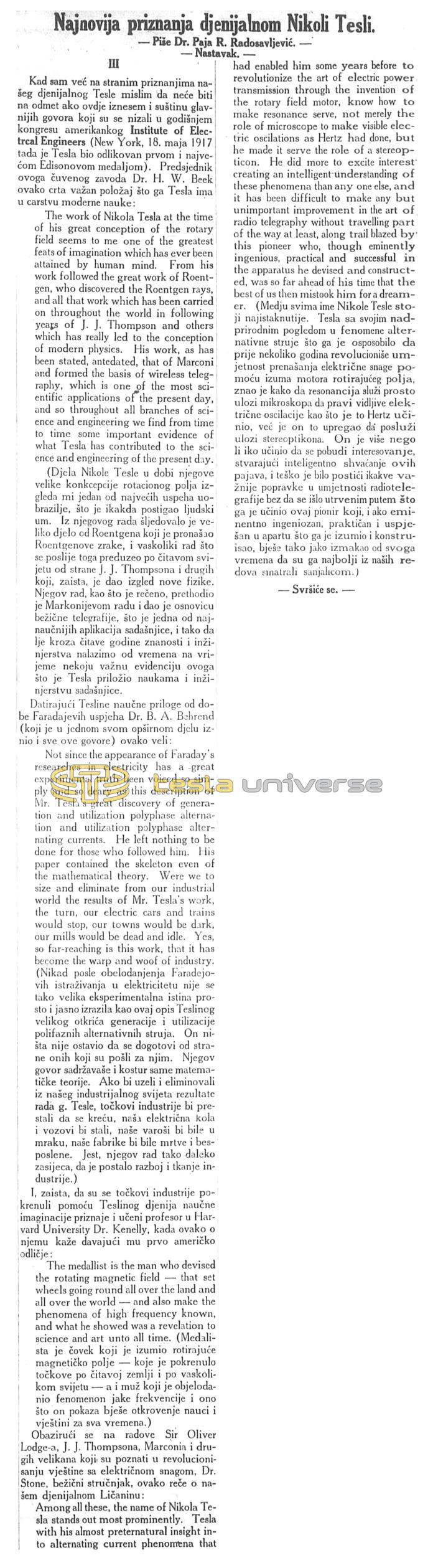
When I think of the foreign tributes to our genius Tesla, it will not be out of place if I here quote in substance the main words spoken at the annual congress of the American Institute of Electrical Engineers (New York, May 18, 1917), when Tesla was awarded the first and largest Edison Medal. The president of this famous institution, Dr. H. W. Buck, thus stated the important position Tesla holds in the realm of modern science:
The work of Nikola Tesla at the time of his great conception of the rotary field seems to me one of the greatest feats of imagination that has ever been attained by human mind. From his work followed the great work of Roentgen, who discovered the Roentgen rays, and all that work which has been carried on throughout the world in following years of J. J. Thompson and others which has really led to the conception of modern physics. His work, as has been stated, antedated that of Marconi and formed the basis of wireless telegraphy, which is one of the most scientific applications of the present day, and so throughout all branches of science and engineering we find from time to time some important evidence of what Tesla has contributed to the science and engineering of the present day.
(The work of Nikola Tesla, at the time of his great conception of the rotary field, seems to me one of the greatest feats of imagination that has ever been attained by the human mind. From his work followed the great work of Roentgen, who discovered the Roentgen rays, and all that work which was later carried on throughout the world by J. J. Thompson and others, which truly led to the conception of modern physics. His work, as has been said, preceded Marconi’s and formed the basis of wireless telegraphy, which is one of the most scientific applications of the present day, and thus through all branches of science and engineering we find from time to time some important evidence of what Tesla has contributed to the science and engineering of the present day.)
Dating Tesla’s scientific contributions to the time of Faraday’s successes, Dr. B. A. Behrend (who in one of his extensive works explained all these statements) says the following:
Not since the appearance of Faraday’s researches in electricity has a great experimental truth been voiced so simply and so clearly as this description of Mr. Tesla’s great discovery of generation and utilization polyphase alternating currents. He left nothing to be done for those who followed him. His paper contained the skeleton even of the mathematical theory. Were we to take and eliminate from our industrial world the results of Mr. Tesla’s work, the turn, our electric cars and trains would stop, our towns would be dark, our mills would be dead and idle. Yes, so far-reaching is this work, that it has become the warp and woof of industry.
(Never since the publication of Faraday’s researches in electricity has so great an experimental truth been expressed so simply and clearly as this description of Tesla’s great discovery of the generation and utilization of polyphase alternating currents. He left nothing for those who came after him to complete. His paper contained the skeleton even of the mathematical theory. If we were to take and eliminate from our industrial world the results of Mr. Tesla’s work, the wheels of industry would stop turning, our electric cars and trains would stop, our towns would be in darkness, our factories would be dead and idle. Yes, his work is so far-reaching that it has become the warp and woof of industry.)
And indeed, that the wheels of industry have been set in motion by Tesla’s genius of scientific imagination is acknowledged by the learned professor at Harvard University, Dr. Kenelly, when he says the following about him, presenting him with the first American medal:
The medallist is the man who devised the rotating magnetic field — that set wheels going round all over the land and all over the world — and also make the phenomena of high frequency known, and what he showed was a revelation to science and art unto all time. (The medallist is the man who invented the rotating magnetic field — which set wheels in motion throughout the entire land and throughout the entire world — and the man who made known the phenomena of high frequency, and what he showed was a revelation to science and art for all time.)
Referring to the works of Sir Oliver Lodge, J. J. Thompson, Marconi and other giants known in the revolutionary skill of electrical science, Dr. Stone, a wireless expert, says the following of our genius Ličanin:
Among all these, the name of Nikola Tesla stands out most prominently. Tesla with his almost preternatural insight into alternating current phenomena that had enabled him some years before to revolutionize the art of electric power transmission through the invention of the rotary field motor, know how to make resonance serve, not merely the role of microscope to make visible electric oscillations as Hertz had done, but he made it serve the role of a stereopticon. He did more to excite interest creating an intelligent understanding of these phenomena than any one else, and it has been difficult to make any but unimportant improvement in the art of radio telegraphy without travelling part of the way at least, along trail blazed by this pioneer who, though eminently ingenious, practical and successful in the apparatus he devised and constructed, was so far ahead of his time that the best of us then mistook him for a dreamer. (Among all these, the name of Nikola Tesla stands out most prominently. Tesla, with his almost supernatural insight into alternating-current phenomena, which several years earlier had enabled him to revolutionize the art of transmitting electrical energy by means of the invention of the rotary-field motor, knew how to make resonance serve not merely the role of a microscope to make electrical oscillations visible, as Hertz had done, but employed it to serve the role of a stereopticon. He did more than anyone else to stimulate interest by creating an intelligent understanding of these phenomena, and it has been difficult to achieve any but unimportant improvements in the art of radiotelegraphy without following at least part of the path blazed by this pioneer who, though eminently ingenious, practical and successful in the apparatus he invented and constructed, was so far ahead of his time that the best of us then considered him a dreamer.)
— The End. —