Nikola Tesla Articles
The Magnetic Storm Page 232
Electrical Experimenter - August 1st, 1918
"WHY" Sparks had stopt reading the New York Evening World: He contemplated his old meerschaum pipe meditatively while with his long and lanky index finger, stained by many acids, he carefully rubbed a long, thin and quivering nose. This was always a sign of deep, concentrated thought of the nose's owner. It also, as a rule, induced the birth of a great idea.
Again, and very slowly he re-read the article, which millions that same day had read casually, without a quiver, let alone, a nose quiver. The newspaper item was simple enough:
NEW YORK, Aug. 10, 1917. — An electromagnetic storm of great violence swept over the eastern section of the United States last night. Due to a brilliant Aurora Borealis, — the Northern Lights,—telegraph and long distance telephone, as well as cable communications were interrupted for hours. No telegraphic traffic was possible between New York and points West. It was impossible to work any of the transatlantic cables between 12:15 A. M. and 9:15 A. M., every one of them having “gone dead.” The Aurora Borealis disturbances affected all telegraph and telephone lines extending between Chicago and the eastern cities. On telegraph wires of the Postal Telegraph Co. without regular battery being applied at terminal offices, grounded lines showed a potential of 425 volts positive, varying to 225 volts negative; the disturbance continuing between 12:15 A. M. and 9:15 A. M.
At Newark, N. J., in the Broad Street office a Western Union operator was severely shocked, trying to operate the key, while long sparks played about his instruments.
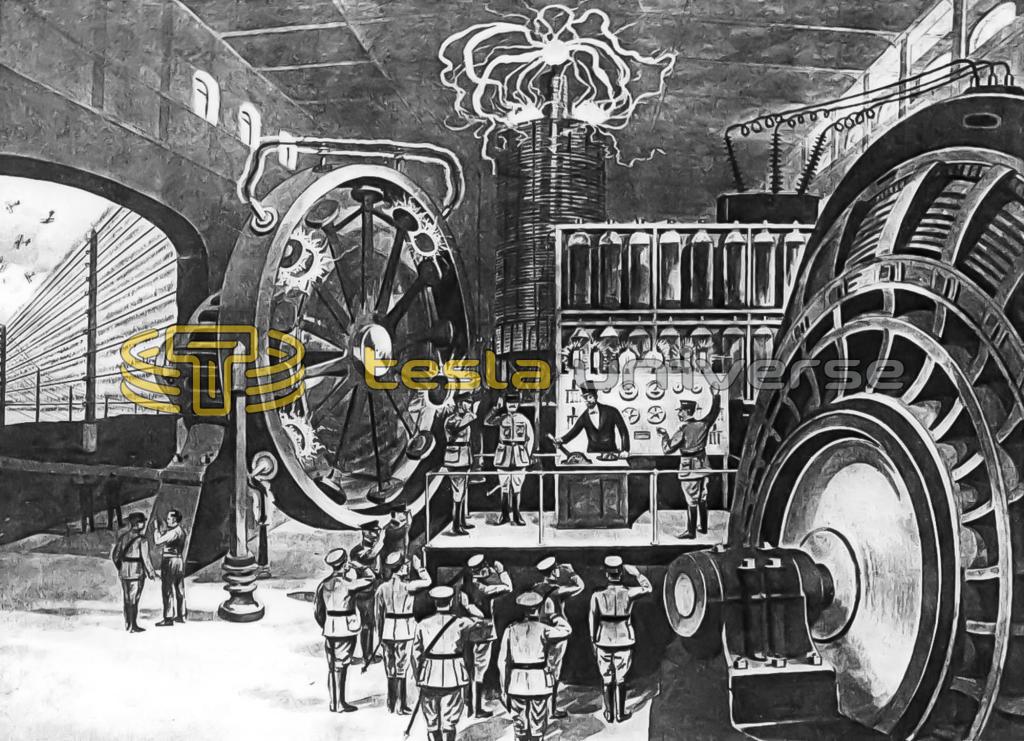
Sparks rose excitedly and began pacing the cement floor of the vast Tesla laboratory, totally oblivious to the fact that he was sucking a cold pipe. The more he paced about, the more excited he became. Finally he flung himself into a chair and began feverishly to make sketches on big white sheets of drawing paper.
“Why” Sparks had been just an ordinary “Bug,” an experimenter, when he entered Tesla's great research laboratory at the beginning of the great war in 1914. Tesla liked the keen, red-haired tousled boy, who always seemed to divine your thoughts before you had uttered five words. His clear blue eyes, lying deep in their sockets, sparkled with life and intelligence and what Sparks did not know about electricity was mighty little indeed. I believe there is no electrical book in existence that Sparks had not devoured ravenously in his spare hours, while having lunch or else while in bed, in the small hours of the morning. His thirst for electrical knowledge was unbounded, and he soaked up every bit of information like a sponge. Yes, and he retained it, too. In short, the young prodigy was a living electrical cyclopedia and highly valued by his associates. No wonder Tesla in three short years had made him superintendent of the laboratory.
Of course, Sparks' first name was not really “Why.” But someone had dubbed him with this sobriquet because of his eternal “But why is this,” “Why, why should we not do it this way” — “Why do you try to do that?” In short his first word always seemed to be “Why” — it had to be, in his unending quest for knowledge. And his “Why” was always very emphatic, explosive-like, imperative, from which there was no escape.
Ah, yes, his first name. To tell the honest
