Nikola Tesla Articles
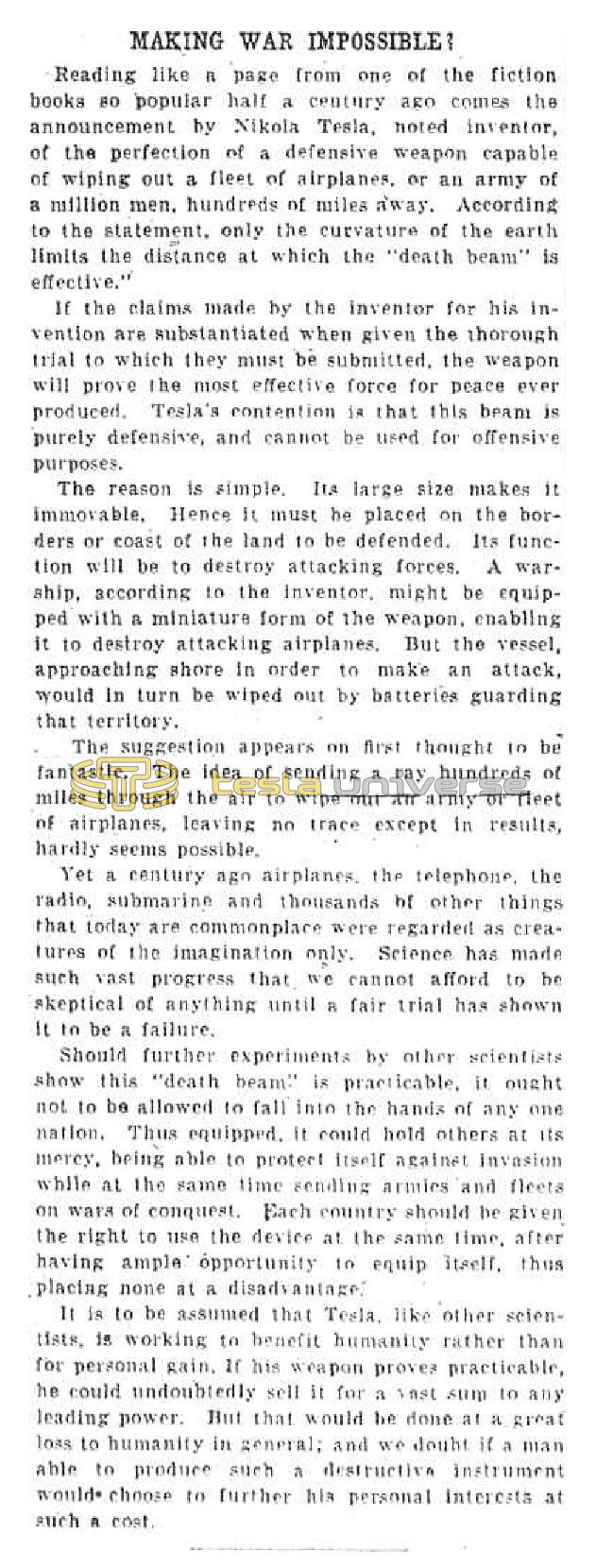
Making War Impossible?
Reading like a page from one of the fiction books so popular half a century ago comes the announcement by Nikola Tesla, noted inventor, of the perfection of a defensive weapon capable of wiping out a fleet of airplanes, or an army of a million men, hundreds of miles away. According to the statement, only the curvature of the earth limits the distance at which the “death beam” is effective."
If the claims made by the inventor for his invention are substantiated when given the thorough trial to which they must be submitted, the weapon will prove the most effective force for peace ever produced. Tesla’s contention is that this beam is purely defensive, and cannot be used for offensive purposes.
The reason is simple. Its large size makes it immovable. Hence it must be placed on the borders or coast of the land to be defended. Its function will be to destroy attacking forces. A warship, according to the inventor, might be equipped with a miniature form of the weapon, enabling it to destroy attacking airplanes. But the vessel, approaching shore in order to make an attack, would in turn be wiped out by batteries guarding that territory.
The suggestion appears on first thought to be fantastic. The idea of sending a ray hundreds of miles through the air to wipe out an army or fleet of airplanes, leaving no trace except in results, hardly seems possible.
Yet a century ago airplanes, the telephone, the radio, submarine and thousands of other things that today are commonplace were regarded as creatures of the imagination only. Science has made such vast progress that we cannot afford to be skeptical of anything until a fair trial has shown it to be a failure.
Should further experiments by other scientists show this “death beam” is practicable, it ought not to be allowed to fall into the hands of any one nation. Thus equipped, it could hold others at its mercy, being able to protect itself against invasion while at the same time sending armies and fleets on wars of conquest. Each country should be given the right to use the device at the same time, after having ample opportunity to equip itself, thus placing none at a disadvantage.
It is to be assumed that Tesla, like other scientists, is working to benefit humanity rather than for personal gain. If his weapon proves practicable, he could undoubtedly sell it for a vast sum to any leading power. But that would be done at a great loss to humanity in general; and we doubt if a man able to produce such a destructive instrument would choose to further his personal interests at such a cost.