Nikola Tesla Articles
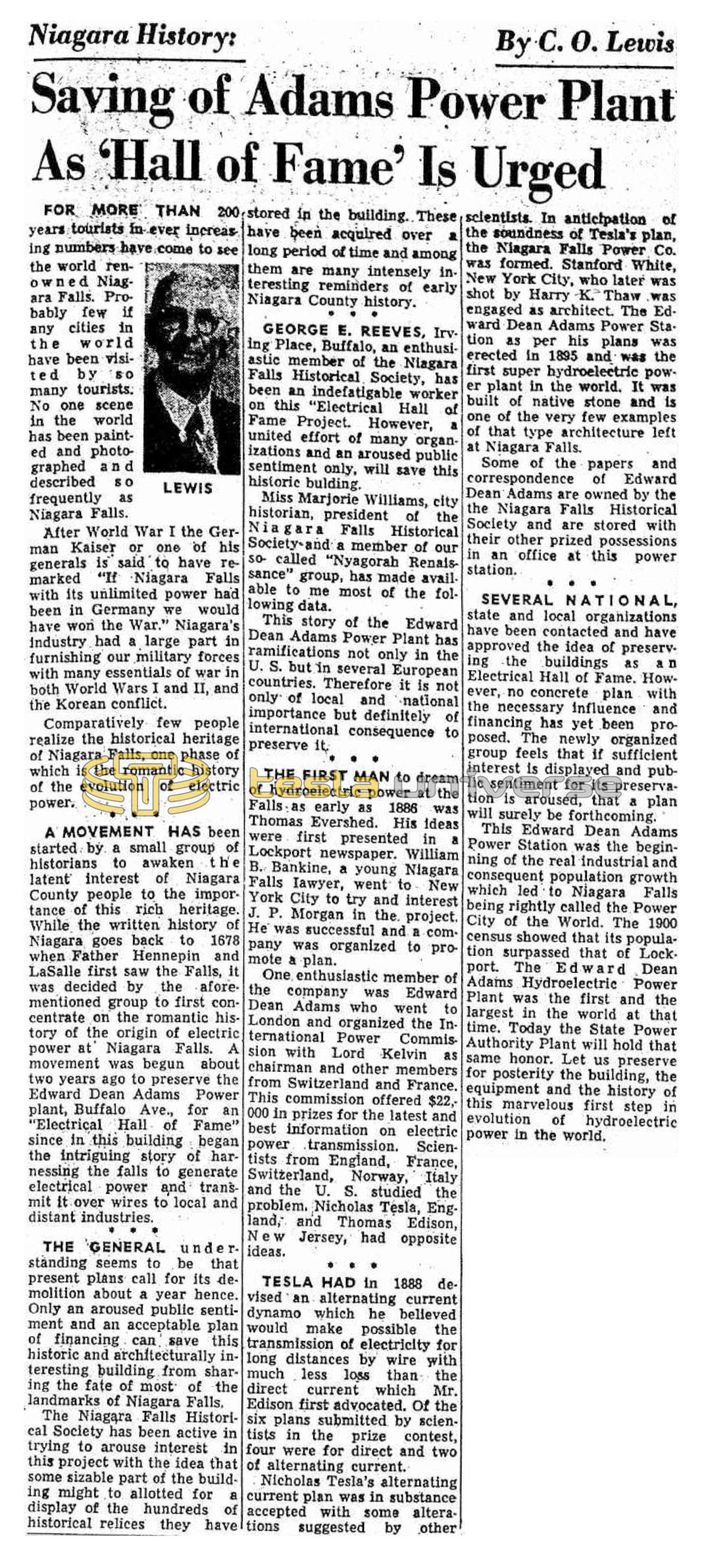
Niagara History - Saving of Adams Power Plant As 'Hall of Fame' is Urged
FOR MORE THAN 200 years tourists in ever increasing numbers have come to see the world renowned Niagara Falls. Probably few if any cities in the world have been visited by so many tourists. No one scene in the world has been painted and photographed and described so frequently as Niagara Falls.
After World War I the German Kaiser or one of his generals is said to have remarked “If Niagara Falls with its unlimited power had been in Germany we would have won the War.” Niagara’s industry had a large part in furnishing our military forces with many essentials of war in both World Wars I and II, and the Korean conflict.
Comparatively few people realize the historical heritage of Niagara Falls, one phase of which is the romantic history of the evolution of electric power.
A MOVEMENT HAS been started by a small group of historians to awaken the latent interest of Niagara County people to the importance of this rich heritage. While the written history of Niagara goes back to 1678 when Father Hennepin and LaSalle first saw the Falls, it was decided by the aforementioned group to first concentrate on the romantic history of the origin of electric power at Niagara Falls. A movement was begun about two years ago to preserve the Edward Dean Adams Power plant, Buffalo Ave., for an “Electrical Hall of Fame” since in this building began the intriguing story of harnessing the falls to generate electrical power and transmit it over wires to local and distant industries.
THE GENERAL understanding seems to be that present plans call for its demolition about a year hence. Only an aroused public sentiment and an acceptable plan of financing can save this historic and architecturally interesting building from sharing the fate of most of the landmarks of Niagara Falls.
The Niagara Falls Historical Society has been active in trying to arouse interest in this project with the idea that some sizable part of the building might be allotted for a display of the hundreds of historical relics they have stored in the building. These have been acquired over a long period of time and among them are many intensely interesting reminders of early Niagara County history.
GEORGE E. REEVES, Irving Place, Buffalo, an enthusiastic member of the Niagara Falls Historical Society, has been an indefatigable worker on this “Electrical Hall of Fame Project.” However, a united effort of many organizations and an aroused public sentiment only, will save this historic building.
Miss Marjorie Williams, city historian, president of the Niagara Falls Historical Society and a member of our so-called “Nyagorah Renaissance” group, has made available to me most of the following data.
This story of the Edward Dean Adams Power Plant has ramifications not only in the U. S. but in several European countries. Therefore it is not only of local and national importance but definitely of international consequence to preserve it.
THE FIRST MAN to dream of hydroelectric power at the Falls as early as 1886 was Thomas Evershed. His ideas were first presented in a Lockport newspaper. William B. Rankine, a young Niagara Falls lawyer, went to New York City to try and interest J. P. Morgan in the project. He was successful and a company was organized to promote a plan.
One enthusiastic member of the company was Edward Dean Adams who went to London and organized the International Power Commission with Lord Kelvin as chairman and other members from Switzerland and France. This commission offered $22,000 in prizes for the latest and best information on electric power transmission. Scientists from England, France, Switzerland, Norway, Italy and the U. S. studied the problem. Nikola Tesla, England, and Thomas Edison, New Jersey, had opposite ideas.
TESLA HAD in 1888 devised an alternating current dynamo which he believed would make possible the transmission of electricity for long distances by wire with much less loss than the direct current which Mr. Edison first advocated. Of the six plans submitted by scientists in the prize contest, four were for direct and two of alternating current.
Nikola Tesla’s alternating current plan was in substance accepted with some alterations suggested by other scientists. In anticipation of the soundness of Tesla’s plan, the Niagara Falls Power Co. was formed. Stanford White, New York City, who later was shot by Harry K. Thaw, was engaged as architect. The Edward Dean Adams Power Station as per his plans was erected in 1895 and was the first super hydroelectric power plant in the world. It was built of native stone and is one of the very few examples of that type architecture left at Niagara Falls.
Some of the papers and correspondence of Edward Dean Adams are owned by the Niagara Falls Historical Society and are stored with their other prized possessions in an office at this power station.
SEVERAL NATIONAL, state and local organizations have been contacted and have approved the idea of preserving the buildings as an Electrical Hall of Fame. However, no concrete plan with the necessary influence and financing has yet been proposed. The newly organized group feels that if sufficient interest is displayed and public sentiment for its preservation is aroused, that a plan will surely be forthcoming.
This Edward Dean Adams Power Station was the beginning of the real industrial and consequent population growth which led to Niagara Falls being rightly called the Power City of the World. The 1900 census showed that its population surpassed that of Lockport. The Edward Dean Adams Hydroelectric Power Plant was the first and the largest in the world at that time. Today the State Power Authority Plant will hold that same honor. Let us preserve for posterity the building, the equipment and the history of this marvelous first step in evolution of hydroelectric power in the world.