Nikola Tesla Articles
Nikola Tesla, His Work and Unfulfilled Promises Page 9
Electrical Age - February 1st, 1903
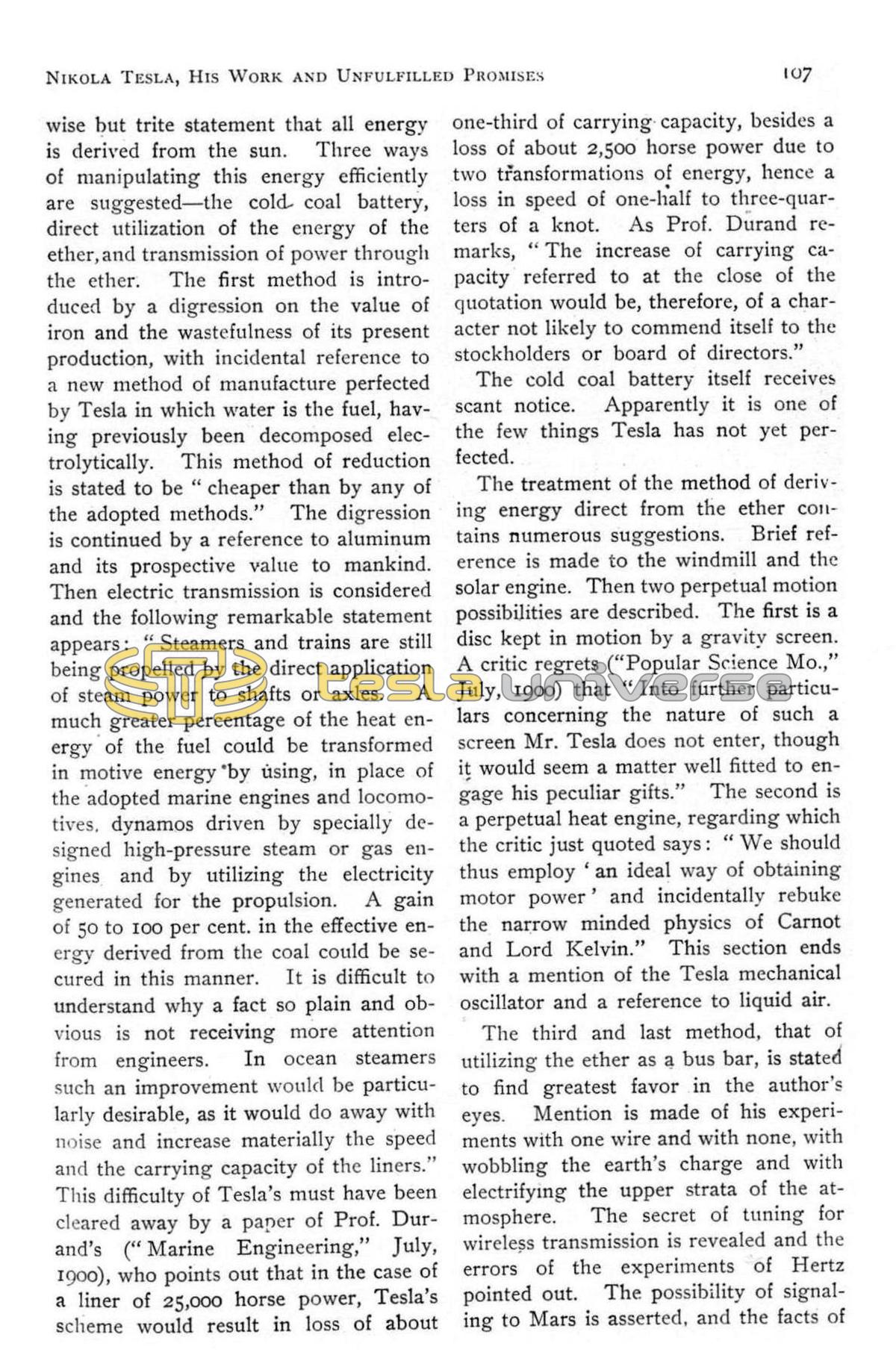
wise but trite statement that all energy is derived from the sun. Three ways of manipulating this energy efficiently are suggested — the cold coal battery, direct utilization of the energy of the ether, and transmission of power through the ether. The first method is introduced by a digression on the value of iron and the wastefulness of its present production, with incidental reference to a new method of manufacture perfected by Tesla in which water is the fuel, having previously been decomposed electrolytically. This method of reduction is stated to be "cheaper than by any of the adopted methods." The digression is continued by a reference to aluminum and its prospective value to mankind. Then electric transmission is considered and the following remarkable statement appears: Steamers and trains are still being propelled by the direct application of steam power to shafts or axles. A much greater percentage of the heat energy of the fuel could be transformed in motive energy by using, in place of the adopted marine engines and locomotives, dynamos driven by specially designed high-pressure steam or gas engines and by utilizing the electricity generated for the propulsion. A gain of 50 to 100 per cent. in the effective energy derived from the coal could be secured in this manner. It is difficult to understand why a fact so plain and obvious is not receiving more attention from engineers. In ocean steamers such an improvement would be particu- larly desirable, as it would do away with noise and increase materially the speed and the carrying capacity of the liners." This difficulty of Tesla's must have been cleared away by a paper of Prof. Durand's ("Marine Engineering," July, 1900), who points out that in the case of a liner of 25,000 horse power, Tesla's scheme would result in loss of about one-third of carrying capacity, besides a loss of about 2,500 horse power due to two transformations of energy, hence a loss in speed of one-half to three-quarters of a knot. As Prof. Durand remarks, "The increase of carrying capacity referred to at the close of the quotation would be, therefore, of a character not likely to commend itself to the stockholders or board of directors."
The cold coal battery itself receives scant notice. Apparently it is one of the few things Tesla has not yet perfected.
The treatment of the method of deriving energy direct from the ether contains numerous suggestions. Brief reference is made to the windmill and the solar engine. Then two perpetual motion possibilities are described. The first is a disc kept in motion by a gravity screen. A critic regrets ("Popular Science Mo.," July, 1900) that "Into further particulars concerning the nature of such a screen Mr. Tesla does not enter, though it would seem a matter well fitted to engage his peculiar gifts." The second is a perpetual heat engine, regarding which the critic just quoted says: "We should thus employ an ideal way of obtaining motor power' and incidentally rebuke the narrow minded physics of Carnot and Lord Kelvin." This section ends with a mention of the Tesla mechanical oscillator and a reference to liquid air. The third and last method, that of utilizing the ether as a bus bar, is stated to find greatest favor in the author's Mention is made of his experiments with one wire and with none, with eyes. wobbling the earth's charge and with electrifying the upper strata of the atmosphere. The secret of tuning for wireless transmission is revealed and the errors of the experiments of Hertz pointed out. The possibility of signaling to Mars is asserted, and the facts of