Nikola Tesla Articles
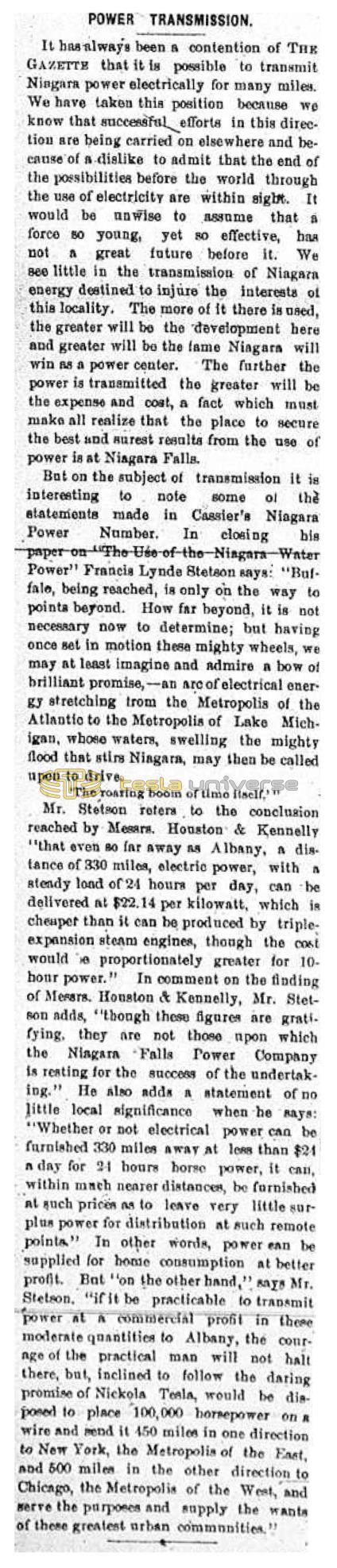
Power Transmission - The Use of the Niagara Water Power
It has always been a contention of THE GAZETTE that it is possible to transmit Niagara power electrically for many miles. We have taken this position because we know that successful efforts in this direction are being carried on elsewhere and because of a dislike to admit that the end of the possibilities before the world through the use of electricity are within sight. It would be unwise to assume that a force so young, yet so effective, has not a great future before it. We see little in the transmission of Niagara energy destined to injure the interests of this locality. The more of it there is used, the greater will be the development here and greater will be the fame Niagara will win as a power center. The further the power is transmitted the greater will be the expense and cost, a fact which must make all realize that the place to secure the best and surest results from the use of power is at Niagara Falls.
But on the subject of transmission it is interesting to note some ol the statements made in Cassier's Niagara Power Number. In closing his paper on "The Use of the Niagara Water Power" Francis Lynde Stetson says: "Buffalo, being reached, is only on the way to points beyond. How far beyond, it is not necessary now to determine; but having once set in motion these mighty wheels, we may at least imagine and admire a bow of brilliant promise, an arc of electrical energy stretching trom the Metropolis of the Atlantic to the Metropolis of Lake Michigan, whose waters, swelling the mighty flood that stirs Niagara, may then be called upon to drive.
'The roaring boom of time itself,'"
Mr. Stetson refers to the conclusion reached by Messrs. Houston & Kennelly "that even so far away as Albany, a distance of 330 miles, electric power, with a steady load of 24 hours per day, can be delivered at $22.14 per kilowatt, which is cheaper than it can be produced by triple-expansion steam engines, though the cost would be proportionately greater for 10-hour power." In comment on the finding of Messrs. Houston & Kennelly, Mr. Stetson adds, "though these figures are gratifying, they are not those upon which the Niagara Falls Power Company is resting for the success of the undertaking." He also adds a statement of no little local significance when he says: "Whether or not electrical power can be furnished 330 miles away at less than $24 a day for 24 hours horse power, it can, within mach nearer distances, be furnished at such prices as to leave very little surplus power for distribution at such remote points" In other words, power can be supplied for home consumption at better profit. But "on the other hand," says Mr. Stetson, "if it be practicable to transmit power at a commercial profit in these moderate quantities to Albany, the courage of the practical man will not halt there, but, inclined to follow the daring promise of Nikola Tesla, would be disposed to place 100,000 horsepower on a wire and send it 450 miles in one direction to New York, the Metropolis of the East, and 500 miles in the other direction to Chicago, the Metropolis of the West, and serve the purposes and supply the wants of these greatest urban communities."