Nikola Tesla Articles
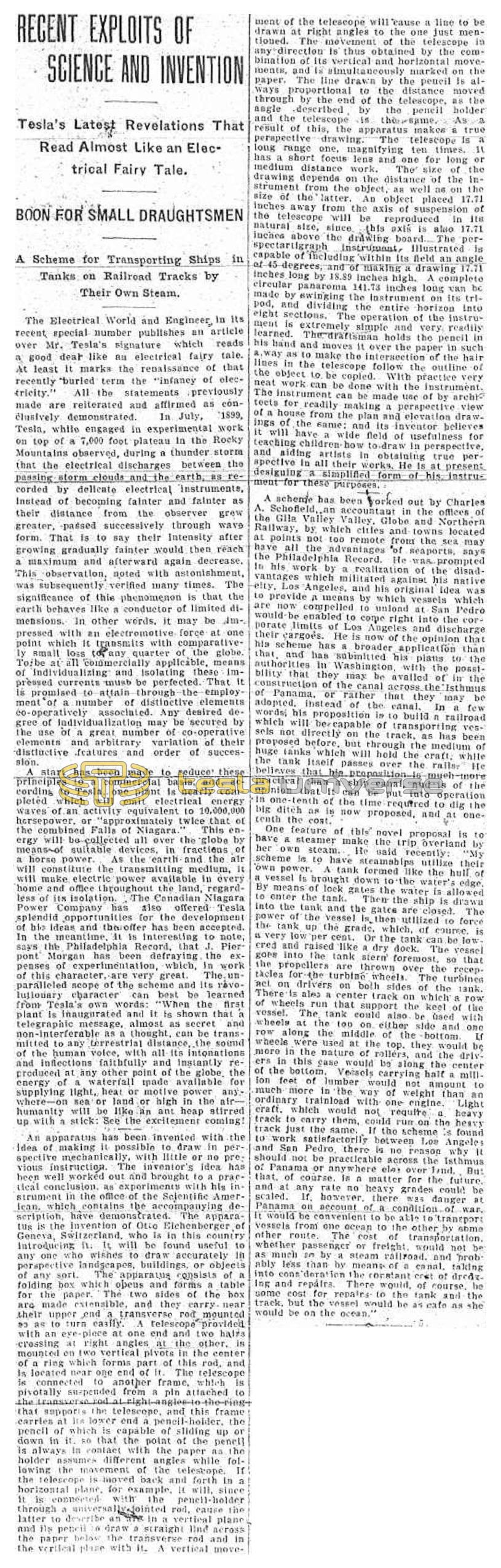
Recent Exploits of Science and Invention
Tesla’s Latest Revelations That Read Almost Like an Electrical Fairy Tale.
BOON FOR SMALL DRAUGHTSMEN
A Scheme for Transporting Ships in Tanks on Railroad Tracks by Their Own Steam.
The Electrical World and Engineer, in its recent special number, publishes an article over Mr. Tesla’s signature which reads a good deal like an electrical fairy tale. At least it marks the renaissance of that recently buried term the “infancy of electricity.” All the statements previously made are reiterated and affirmed as conclusively demonstrated. In July, 1899, Tesla, while engaged in experimental work on top of a 7,000 foot plateau in the Rocky Mountains observed, during a thunder storm that the electrical discharges between the passing storm clouds and the earth, as recorded by delicate electrical instruments, instead of becoming fainter and fainter as their distance from the observer grew greater, passed successively through wave form. That is to say their intensity after growing gradually fainter would then reach a maximum and afterward again decrease. This observation, noted with astonishment, was subsequently verified many times. The significance of this phenomenon is that the earth behaves like a conductor of limited dimensions. In other words, it may be impressed with an electromotive force at one point which it transmits with comparatively small loss to any quarter of the globe. To be at all commercially applicable, means of individualizing and isolating these impressed currents must be perfected. That it is promised to attain through the employment of a number of distinctive elements co-operatively associated. Any desired degree of individualization may be secured by the use of a great number of co-operative elements and arbitrary variation of their distinctive features and order of succession.
A start has been made to reduce these principles to a commercial basis, and, according to Tesla, one plant is nearly completed which will emit electrical energy waves of an activity equivalent to 10,000,000 horsepower, or “approximately twice that of the combined Falls of Niagara.” This energy will be collected all over the globe by means of suitable devices, in fractions of a horse power. As the earth and the air will constitute the transmitting medium, it will make electric power available in every home and office throughout the land, regardless of its isolation. The Canadian Niagara Power Company has also offered Tesla splendid opportunities for the development of his ideas and the offer has been accepted. In the meantime, it is interesting to note, says the Philadelphia Record, that J. Pierpont Morgan has been defraying the expenses of experimentation, which, in work of this character, are very great. The unparalleled scope of the scheme and its revolutionary character can best be learned from Tesla’s own words: “When the first plant is inaugurated and it is shown that a telegraphic message, almost as secret and non-interferable as a thought, can be transmitted to any terrestrial distance, the sound of the human voice, with all its intonations and inflections faithfully and instantly reproduced at any other point of the globe, the energy of a waterfall made available for supplying light, heat or motive power anywhere — on sea or land or high in the air — humanity will be like an ant heap stirred up with a stick: See the excitement coming!”
An apparatus has been invented with the idea of making it possible to draw in perspective mechanically, with little or no previous instruction. The inventor’s idea has been well worked out and brought to a practical conclusion, as experiments with his instrument in the office of the Scientific American, which contains the accompanying description, have demonstrated. The apparatus is the invention of Otto Eichenberger of Geneva, Switzerland, who is in this country introducing it. It will be found useful to any one who wishes to draw accurately in perspective landscapes, buildings, or objects of any sort. The apparatus consists of a folding box which opens and forms a table for the paper. The two sides of the box are made extensible, and they carry near their upper end a transverse rod mounted so as to turn easily. A telescope provided with an eye-piece at one end and two hairs crossing at right angles at the other, is mounted on two vertical pivots in the center of a ring which forms part of this rod, and is located near one end of it. The telescope is connected to another frame, which is pivotally suspended from a pin attached to the transverse rod at right angles to the ring that supports the telescope, and this frame carries at its lower end a pencil-holder, the pencil of which is capable of sliding up or down in it, so that the point of the pencil is always in contact with the paper as the holder assumes different angles while following the movement of the telescope. If the telescope is moved back and forth in a horizontal plane, for example, it will, since it is connected with the pencil-holder through a universally jointed rod, cause the latter to describe an arc in a vertical plane and its pencil to draw a straight line across the paper below the transverse rod and in the vertical plane with it. A vertical movement of the telescope will cause a line to be drawn at right angles to the one just mentioned. The movement of the telescope in any direction is thus obtained by the combination of its vertical and horizontal movements, and is simultaneously marked on the paper. The line drawn by the pencil is always proportional to the distance moved through by the end of the telescope, as the angle described by the pencil holder and the telescope is the same. As a result of this, the apparatus makes a true perspective drawing. The telescope is a long range one, magnifying ten times. It has a short focus lens and one for long or medium distance work. The size of the drawing depends on the distance of the instrument from the object, as well as on the size of the latter. An object placed 17.71 inches away from the axis of suspension of the telescope will be reproduced in its natural size, since this axis is also 17.71 inches above the drawing board. The perspectograph instrument illustrated is capable of including within its field an angle of 45 degrees, and of making a drawing 17.71 inches long by 18.89 inches high. A complete circular panorama 141.73 inches long can be made by swinging the instrument on its tripod, and dividing the entire horizon into eight sections. The operation of the instrument is extremely simple and very readily learned. The draftsman holds the pencil in his hand and moves it over the paper in such a way as to make the intersection of the hair lines in the telescope follow the outline of the object to be copied. With practice very neat work can be done with the instrument. The instrument can be made use of by architects for readily making a perspective view of a house from the plan and elevation drawings of the same; and its inventor believes it will have a wide field of usefulness for teaching children how to draw in perspective, and aiding artists in obtaining true perspective in all their works. He is at present designing a simplified form of his instrument for these purposes.
A scheme has been worked out by Charles A. Schofield, an accountant in the offices of the Gila Valley, Globe and Northern Railway, by which cities and towns located at points not too remote from the sea may have all the advantages of seaports, says the Philadelphia Record. He was prompted in his work by a realization of the disadvantages which militated against his native city, Los Angeles, and his original idea was to provide a means by which vessels which are now compelled to unload at San Pedro would be enabled to come right into the corporate limits of Los Angeles and discharge their cargoes. He is now of the opinion that his scheme has a broader application than that, and has submitted his plans to the authorities in Washington, with the possibility that they may be availed of in the construction of the canal across the Isthmus of Panama, or rather that they may be adopted, instead of the canal. In a few words, his proposition is to build a railroad which will be capable of transporting vessels not directly on the track, as has been proposed before, but through the medium of huge tanks which will hold the craft, while the tank itself passes over the rails. He believes that his proposition is much more practical than a ship canal, and is of the opinion that it can be put into operation in one-tenth of the time required to dig the big ditch as is now proposed, and at one-tenth the cost.
One feature of this novel proposal is to have a steamer make the trip overland by her own steam. He said recently: “My scheme is to have steamships utilize their own power. A tank formed like the hull of a vessel is brought down to the water’s edge. By means of lock gates the water is allowed to enter the tank. Then the ship is drawn into the tank and the gates are closed. The power of the vessel is then utilized to force the tank up the grade, which, of course, is a very low per cent. Or the tank can be lowered and raised like a dry dock. The vessel goes into the tank stern foremost, so that the propellers are thrown over the receptacles for the turbine wheels. The turbines act on drivers on both sides of the tank. There is also a center track on which a row of wheels run that support the keel of the vessel. The tank could also be used with wheels at the top on either side and one row along the middle of the bottom. If wheels were used at the top, they would be more in the nature of rollers, and the drivers in this case would be along the center of the bottom. Vessels carrying half a million feet of lumber would not amount to much more in the way of weight than an ordinary trainload with one engine. Light craft, which would not require a heavy track to carry them, could run on the heavy track just the same. If the scheme is found to work satisfactorily between Los Angeles and San Pedro, there is no reason why it should not be practicable across the Isthmus of Panama or anywhere else over land. But that, of course, is a matter for the future, and at any rate no heavy grades could be scaled. If, however, there was danger at Panama on account of a condition of war, it would be convenient to be able to transport vessels from one ocean to the other by some other route. The cost of transportation, whether passenger or freight, would not be as much so by a steam railroad, and probably less than by means of a canal, taking into consideration the constant cost of dredging and repairs. There would, of course, be some cost for repairs to the tank and the track, but the vessel would be as safe as she would be on the ocean.”