Nikola Tesla Articles
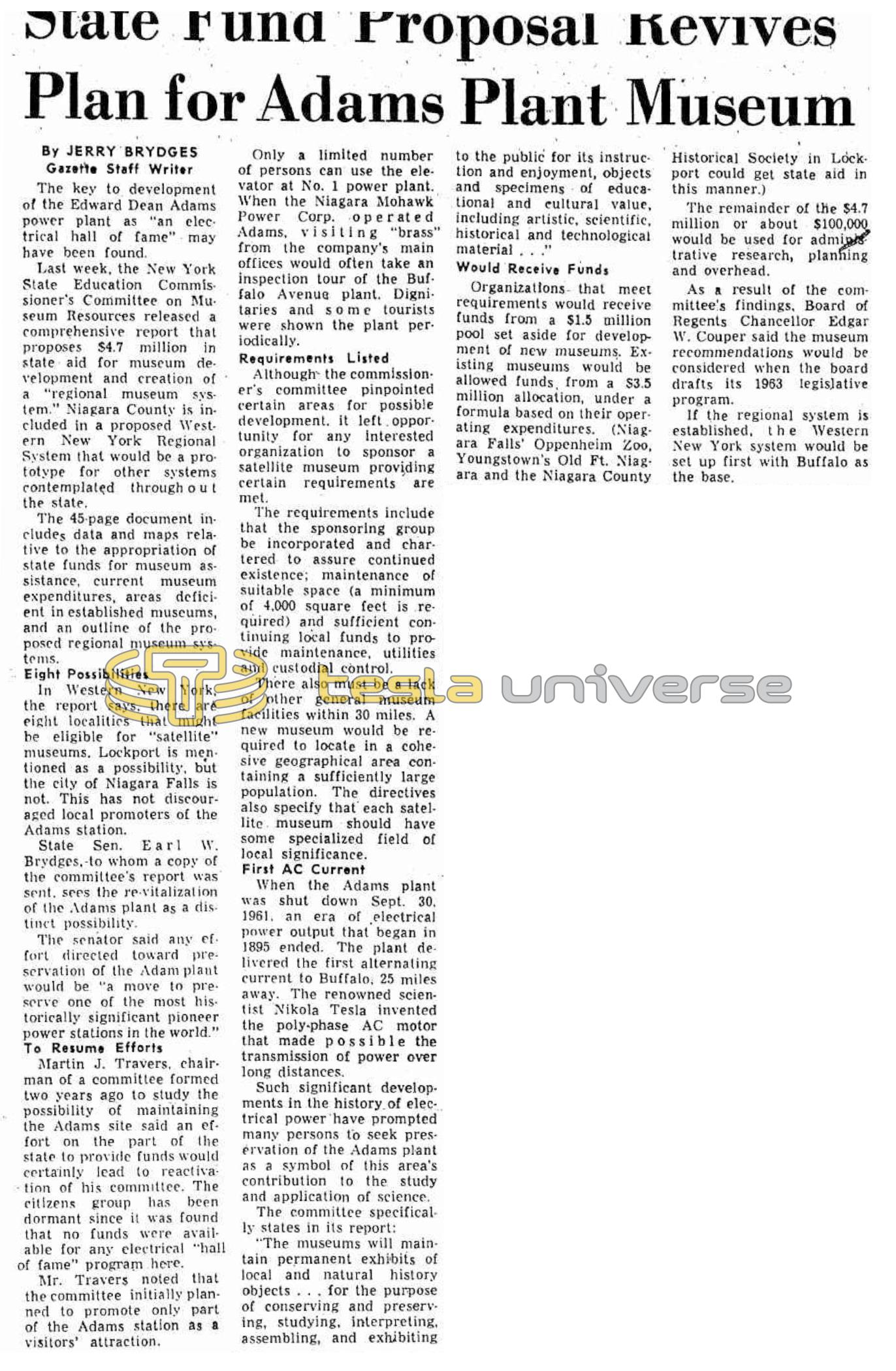
State Fund Proposal Revives Plan for Adams Plant Museum
By JERRY BRYDGES
Gazette Staff Writer
The key to development of the Edward Dean Adams power plant as "an electrical hall of fame" may have been found.
Last week, the New York State Education Commissioner's Committee on Museum Resources released a comprehensive report that proposes $4.7 million in state aid for museum development and creation of a "regional museum system." Niagara County is included in a proposed Western New York Regional System that would be a prototype for other systems contemplated throughout the state.
The 45-page document includes data and maps relative to the appropriation of state funds for museum assistance, current museum expenditures, areas deficient in established museums, and an outline of the proposed regional museum systems.
Eight Possibilities
In Western New York, the report says, there are eight localities that might be eligible for "satellite" museums. Lockport is mentioned as a possibility, but the city of Niagara Falls is not. This has not discouraged local promoters of the Adams station.
State Sen. Earl W. Brydges, to whom a copy of the committee's report was sent, sees the revitalization of the Adams plant as a distinct possibility.
The senator said any effort directed toward preservation of the Adams plant would be "a move to preserve one of the most historically significant pioneer power stations in the world."
To Resume Efforts
Martin J. Travers, chairman of a committee formed two years ago to study the possibility of maintaining the Adams site said an effort on the part of the state to provide funds would certainly lead to reactivation of his committee. The citizens group has been dormant since it was found that no funds were available for any electrical "hall of fame" program here.
Mr. Travers noted that the committee initially planned to promote only part of the Adams station as a visitors' attraction.
Only a limited number of persons can use the elevator at No. 1 power plant. When the Niagara Mohawk Power Corp. operated Adams, visiting "brass" from the company's main offices would often take an inspection tour of the Buffalo Avenue plant. Dignitaries and some tourists were shown the plant periodically.
Requirements Listed
Although the commissioner's committee pinpointed certain areas for possible development, it left opportunity for any interested organization to sponsor a satellite museum providing certain requirements are met.
The requirements include that the sponsoring group be incorporated and chartered to assure continued existence; maintenance of suitable space (a minimum of 4,000 square feet is required) and sufficient continuing local funds to provide maintenance, utilities and custodial control.
There also must be a lack of other general museum facilities within 30 miles. A new museum would be required to locate in a cohesive geographical area containing a sufficiently large population. The directives also specify that each satellite museum should have some specialized field of local significance.
First AC Current
When the Adams plant was shut down Sept. 30, 1961, an era of electrical power output that began in 1895 ended. The plant delivered the first alternating current to Buffalo, 25 miles away. The renowned scientist Nikola Tesla invented the poly-phase AC motor that made possible the transmission of power over long distances.
Such significant developments in the history of electrical power have prompted many persons to seek preservation of the Adams plant as a symbol of this area's contribution to the study and application of science.
The committee specifically states in its report:
"The museums will maintain permanent exhibits of local and natural history objects . . . for the purpose of conserving and preserving, studying, interpreting, assembling, and exhibiting to the public for its instruction and enjoyment, objects and specimens of educational and cultural value, including artistic, scientific, historical and technological material . . ."
Would Receive Funds
Organizations that meet requirements would receive funds from a $1.5 million pool set aside for development of new museums. Existing museums would be allowed funds from a $3.5 million allocation, under a formula based on their operating expenditures. (Niagara Falls' Oppenheim Zoo, Youngstown's Old Ft. Niagara and the Niagara County Historical Society in Lockport could get state aid in this manner.)
The remainder of the $4.7 million or about $100,000 would be used for administrative research, planning and overhead.
As a result of the committee's findings, Board of Regents Chancellor Edgar W. Couper said the museum recommendations would be considered when the board drafts its 1963 legislative program.
If the regional system is established, the Western New York system would be set up first with Buffalo as the base.