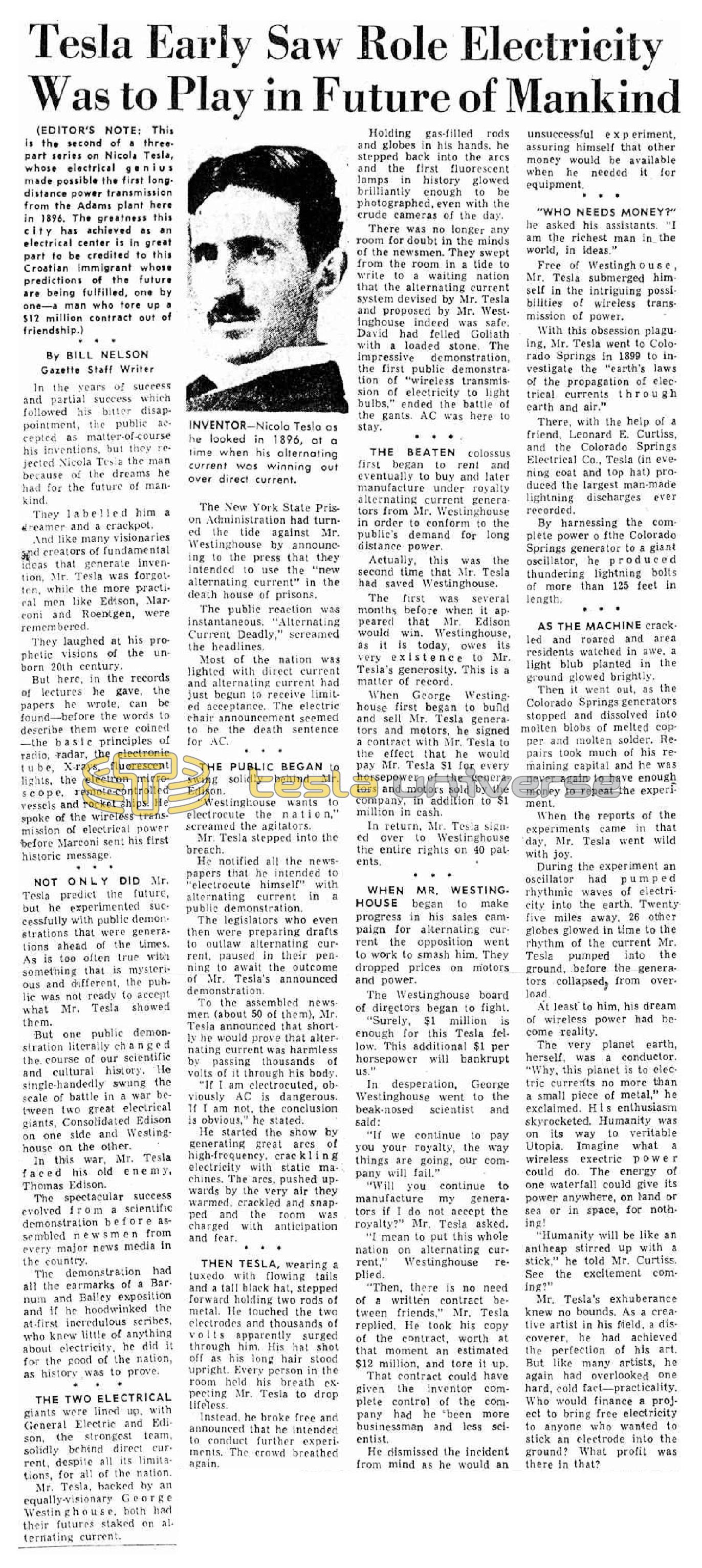
Nikola Tesla Articles
Tesla Early Saw Role Electricity Was to Play in Future of Mankind
(EDITOR'S NOTE: This is the second of a three-part series on Nikola Tesla, whose electrical genius made possible the first long-distance power transmission from the Adams plant here in 1896. The greatness this city has achieved as an electrical center is in great part to be credited to this Croatian immigrant whose predictions of the future are being fulfilled, one by one — a man who tore up a $12 million contract out of friendship.)
By BILL NELSON
Gazette Staff Writer
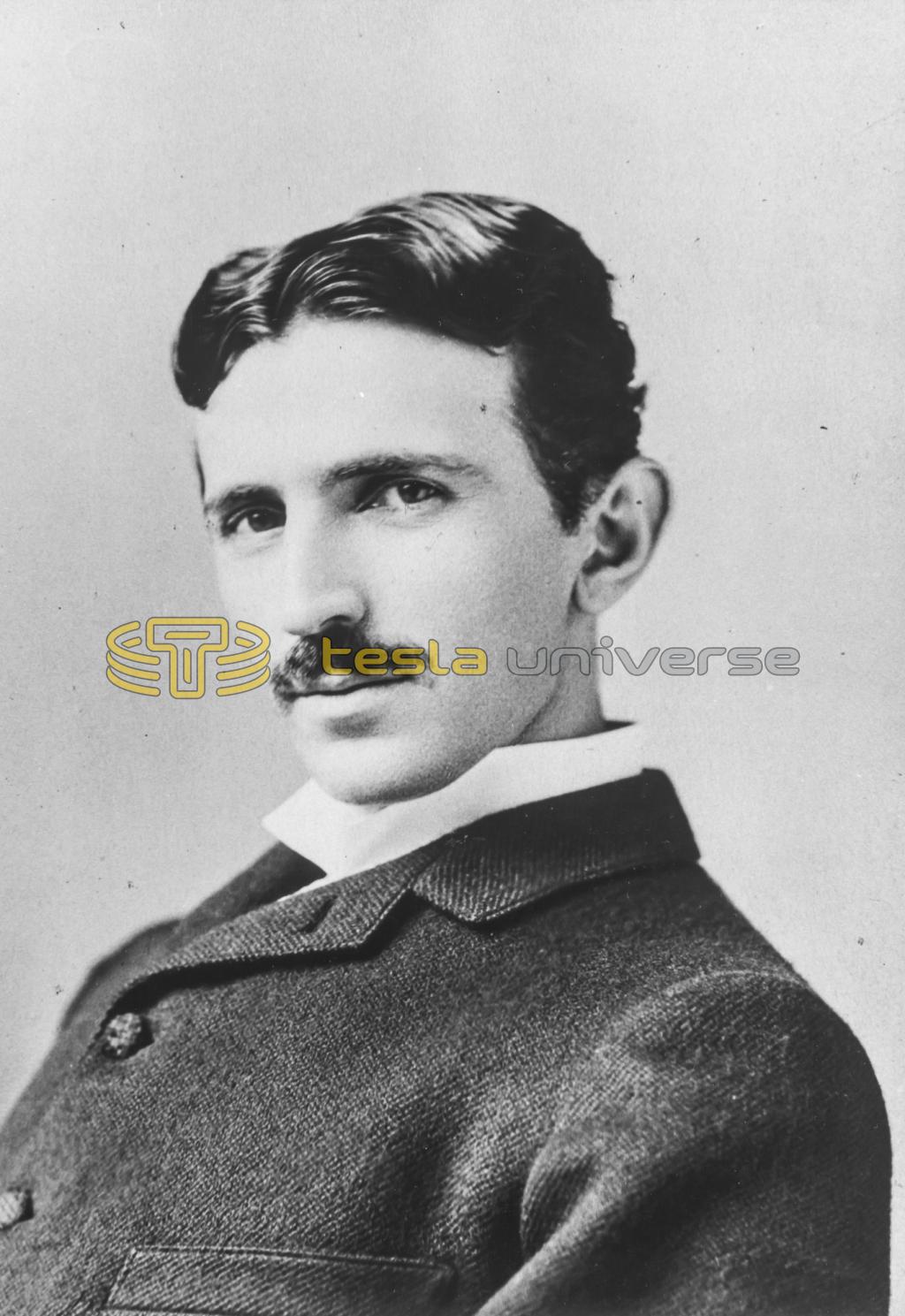
In the years of success and partial success which followed his bitter disappointment, the public accepted as matter-of-course his inventions, but they rejected Nikola Tesla the man because of the dreams he had for the future of mankind.
They labelled him a dreamer and a crackpot.
And like many visionaries and creators of fundamental ideas that generate invention, Mr. Tesla was forgotten, while the more practical men like Edison, Marconi and Roentgen, were remembered.
They laughed at his prophetic visions of the unborn 20th century.
But here, in the records of lectures he gave, the papers he wrote, can be found before the words to describe them were coined — the basic principles of radio, radar, the electronic tube, X-rays, fluorescent lights, the electron microscope, remote-controlled vessels and rocket ships. He spoke of the wireless transmission of electrical power before Marconi sent his first historic message.
NOT ONLY DID Mr. Tesla predict the future, but he experimented successfully with public demonstrations that were generations ahead of the times. As is too often true with something that is mysterious and different, the public was not ready to accept what Mr. Tesla showed them.
But one public demonstration literally changed the course of our scientific and cultural history. He single-handedly swung the scale of battle in a war between two great electrical giants, Consolidated Edison on one side and Westinghouse on the other.
In this war, Mr. Tesla faced his old enemy. Thomas Edison.
The spectacular success evolved from a scientific demonstration before assembled newsmen from every major news media in the country.
The demonstration had all the earmarks of a Barnum and Bailey exposition and if he hoodwinked the at-first incredulous scribes, who knew little of anything about electricity, he did it for the good of the nation, as history was to prove.
THE TWO ELECTRICAL giants were lined up, with General Electric and Edison, the strongest team, solidly behind direct current, despite all its limitations, for all of the nation.
Mr. Tesla, backed by an equally-visionary George Westinghouse, both had their futures staked on alternating current.
The New York State Prison Administration had turned the tide against Mr. Westinghouse by announcing to the press that they intended to use the "new alternating current" in the death house of prisons.
The public reaction was instantaneous. "Alternating Current Deadly," screamed the headlines.
Most of the nation was lighted with direct current and alternating current had just begun to receive limited acceptance. The electric chair announcement seemed to be the death sentence for AC.
THE PUBLIC BEGAN to swing solidly behind Mr. Edison.
"Westinghouse wants to electrocute the nation," screamed the agitators.
Mr. Tesla stepped into the breach.
He notified all the newspapers that he intended to "electrocute himself" with alternating current in a public demonstration.
The legislators who even then were preparing drafts to outlaw alternating current, paused in their penning to await the outcome of Mr. Tesla's announced demonstration.
To the assembled newsmen (about 50 of them), Mr. Tesla announced that shortly he would prove that alternating current was harmless by passing thousands of volts of it through his body.
"If I am electrocuted, obviously AC is dangerous. If I am not, the conclusion is obvious," he stated.
He started the show by generating great arcs of high-frequency, crackling electricity with static machines. The arcs, pushed upwards by the very air they warmed, crackled and snapped and the room was charged with anticipation and fear.
THEN TESLA, wearing a tuxedo with flowing tails and a tall black hat, stepped forward holding two rods of metal. He touched the two electrodes and thousands of volts apparently surged through him. His hat shot off as his long hair stood upright. Every person in the room held his breath expecting Mr. Tesla to drop lifeless.
Instead, he broke free and announced that he intended to conduct further experiments. The crowd breathed again.
Holding gas-filled rods and globes in his hands, he stepped back into the arcs and the first fluorescent lamps in history glowed brilliantly enough to be photographed, even with the crude cameras of the day.
There was no longer any room for doubt in the minds of the newsmen. They swept from the room in a tide to write to a waiting nation that the alternating current system devised by Mr. Tesla and proposed by Mr. Westinghouse indeed was safe. David had felled Goliath with a loaded stone. The impressive demonstration, the first public demonstration of "wireless transmission of electricity to light bulbs," ended the battle of the gants. AC was here to stay.
THE BEATEN colossus first began to rent and eventually to buy and later manufacture under royalty alternating current generators from Mr. Westinghouse in order to conform to the public's demand for long distance power.
Actually, this was the second time that Mr. Tesla had saved Westinghouse.
The first was several months before when it appeared that Mr. Edison would win. Westinghouse, as it is today, owes its very existence to Mr. Tesla's generosity. This is a matter of record.
When George Westinghouse first began to build and sell Mr. Tesla generators and motors, he signed a contract with Mr. Tesla to the effect that he would pay Mr. Tesla $1 for every horsepower of the generators and motors sold by the company, in addition to $1 million in cash.
In return, Mr. Tesla signed over to Westinghouse the entire rights on 40 patents.
WHEN MR. WESTINGHOUSE began to make progress in his sales campaign for alternating current the opposition went to work to smash him. They dropped prices on motors and power.
The Westinghouse board of directors began to fight.
"Surely, $1 million is enough for this Tesla fellow. This additional $1 per horsepower will bankrupt us."
In desperation, George Westinghouse went to the beak-nosed scientist and said:
"If we continue to pay you your royalty, the way things are going, our company will fail."
"Will you continue to manufacture my generators if I do not accept the royalty?" Mr. Tesla asked.
"I mean to put this whole nation on alternating current," Westinghouse replied.
"Then, there is no need of a written contract between friends," Mr. Tesla replied. He took his copy of the contract, worth at that moment an estimated $12 million, and tore it up.
That contract could have given the inventor complete control of the company had he been more businessman and less scientist.
He dismissed the incident from mind as he would an unsuccessful experiment, assuring himself that other money would be available when he needed it for equipment.
"WHO NEEDS MONEY?" he asked his assistants. "I am the richest man in the world, in ideas."
Free of Westinghouse, Mr. Tesla submerged himself in the intriguing possibilities of wireless transmission of power.
With this obsession plaguing, Mr. Tesla went to Colorado Springs in 1899 to investigate the "earth's laws of the propagation of electrical currents through earth and air."
There, with the help of a friend, Leonard E. Curtiss, and the Colorado Springs Electrical Co., Tesla (in evening coat and top hat) produced the largest man-made lightning discharges ever recorded.
By harnessing the complete power of the Colorado Springs generator to a giant oscillator, he produced thundering lightning bolts of more than 125 feet in length.
AS THE MACHINE crackled and roared and area residents watched in awe, a light bulb planted in the ground glowed brightly.
Then it went out, as the Colorado Springs generators stopped and dissolved into molten blobs of melted copper and molten solder. Repairs took much of his remaining capital and he was never again to have enough money to repeat the experiment.
When the reports of the experiments came in that day, Mr. Tesla went wild with joy.
During the experiment an oscillator had pumped rhythmic waves of electricity into the earth. Twenty-five miles away. 26 other globes glowed in time to the rhythm of the current Mr. Tesla pumped into the ground, before the generators collapsed, from overload.
At least to him, his dream of wireless power had become reality.
The very planet earth, herself, was a conductor. "Why, this planet is to electric currents no more than a small piece of metal," he exclaimed. His enthusiasm skyrocketed. Humanity was on its way to veritable Utopia. Imagine what a wireless electric power could do. The energy of one waterfall could give its power anywhere, on land or sea or in space, for nothing!
"Humanity will be like an antheap stirred up with a stick," he told Mr. Curtiss. See the excitement coming?"
Mr. Tesla's exuberance knew no bounds. As a creative artist in his field, a discoverer, he had achieved the perfection of his art. But like many artists, he again had overlooked one hard, cold fact — practicality. Who would finance a project to bring free electricity to anyone who wanted to stick an electrode into the ground? What profit was there in that?