Nikola Tesla Articles
Transatlantic Wireless Telegraphy II
IN the spring of 1903 the transmission of news messages from America to the London Times was attempted, in order to demonstrate that messages could be sent from America by means of the new method, and for a time these messages were correctly received and published in that newspaper.
By reference to the files of the Times I find that 267 words of news, transmitted across the Atlantic by wireless, were published in the London Times during the latter part of March and the early part of April of that year. A breakdown in the insulation of the apparatus at Glace Bay made it necessary, however, to suspend the service, and, unfortunately, further accidents made the transmission of messages uncertain and untrustworthy. In consequence of this it was decided not to attempt, for the time being, the transmission of any more public messages until such time as a trustworthy service could be maintained in both directions under all ordinary conditions.
As I found that many improvements evolved during the course of the numerous tests and experiments could not be readily applied to the plants at Poldhu and Cape Breton, it was decided to erect a completely new long-distance station in Ireland, and to transport the one at Glace Bay to a different site in the vicinity, where sufficient land was available for experimenting with aerials of much larger dimensions than had been hitherto employed.
Experiments were, however, continued with Poldhu, and in October, 1903, it became possible to supply the Cunard steamship Lucania, during her entire crossing from New York to Liverpool, with news transmitted direct from the shore.
In November of the same year tests similar to those carried out with the Italian cruiser took place on behalf of the British Admiralty between Poldhu and H.M.S. Duncan.
Communication with Poldhu was maintained during the entire cruise of this battleship from Portsmouth to Gibraltar, and further communication was established between Poldhu and the Admiralty station situated on the Rock of Gibraltar. It should be noted that the distance between Cornwall and Gibraltar is 1000 miles — 500 over land and 500 over water.
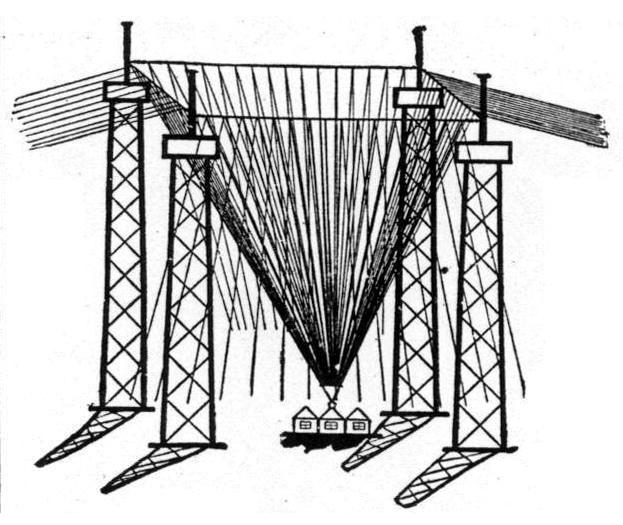
The aerial at Poldhu was shortly afterwards extended by the addition of wires sloping downwards, umbrella-fashion, as shown in Fig. 10. This increased the capacity of the aerial, and some further tests were carried out with a station at Fraserburgh, in the north of Scotland. From these tests considerable advantage appeared to be derived, at least for communication over land, by the adoption of much longer waves than had been hitherto employed, and with a wave-length of 14,000 feet it was found possible to telegraph over a distance of 550 miles with an expenditure of energy of about 1 kilowatt.
The operation of the long-distance stations in England and America made it possible to transmit messages to ships, whatever their position, between Europe and North America; and to the Cunard Company belongs the credit of having greatly encouraged the long-distance tests, a circumstance which enabled them to commence, in June, 1904, the regular publication on their principal vessels of a daily newspaper, containing telegraphic messages of the latest news from Europe and America.
This daily newspaper has now been adopted by nearly all the large liners plying to New York and the Mediterranean, and it obviously owes its entire existence to long-distance wireless telegraphy. Therefore the tranquillity and isolation from the outside world, which it is still possible to enjoy on board of some ships, is rapidly becoming a thing of the past; but, however much travelers may sigh over the innovations which have lately been brought about, they seem anxious enough to avail themselves of the new method of communication on all possible occasions.
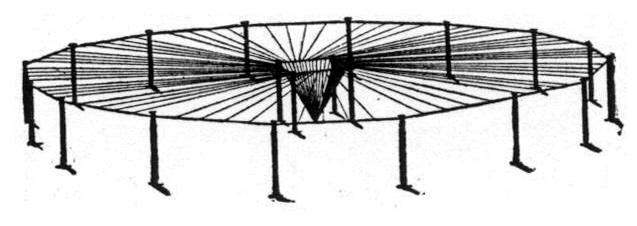
Early in 1905 the construction of the new station at Glace Bay was sufficiently advanced to allow of preliminary tests being carried out. The aerial was very large, and consisted of a vertical portion in the middle 220 feet long supported by four towers and attached to horizontal wires, 200 in number, each 1000 feet long, extending radially all round, and supported at a height of 180 feet from the ground by an inner circle of eight and an outer circle of sixteen masts (Fig. 11). The natural period of oscillation of this aerial gave a wave-length of 12,000 feet. The capacity employed was 1.8 microfarads, and the spark-length 3/4-inch.
Signals and messages from this station were received at Poldhu by day as well as by night, but no commercial use of the station was made at that time, in consequence of the fact that, although the signals came through by day as well as by night, they were exceedingly weak and faint, and also because the corresponding station on the same plan had not yet been erected in Ireland.
A further step in advance was the adoption at the Transatlantic stations of the directional aerial shown in Fig. 12.2 The ordinary wireless telegraph aerials, which I have already described, send out electric radiation equally in all directions. This is, however, in many cases a disadvantage. Many suggestions respecting methods for limiting the direction of radiation have been made by various workers, notably by Messrs. Artom, Braun, and Bellini Tosi.
In some of my earliest experiments, in 1896, I used copper mirrors, by the aid of which it was possible to project a beam of electric radiation in a certain direction, but I soon found that this method would only work over short distances.
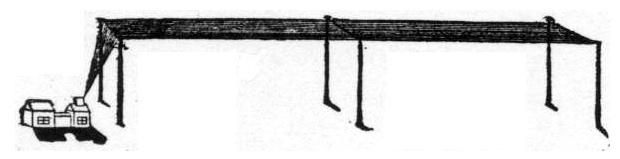
About three years ago I again took up the subject, and was able to determine that by means of horizontal aerials, disposed in a particular manner, it was possible to confine the effects of electric waves mainly to certain directions as desired. True, the limitation of transmission to one direction is not very sharply defined, but it is nevertheless very useful. The practical result of this method has been, so far, that messages can be sent over considerable distances in the desired directions, while they travel only over a comparatively short distance in other directions, and that, with aerials of moderate height, greater efficiency in a given direction can be obtained than can be obtained all round by means of the ordinary aerials.
When this type of aërial was adopted at Glace Bay a considerable strengthening of the received signals at Poldhu was noticed. It was therefore decided to adopt the directional aërial at all long-distance stations.
A further improvement introduced at Clifden and Glace Bay consisted in the adoption of air condensers, composed of insulated metallic plates suspended in air at ordinary pressure. In this manner it is possible to prevent the dissipation of energy due to losses caused by the dielectric hysteresis in the glass dielectric of the condensers previously employed, and a very appreciable economy in working, resulting from the absence of breakages of the dielectric, is effected. These air condensers, which have been in use since May, 1907, have been entirely satisfactory. After very considerable delay and expense, the new station at Clifden was got ready for tests by the end of May, 1907, and experiments were then commenced with Glace Bay.
The wave-length used during these tests was 12,000 feet, the capacity employed 1.6 microfarads, and the potential to which the condenser was charged 80,000 volts.
Good signals were obtained at Cape Breton from the very commencement of the tests, but some difficulty was encountered in consequence of the effects of atmospheric electricity due to the prevalence of thunderstorms in the eastern part of Canada during the first few days of the tests.
Simultaneously with these tests others were carried out from Poldhu to Glace Bay with a new system of transmitting apparatus, by means of which continuous or semi-continuous oscillations could be produced.
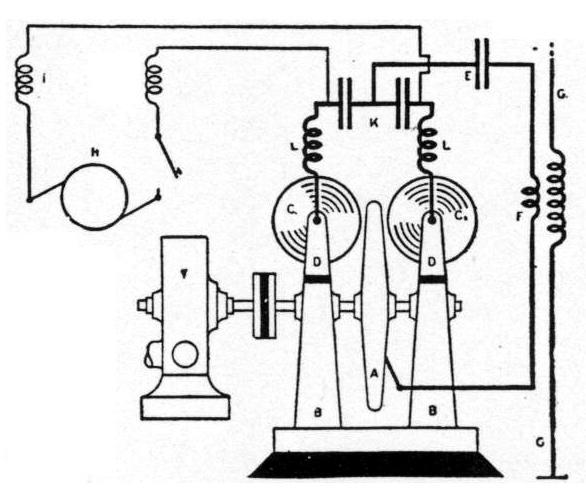
Proportionately to the energy employed the signals from Poldhu were so much better than those from Clifden that I decided at once to adopt this new method of transmission at Glace Bay and Clifden. The apparatus which I have been using for producing continuous or closely adjacent trains of electric oscillations is as follows: — A metal disc A (Fig. 13), insulated from the earth, is caused to rotate at a very high speed by means of a high-speed electric motor or steam turbine. Adjacent to this disc, which I shall call the middle disc, are placed two other discs, C₁, C₂, which may be called polar discs, and which also can be rotated at a high rate of speed. These polar discs should have their peripheries very close to the surface or edges of the middle disc.

If a small amount of energy is used, stationary knobs or points may be used in place of the side discs.
The two polar discs are connected respectively through suitable brushes to the outer ends or terminals of two condensers K, joined in series, and these condensers are also connected through suitable inductive resistances to the terminals of a generator, which should be a high-tension continuous-current dynamo.
On the high-speed or middle disc a suitable brush or rubbing contact is provided, and connected between this contact and the middle point of the two condensers is inserted an oscillating circuit consisting of a condenser E in series with the inductance, which last is connected inductively or conductively to the aerial.
If the necessary conditions are fulfilled, and a sufficient E.M.F. is employed, a discharge will pass between the outer discs and the middle disc, which discharge is neither an oscillatory spark nor an ordinary arc, and powerful oscillations will be created in the signalling condenser B and oscillatory circuit F.
I have found that in order to obtain good effects a peripheral speed of more than 100 meters per second is desirable; therefore particular precautions have to be taken in the construction of the discs. Electrical oscillations of a frequency as high as 200,000 per second can be obtained.
The apparatus works probably in the following manner: — Let us imagine that the source of electricity is gradually charging the double condenser and increasing the potential at the discs, say C₁ positively and C₂ negatively; at a certain instant the potential will cause the charge to jump across one of the gaps, say between C₂ and A. This will charge the condenser E, which will then commence to oscillate, and the charge in swinging back will jump from A to C₁, which is charged to the opposite potential. The charge of E will again reverse, picking up energy at each reversal from the condensers K. The same process will go on indefinitely, the losses which occur in the oscillating circuit EF being made good by the energy supplied from the generator H. If the disc is not rotated, or rotated slowly, an ordinary arc is at once established across the small gaps, and no oscillations take place. The efficient cooling of the discharge by the rapidly revolving disc seems to be one of the conditions necessary for the production of the phenomena.
By means of this apparatus tests were carried out, but it was found, as was to be expected, that the oscillations were too continuous and of too high a frequency to affect a receiver, such as the magnetic detector, unless an interrupter was inserted in one of the circuits of the receiver.
A syntonic coherer receiver would, however, work, in consequence, no doubt, of the considerable rise of potential which occurred at its terminals through the cumulative effect of resonance.
The best results over long distances have, however, been obtained by a disc as shown in Fig. 14, in which the active surface is not smooth, but consists of a number of knobs or pegs, at the end of which the discharges take place at regular intervals. In this case, of course, the oscillations are not continuous, but consist of a regular succession of trains of undamped or slightly damped waves.
In that manner it is possible to cause the groups of oscillations radiated to reproduce a musical note in the receiver, distinguishable in a telephone, and thereby it is easier to differentiate between the signals emanating from the transmitting station and noises caused by atmospheric electrical disturbances. By this method very efficient resonance can, moreover, be obtained in appropriately designed receivers.
A few tests with apparatus based on the principle described were carried out between Glace Bay and Clifden, and on October 17 of the year 1907 a limited service for Press messages was commenced between Great Britain and America. Difficulties were experienced, however, over the question of rates with the telegraph companies working the land-lines between Glace Bay and the principal towns of Canada and the United States, and at present the strange anomaly exists that the rates for Press messages on the American land-lines are much cheaper for messages going from England to New York than in the reverse direction. On February 3, 1908, this service was extended to ordinary messages between London and Montreal.
The stations at Clifden and Glace Bay are not complete, and the necessary duplication of the running machinery has not yet been executed, but nevertheless communication across the Atlantic has never been interrupted for more than a few hours since the commencement of commercial working on October 17, 1907.
There have, however, been several serious interruptions at Clifden, due to the untrustworthiness of the land-lines connecting Clifden to the ordinary telegraph system. On one occasion one of these interruptions lasted from 5.20 p.m. to 10.30 a.m., a duration of seventeen hours, and on another occasion the land telegraph wires were struck by lightning and disabled for twelve hours. There have also been recorded numerous other interruptions of shorter duration, which resulted in delays to private and Press messages. Further delays have also been caused through interruptions on the land-lines connected with the Canadian station.
During the first months, on account of imperfections in the auxiliary apparatus connected principally with the operating keys and switches, only a fraction of the available transmitting power was used. In consequence of this the speed of transmission was slow, and short interruptions somewhat frequent. Many of these difficulties have now been overcome, and in a few more months, when it should be possible to utilize the full power available, a very much greater speed and efficiency is likely to be attained.
Messages can now be transmitted across the Atlantic by day as well as by night, but there still exist certain periods, fortunately of short duration, when transmission across the Atlantic is difficult and at times ineffective, unless an amount of energy greater than that used during what I might call normal conditions is employed.
Thus, in the morning and evening when, due to the difference in longitude, daylight or darkness extends only part of the way across the Atlantic, the received signals are weak and sometimes cease altogether.
It would almost appear as if illuminated space possessed for electric waves a different refractive index from dark space, and that in consequence the electric waves may be refracted and reflected in passing from one medium to the other. It is therefore probable that these difficulties would not be experienced in telegraphing over equal distances from north to south, or vice versa, as in this case the passage from daylight to darkness would occur almost simultaneously in the whole of the medium between the two points.
In the same manner a storm area in the path of the signals often brings about a considerable weakening of the received waves, whilst if stormy conditions prevail all the way across the Atlantic no interference is noticeable. Electric-wave shadows, like sound shadows, may be formed by the interference of reflected waves with the direct waves, whereby signals may be much less effective or imperceptible in the area of such electric-wave shadow.
In the same manner as there exist periods when signals across the Atlantic are unusually weak, there exist other conditions, especially at night, which make the signals abnormally strong. Thus on many occasions ships, and stations equipped with apparatus of a normal range of 200 miles, have been able to communicate over distances of more than 1000 miles. This occurred recently when a ship in the English Channel was able to correspond with another in the Mediterranean. But the important factor about wireless telegraphy is that a service established for a certain distance shall be able to maintain trustworthy communication over that distance.
Long-distance stations are now in course of erection in many parts of the world, the most powerful of all being that of the Italian Government at Coltano, and I have not the slightest doubt but that telegraphy through space will soon be in the position of affording communication between distant countries at cheaper rates than can be obtained by any other means.
As to the practicability of wireless telegraphy working over long distances, such as that separating England from America, there is no longer need for any doubt. Although the stations have been worked for only a few hours daily, 119,945 words of Press and commercial messages had been transmitted across the ocean by this means up to the end of February, 1908, since the service was opened.
The best judges of a service are those who have made use of it, and amongst newspapers, the chief users have been the New York Times and the London Times, which have already publicly expressed their opinion of this new method of communication.
Whether the new telegraphy will or will not injure or displace the cables is still a matter of conjecture, but in my opinion it rests a good deal on what the cables can do in the way of cheaper rates. It is not, as some appear to imagine, either the business or the wish of those concerned in the development of wireless telegraphy to injure the cable industry. They are endeavoring at present to demonstrate that the new method is not only valuable for shipping, but that it should be also regarded as a new and cheaper method of communicating with far distant countries. Whatever may be the view as to its shortcomings and defects, there can be no doubt but that wireless telegraphy across the Atlantic has come to stay, and will not only stay, but continue to advance.
In seven years the useful range of wireless telegraphy has increased from 200 miles to 2500 miles. In view of that fact, he will be a bold prophet who will venture to affirm what may not be done in seven years more.
I shall not presume to say that at the present moment the wireless telegraph service between London and New York is as efficient and as rapid as that supplied by the cables. For nearly fifty years the Transatlantic cable organization has been in existence, and there are now sixteen cables working across the North Atlantic, so that in the case of a breakdown of one cable the traffic is sent by one of the others. Moreover, long experience has served to bring their land-line connections to a high state of perfection. Nevertheless, I am convinced that if there were only one cable and the present wireless service, interruptions would be more frequent and much more serious in the case of the cable than in that of the wireless service.
We have only to look towards those parts of the globe such as India, South Africa, and so forth, where transoceanic communication is dependent upon only one or two cables, and the force of my remarks will be more readily appreciated. The cases of delay in regard, not only to commercial messages, but also to Government dispatches, are only too frequent, as no doubt you have observed from time to time in the daily Press.
Among many people there seems to be a rooted conviction that wireless telegraphy is not suitable for the handling of code or cipher messages. Whatever gave rise to this idea I do not know, but I wish to emphasize that it is purely fictitious. Code messages can be sent just as well by wireless as by ordinary methods of telegraphy.
I need hardly say that most of the wireless messages passing between warships are now expressed in code, as are likewise the majority of the commercial messages handled by the Clifden and Cape Breton stations.
I do not wish to claim that wireless telegraphy is infallible, and although errors do sometimes occur, it is absolutely certain that, having regard to the London and Montreal service, most of the mistakes can be traced to the land-line telegraph transmission between London and Clifden, and between Glace Bay and Montreal.
I find, however, that probably the greatest ignorance prevails in regard to what is termed “tapping,” or intercepting wireless messages. No telegraph system is secret. The contents of every telegram are known to every operator who handles it. It is incorrect to suppose that anyone can at will pick up wireless messages. On the other hand, it is easy for anyone knowing the Morse code to step into many telegraph offices and read off the messages by the click of the instruments.
Further, it is practicable, but illegal in this country, to make arrangements so that messages which pass over a telegraph line can be read by persons who are not operating the line at all. It is also expensive to erect a tall pole or tower and fix up all the instruments which are necessary before wireless messages can be taken in, and, moreover, such proceeding is contrary to the law of the land.
It should be remembered, too, that any ordinary telegraph or telephone wire can be tapped, and the conversation going through it overheard, or its operation interfered with. Results published by Sir William Preece show that it is possible to pick up at a distance, on another circuit, the conversation which may be passing through a telephone or telegraph wire.
At Poldhu, on a telephone connected to a long horizontal wire, the messages passing through a Government telegraph line a quarter of a mile away can be distinctly read. In a paper on his method of magnetic space telegraphy, Sir Oliver Lodge mentions an occasion on which he was able to interfere, from a distance, with the working of the ordinary telephones in the city of Liverpool.
Many instances can be enumerated showing that electric light and tramway power-stations have interfered with cables and land-lines. Nevertheless, there are penalties attached to the tapping of a telegraph wire, and it ought to be as well known that, since the passing of the Wireless Telegraphy Act, there are penalties involved if any wireless stations are erected or worked without the consent of the Postmaster-General. In conclusion, I may say that I am very confident that it is only a question of time, and that not a very long time, before wireless telegraphy over great distances, possibly round the world, will become an indispensable aid to commerce and civilization.
1 From a discourse delivered at the Royal Institution on Friday, March 13, 1908, by Commendatore G. Marconi. Continued from p. 237.
2 “On Methods whereby the Radiation of Electric Waves may be mainly Confined,” &c. Proc. Roy. Soc., A. lxxii., Marconi, 1906.
3 Patent Application No. 20,119, September 9, 1907.