
Nikola Tesla Articles
Wireless Transmission of Energy - Dream or Possibility Page 33
Galaxy - September 1st, 1984
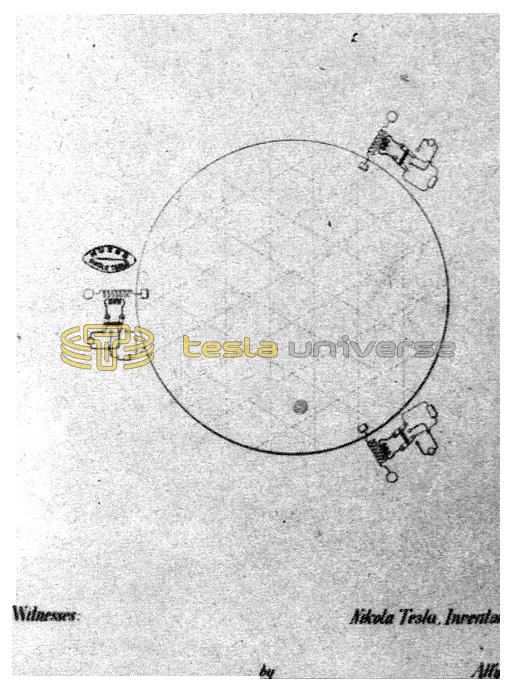
notes is shown in Fig. 5. We quote a few interesting details:
“…One example can help us see what we may really expect in the practical application of the principle for the purpose under consideration (Tesla means the principle of the transmission of energy through the terrestrial globe — author’s note). Let us assume a capacitance of 10,000 cm. This can be achieved by using a roof (a metal one) on insulated supports. If the roof is in the form of a sphere (this is what will be used in the example under consideration), it would have to have a radius of about 100 m. But, as has been demonstrated in many tests, the capacitance of an insulated terminal increases by about 1/2 percent per foot, so that raising the sphere 400 feet would be a sufficient radius of only 33 m.
Let us now assume that we are working with 100,000 periods a second and that we have a generator of 100 h.p. What may we, in the best case, expect to obtain at the receiving station? 100,000 h.p. is roughly 75,000 W. Knowing this, we can find the potential which we shall obtain on the sphere of capacitance C by applying the energy which is at our disposal.
Let the potential which we seek be P. On the basis of
\( \dfrac{1}{2} P^{2} \dfrac{10000}{9 \cdot 10^{11}} \cdot 200000 = 75000 \).
Roughly, this gives 8,200 V. This means that we can periodically bring to the terminal a potential of 8,200 V (200,000 times a second).
Obviously, with so small a voltage the effects at a distance will be small, but we can increase the voltage many times by the use of resonance, without using greater power…”
Without going further into the details of Tesla’s calculation, we quote the result of the calculation:
“…On the basis of the law of current density and obvious facts, it follows that the e.m.f. which will be had at the polar cap (the polar cap, according to Tesla, is a part of the sphere about the antipode of the point at which the transmitter is located, and its surface is defined so that it amounts to half a wavelength measured from the antipode to the boundary of the cap — author’s note) will be in the same ratio smaller as the density is smaller, and so it will be \( \dfrac{8200}{900} = 8 \) V…”
Tesla further develops the idea of how the energy will be collected at the polar cap and concludes that this can be realized by the use of a bundle of vertical wires which serve as an antenna! These wires would have to be arranged in concentric circles. He concludes that with elevated wires (or rather a curtain of wires) 200 feet long (about 60 m) we obtain 500 cm per wire. In order to obtain a capacitance of \( 900 \times 10000 \) cm, he calculates that he would need 18,000 vertical wires, of a total length of 680 miles. Then, according to Tesla, all the power could be collected at the polar cap (Tesla foresees that there will be losses, but he considers that they are small enough for the system to be efficient). In the example under consideration it follows that each wire would receive 4.16 W.
It is not easy to understand Tesla’s theory of the transmission of energy by the redistribution of the electrical charge on the sphere. We have already mentioned that Tesla combined the electrostatic case, on the basis of which he finds the distribution of the potential on the sphere–antenna and on the sphere–Earth. However, in explaining the transmission of energy he includes the propagation of a current wave across the sphere–Earth, only to return at the end to the static case in calculating the transmitted power. In an interesting way Tesla tried, by the application of a simple electrical model, to illuminate the transmission of energy through a conducting body. To insist that this model is sufficiently exact would, in our opinion, be as wrong as simply rejecting the reader’s theories of Tesla. Energy from the transmitter is not transmitted through the Earth alone, but the surrounding space also takes part. Tesla considered that by the use of sufficiently low frequencies the condition would be realized for the Earth, as a sphere, to radiate very little wave. He even used Hertz’s formulas and on the basis of them obtained data that low frequencies are those which must be applied in the case when the system is to radiate little.
The author devoted a fair amount of time to the study of Tesla’s notes from Long Island and with regret concludes that he did not find in them a final answer, or a confirmation of experiments which would indicate that Tesla succeeded in transmitting some significant amounts of energy without wires over distances, which would confirm Tesla’s calculations and convictions. The necessary apparatus is expensive in the first place, and Tesla did not have the means to realize this undertaking. What he began to build on Long Island was very impressive, solid and ambitious. In the notes he speaks of experiments in measuring the resistance of the grounding and of some tests of apparatus, but the greater part is devoted to various calculations.
Transmission of an image by electrical means
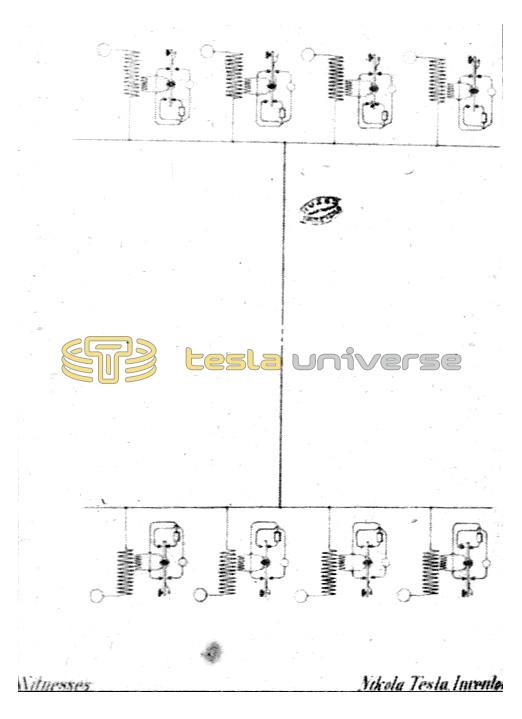
Of the parts of the notes which relate to unrealized ideas, an interesting one is the entry of 30 May 1901, where he speaks of a system for the transmission of drawings or images through wires, the method and the apparatus. We quote a translation of this entry:
New York, 30 May 1901.
Transmission at a distance through wires or conductors of written text or pictures. Also “seeing by means of wires.” Method and apparatus for this.
The basic idea on which the discovery rests is that it is possible to establish conditions similar to those which exist in the eye and the optic nerves. There must exist a definite relation with respect to order and intensity between the numerous channel fibers, or nerves, of the transmitter and the receiver. For this purpose I make use of tuned circuits, and in the application of the method and apparatus which I have already described, as many circuits as are needed can easily be applied. By the application of only a few basic tones a large number of combinations can be obtained, compared with the necessary combinations which appear in visual images. The eye receives waves which propagate in straight lines, and these maintain their order in space. The transmission of an impulse through one channel differs from transmission through a group of fibers which are mutually isolated. In spite of this the result is practically the same from the point of view, for, as in the transmission of light images by means of rays, the transmitting and receiving circuit can be arranged in the same way. Although the impulses will be transmitted through the wires without preservation of order (that is, they will be mixed in the time domain — author’s note), if they are separated in the same way as they are combined in the transmitter, it is clear that
