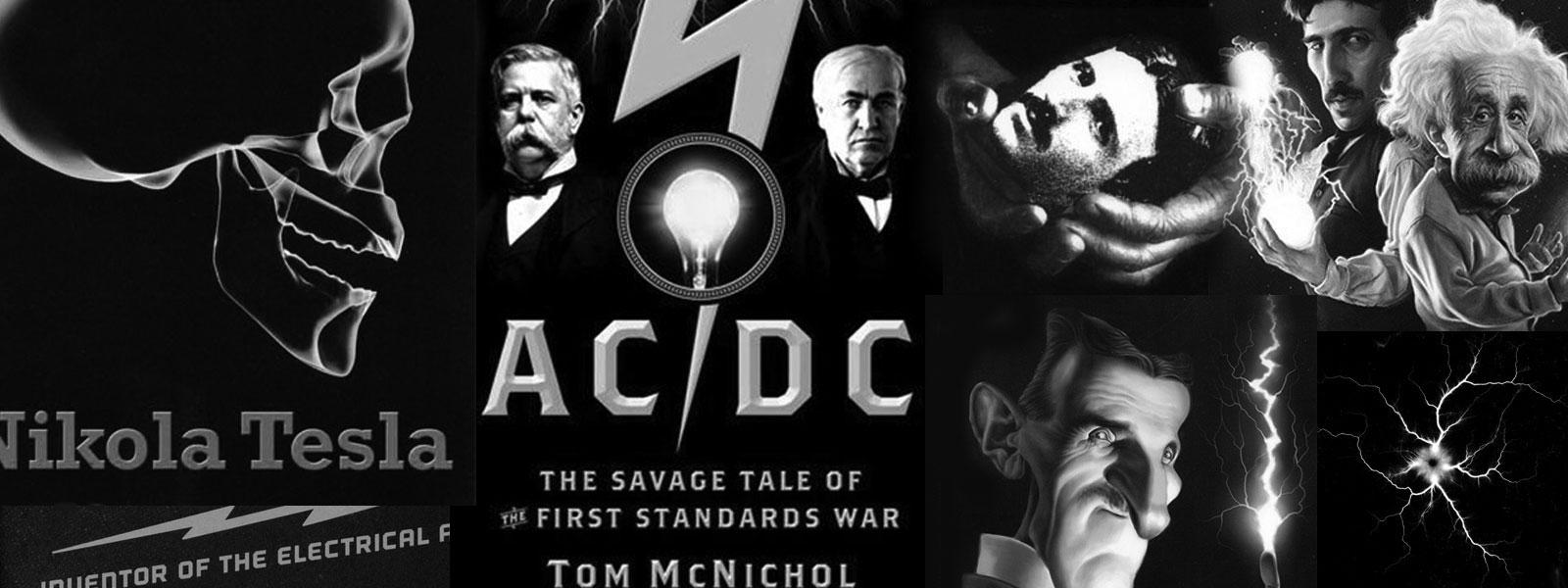
Nikola Tesla Books
surprise I soon realized that his works comprised one hundred heavy volumes in small print, written by that giant. Destroying, in the process, as many as seventy-two cups of black coffee a day, I had to finish that task as well. When I read the last volume, I said: never again.
The opposite of Nikola Tesla was the great founder of the modern theory of the atom and, in fact, the founder of modern chemistry, John Dalton (1776–1844), otherwise a private teacher of mathematics, who once stated that he could carry his entire library on his back, and that he had not read half of those books at all. Thus, a passion for reading is not an essential characteristic of creativity.
In addition to a passion for reading, Tesla possessed an extraordinarily developed memory, so that even in his later years he knew by heart entire passages from our national poems, "The Mountain Wreath," "The Death of Smail-aga Chengic," and he knew excerpts from Goethe’s "Faust," Dante's "Divine Comedy," Shakespeare's "Hamlet," Byron's "Childe Harold," and Pushkin's "Eugene Onegin" - all of this in the original languages. His favorite poet among our own was Jovan Jovanovic Zmaj. In his youth he loved to read Mark Twain, with whom he later, in America, became a close friend.
This great capacity for memory stands in sharp contrast, for example, to the well-known forgetfulness of the great and congenial predecessor of Tesla, the classic of physical science Michael Faraday (1791-1867), a trained bookbinder's apprentice and journalistic colporteur, and later president of the Royal Institution (Academy of Sciences) in London, who is known as the founder of the modern science of electricity. When Faraday was twenty-nine years old, he traveled through Wales and saw many interesting things
