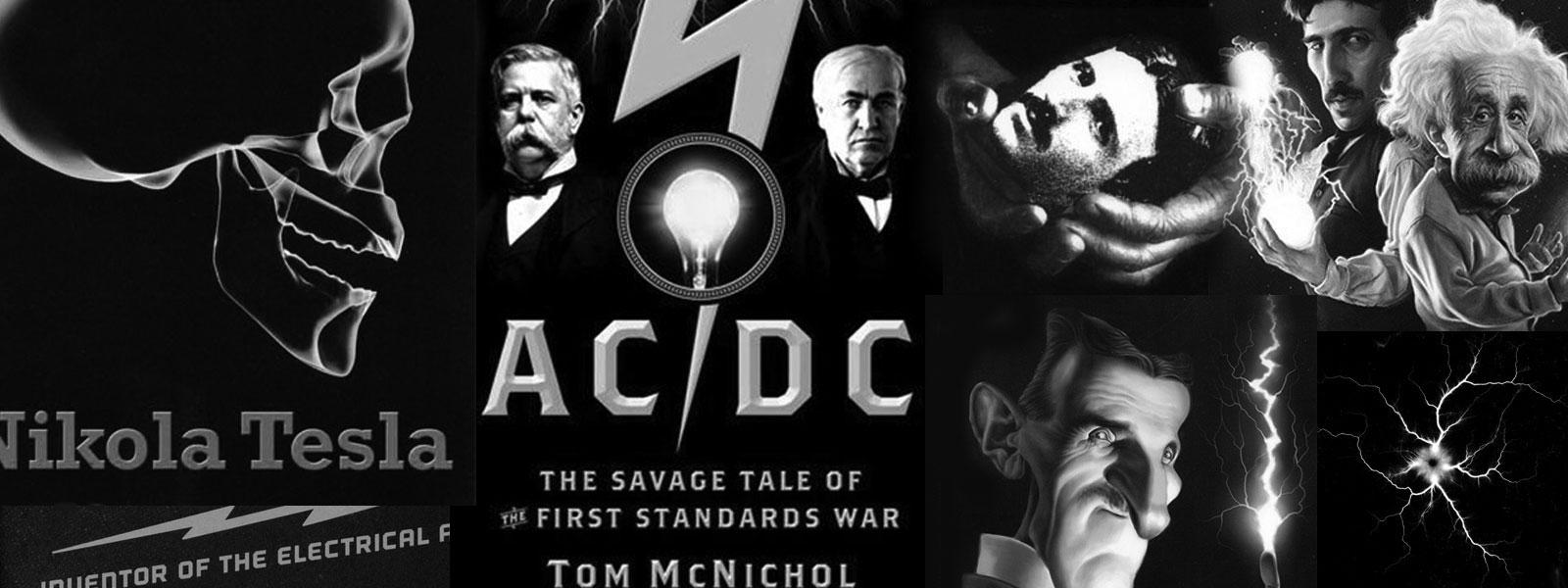
Nikola Tesla Books
death in the London magazine Nature, February
1943:
Tesla's main intention was the transmission of power and messages
through space. In 1892 and 1893, he developed his scheme. He supplied high-frequency energy to a large antenna, which consisted of a highly raised metal surface, connected by a vertical wire to a large metal plate buried in the ground. The receiving antenna was in every respect identical to the transmitting one... He did not patent the antenna... In this way, Tesla created, two years before wireless telegraphy began to be exploited on a commercial basis, all the elements for transmitting radio stations. After building several small stations, he built a large 200-kilowatt station in Colorado in 1899. From it, he transmitted enough power wirelessly to be able to
light a lamp 30 km away. From his station in Colorado, Tesla transmitted and received signals wirelessly over a distance of 1000 km. Later, his antenna design, his rotating interrupter, and his tuned transformer (circuits and resonance) were successfully utilized by many others in spark stations around the world.Space compels us to reduce this overview of Tesla's works
to just a few achievements that Tesla's creative imagination and constructive genius gave to the world... Some 700 patents are linked to his name, and a large part of these patents were realized before he turned 50 years old... Throughout his life of 86 years, Tesla rarely focused his attention on his personal success. He never revisited his earlier works and rarely sought priority, although he was constantly plagiarized. Such a reserve is especially strange for a mind that was so rich in creative thoughts and so competent in practical matters.
The inventor of the electronic oscillator, superheterodyne,
and frequency modulation, E. K. Armstrong, Nobel Prize
laureate, states in Radio Craft magazine, from February 1943, among other things, the following:
Nikola Tesla's inventions in the field of polyphase currents and his induction motor would be enough to immortalize his fame. Regarding his later work in the field of high-frequency and high-voltage currents, I feel compelled to state my opinion
