Nikola Tesla Images and Photographs

1983 U.S. American Inventors First Day Cover (Tesla Block of Four)
Official-style first day of issue cover for the September 21, 1983, U.S. 20 cent American Inventors block of four (Scott 2055–2058), postmarked Washington, D.C. The stamps honor Charles Steinmetz (electrical theories), Edwin Armstrong (frequency modulation), Nikola Tesla (induction motor), and Philo T. Farnsworth (first television camera). The cachet features portraits of the four electrical engineers and marks “A Century of Electrical Progress” (1884–1984). FDC SC #2055-2058
The enclosed card provides the following biographical notes:
Nikola Tesla (1855–1943)
was born of Serbian parents in the village of Smiljan, in what is now Yugoslavia. He showed his technical brilliance early, but felt that his native country offered him only limited opportunities, so in 1884 he emigrated to the United States and soon began working for Thomas Edison. He soon struck out on his own, however, for Edison had little use for Tesla’s bold new ideas — in particular, his polyphase ac system. Tesla’s polyphase ac system was brought to market by George Westinghouse, and after an acrimonious struggle with the Edison interests, who were wedded to the use of direct current (dc), the Tesla system became the standard of the twentieth century. Tesla’s other inventions included the synchronous ac motor, devices for generating high voltage and high frequency currents, and contributions to radio technology. Tesla received the Edison Medal of the American Institute of Electrical Engineers in 1916.
Philo Taylor Farnsworth (1906–1971)
was born on a farm near Beaver City, Utah and herded sheep as a young boy. As a high school student in Idaho he explained to his teacher his conception for sending pictures through the air, and he worked doggedly to create an all-electronic television system. After attending Brigham Young University he set up a laboratory in San Francisco and there, in 1927, transmitted his first image — a horizontal line. The next year he was able to send two-dimensional images and, after solving distortion problems, demonstrated a completely electronic television system on September 2, 1928. Farnsworth, who held 165 patents, founded the Farnsworth Television and Radio Corporation, and in addition to this television work also helped develop radar systems and special purpose vacuum tubes. The Institute of Radio Engineers presented him with the Morris N. Liebmann Memorial Award for important contributions to emerging technologies. He was a fellow of the American Association for the Advancement of Science and the IEEE.
Charles Proteus Steinmetz (1865–1923)
came to the United States in 1889 from Breslau, Germany, where he was a student at the University of Breslau. He joined the inventor Rudolf Eickemeyer in building electric apparatus at Yonkers, N.Y., and at the age of 27 formulated the law of hysteresis, which made it possible to reduce the loss of efficiency in electrical apparatus. When Eickemeyer’s firm was bought by General Electric, Steinmetz joined the new company, beginning a 31-year relationship that ended only with his death. His improvement in methods of making calculations of current in alternating current circuits revolutionized power engineering, and his theory of electrical transients stood as another important contribution. In the midst of his G.E. career, Steinmetz was also a professor at Union College and a vocal champion of civic and political causes. A President of the American Institute of Electrical Engineers (1901–02), he also received the Elliott Cresson Gold Medal of the Franklin Institute.
Edwin Howard Armstrong (1890–1954)
was born in New York and became interested in radio engineering as a high school student. He attended Columbia University and as an undergraduate made the first of his many inventions, an improvement for radio called regenerative circuit. Later he developed the superheterodyne circuit, which made radio receivers vastly more sensitive and stable. His third important discovery was superregeneration, which limited oscillation in amplification, and his greatest contribution was frequency modulation, or FM radio. Armstrong patented 42 inventions. He was a recipient of the Edison Medal of the American Institute of Electrical Engineers and the Medal of Honor of the Institute of Radio Engineers. He is also honored in the Pantheon of the International Telecommunications Union in Geneva.
Related images






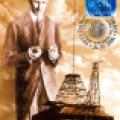

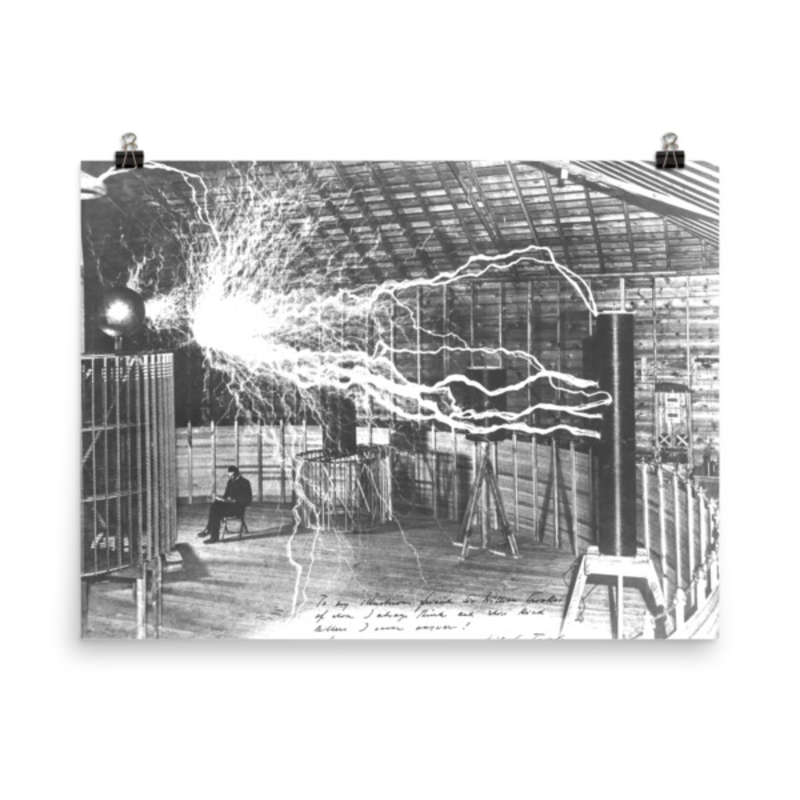
Nikola Tesla Colorado Springs Poster
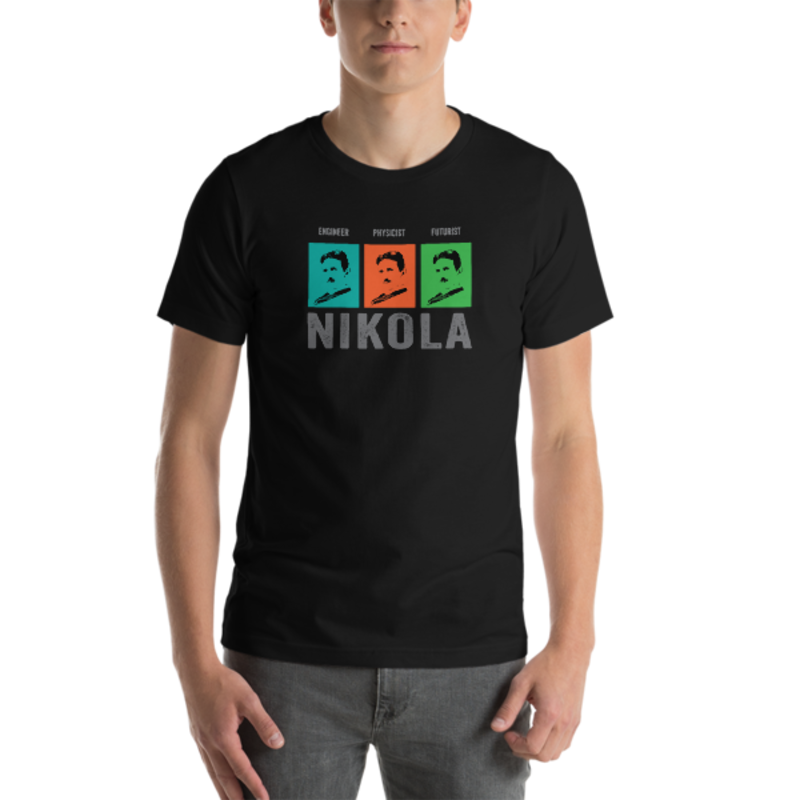
Nikola Tesla - Engineer, Physicist, Futurist - T-Shirt