Nikola Tesla Inventions
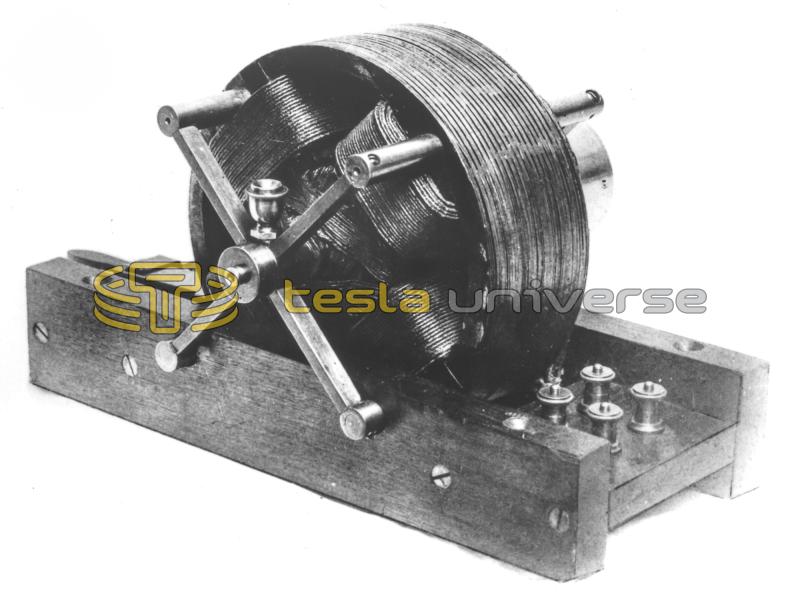
Alternating Current Induction Motor
Patented in 1888 under U.S. Patent 381,969, Nikola Tesla's alternating current (AC) induction motor revolutionized electrical engineering by using a rotating magnetic field to drive a rotor without physical connections or commutators. Tesla conceived the idea in 1882 while walking in a Budapest park, visualizing polyphase currents creating a spinning magnetic field in the stator windings, which induces currents in the rotor to produce torque. The motor features a stationary stator with multiple coil windings connected to an AC power source, generating shifting magnetic poles that "drag" the rotor—typically a squirrel-cage design of conductive bars—into synchronous rotation. This eliminated the sparking and maintenance issues of direct current (DC) motors, enabling efficient, reliable operation at constant speeds. Tesla's prototype, developed by 1888, was a half-horsepower model that proved the feasibility of unit drives for machinery.
The invention's historical impact was profound during the "War of the Currents," where Tesla's collaboration with George Westinghouse demonstrated AC's superiority for long-distance transmission, powering the 1893 Chicago World's Fair and the Niagara Falls hydroelectric plant. It made individual machine drives practical, spurring industrial growth and electrification worldwide. Today, induction motors are ubiquitous in household appliances, electric vehicles, and manufacturing, accounting for over 50% of global electricity consumption due to their robustness and efficiency. Variations like three-phase systems enhance power delivery, while modern advancements incorporate variable frequency drives for speed control. Tesla's motor not only transformed energy distribution but also laid the foundation for sustainable technologies, underscoring his role in the second industrial revolution.
Related content
- What Are the Ten Greatest Inventions of Our Time?
- Tesla Demonstrates A.C. Motor
- The first Nikola Tesla alternating current induction motor
- In the Footsteps of Genius - Page 8
- Dr. Nikola Tesla and His Achievements
- My Inventions III - My Later Endeavors
- A Famous Prophet of Science Looks Into the Future
- Some Personal Recollections
- Mr. Tesla's Personal Exhibit at the World's Fair
- Nikola Tesla: Programme of Celebrations (1976) - Page 44