Nikola Tesla Inventions
Tesla Coil (Electrical Oscillator)
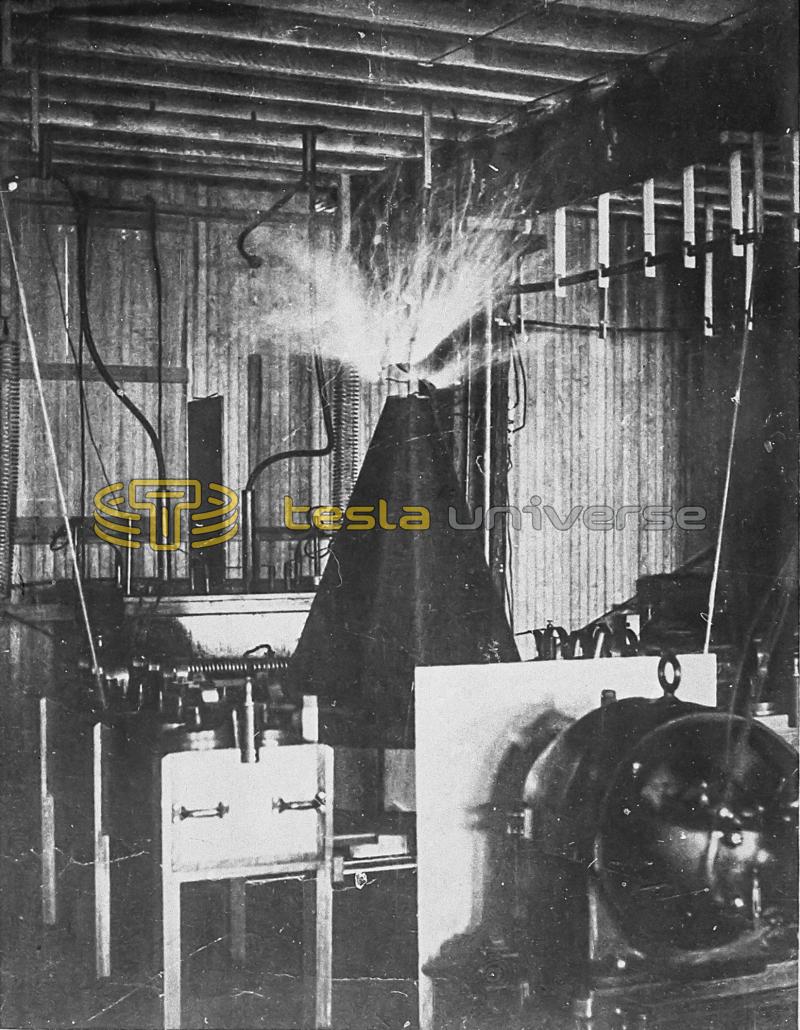
The Tesla coil, patented in 1891 under U.S. Patent 454,622, is a resonant transformer circuit invented by Nikola Tesla to produce high-voltage, low-current, high-frequency alternating current electricity. Tesla developed this device during his efforts to create a wireless lighting system, using it to generate powerful electrical fields that could illuminate gas discharge tubes without wires. The coil consists of two main parts: a primary coil with a few turns of thick wire connected to a capacitor and spark gap, and a secondary coil with many turns of finer wire, often topped with a toroidal or spherical electrode to prevent corona discharge. When powered, the primary circuit creates a rapidly oscillating magnetic field that induces voltage in the secondary coil through electromagnetic induction, stepping up the voltage to millions of volts and producing spectacular electrical arcs and sparks. This invention was first publicly demonstrated on May 20, 1891, in Tesla's lecture "Experiments with Alternate Currents of High Potential and High Frequency" at Columbia College, where he showcased its ability to light bulbs wirelessly and create luminous effects.
Historically, the Tesla coil was central to Tesla's experiments in wireless power transmission and radio technology, influencing early developments in X-ray generation and high-frequency electrotherapy. Although Tesla intended it for practical applications like global wireless communication, it faced commercial challenges due to funding issues and competition from figures like Guglielmo Marconi. Today, Tesla coils are used in educational demonstrations to illustrate principles of electromagnetism, resonance, and high-voltage phenomena, as well as in entertainment for creating artificial lightning in museums and science shows. They also find niche applications in medical devices for diathermy and in plasma speakers or musical instruments that produce sound through modulated arcs. The enduring legacy of the Tesla coil lies in its demonstration of resonance's power, inspiring modern technologies like inductive charging and RFID systems, and symbolizing Tesla's visionary approach to harnessing electricity's untapped potential.