Nikola Tesla Inventions
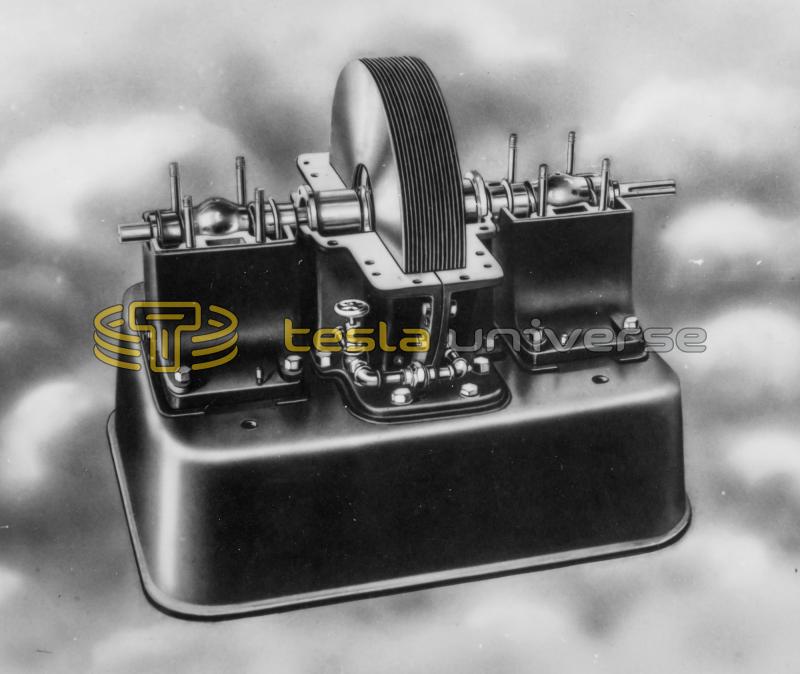
Tesla Turbine
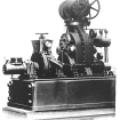
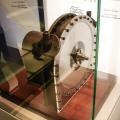
The Tesla turbine, patented in 1913 under U.S. Patent 1,061,206, is a bladeless centripetal-flow turbine designed by Nikola Tesla to convert fluid energy into mechanical power using boundary layer effects rather than traditional blades. Tesla first conceived the idea in 1906, building a prototype that weighed under 10 pounds yet generated 30 horsepower, demonstrating its compact efficiency. The device consists of a series of closely spaced parallel disks mounted on a shaft within a cylindrical housing; fluid (such as steam, gas, or water) enters tangentially at the periphery, adhering to the disks due to viscosity and friction, spiraling inward to the center exhaust while imparting rotational force through drag. This design eliminates the need for complex blade geometries, reducing manufacturing costs and wear from erosion or cavitation, and allows for high rotational speeds up to 35,000 RPM in early models. Tesla described it as his "best invention," aiming to replace inefficient piston engines and conventional turbines in applications like pumps, compressors, and generators.
Despite its innovative principles, the Tesla turbine faced challenges in commercialization due to material limitations of the era, such as disk warping under high temperatures, and inefficiencies at lower speeds or with viscous fluids. Tesla tested it extensively between 1909 and 1911 at the Waterside Power Station in New York, achieving efficiencies up to 97% in theory but around 40% in practice for large-scale models. Modern reviews have revived interest, with computational fluid dynamics simulations optimizing designs for micro-turbines in renewable energy systems, aerospace propulsion, and biomedical pumps. Its simplicity and scalability make it suitable for waste heat recovery and geothermal applications, influencing contemporary bladeless fans and fluidic devices. The turbine exemplifies Tesla's interdisciplinary genius, blending fluid dynamics with mechanical engineering to challenge established paradigms and inspire sustainable energy solutions.
Related content
- Tesla's New Rotary Machine
- An 18-inch Tesla turbine with the cover removed to display the rotor
- Tesla's 10,000 HP Steam Turbine
- The Tesla Turbine (March, 1912)
- Dr. Nikola Tesla and His Achievements
- Tesla Turbine Made Public
- The Tesla Turbine (December, 1911)
- Powerful Turbine a Mere Toy
- The Tesla Steam Turbine (October 12, 1911)
- Tesla turbine model inside the replica home of Tesla in Smiljan, Croatia
- Tesla's New Monarch of Mechanics
- The Tesla Steam Turbine
- The Turbine Gas Engine is Here