Nikola Tesla Articles
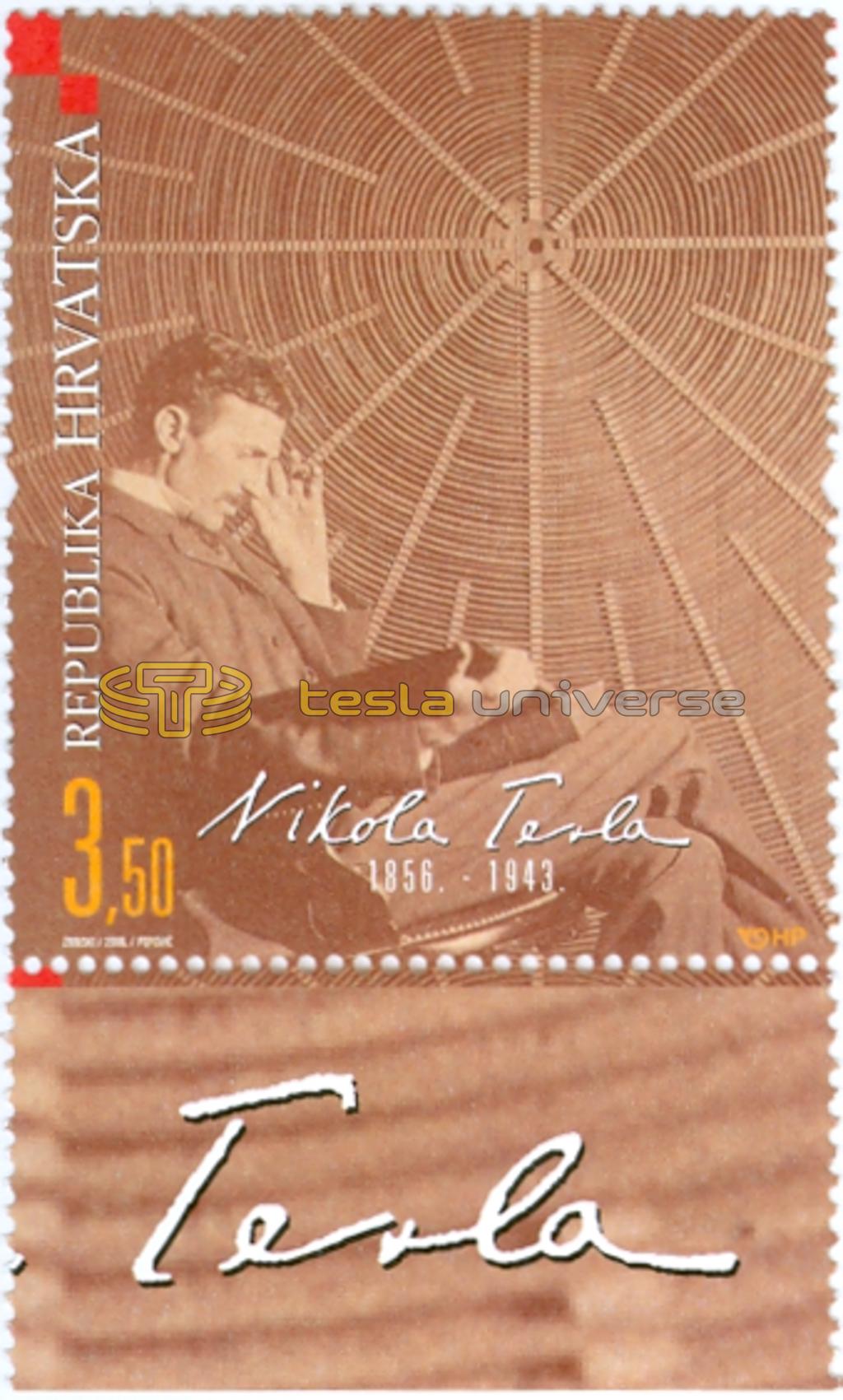
150th Nikola Tesla's Birthday Anniversary Commemorative Stamp
Motif: a George Grantham Bain’s photo “Nikola Tesla with a book of Ruđer Bošković in front of the spiral indicator needle of high-frequency transformer in his laboratory in New York, 46 East Houston Street”, April 5th, 1901; Nikola Tesla inheritance, stored in Nikola Tesla Museum in Belgrade, Republic of Serbia. Author: Danijel Popović, a designer from Zagreb. Issued on a sheet paper of sixteen stamps with the occasional first day cover.
NIKOLA TESLA – AN INVENTOR WITH A VIEW IN FUTURE
The progressive development of a man is vitally dependent on invention. It is the most important product of his creative brain. Its ultimate purpose is the complete mastery of mind over the material world, the harnessing of the forces of nature to human needs. This is the difficult task of the inventor who is often misunderstood and unrewarded. But he finds ample compensation in the pleasing exercises of his powers and in the knowledge of being one of that exceptionally privileged class without whom the race would have long ago perished against pitiless elements. (An extract from the autobiography book My Inventions, New York, Century 1919.)
Nikola Tesla is one of the greatest scientists and inventors in the history of technological development of mankind. His patents and theory work set up the conditions for world’s electrification through the system of poly-phase alternating current. Furthermore, his work on the high-frequency current field as well as on wireless transmission of electromagnetic waves enabled the development of radio engineering and telecommunications. Tesla’s researches helped the invention of radar, and contributed a lot to the development of lights.
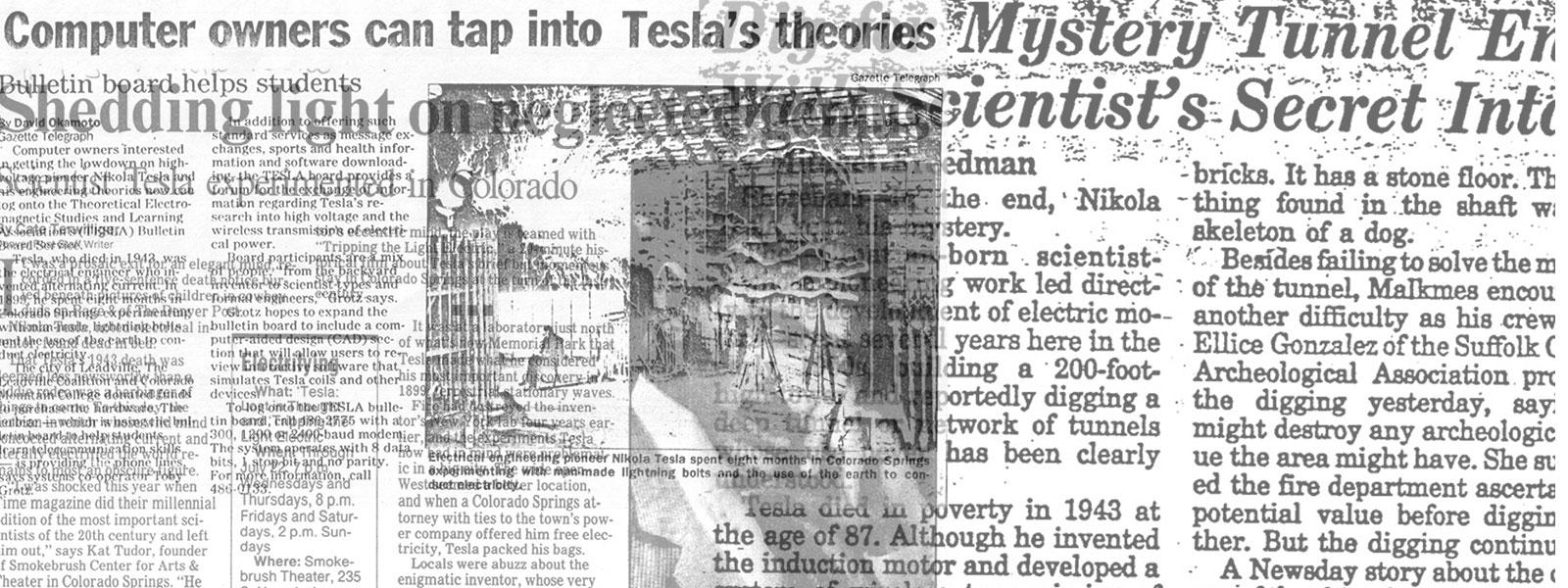
Tesla had an unusual way of reaching the invention. First, in his brain he would analyse the way of work of a certain apparatus to the last detail and “saw” the way it should work, only then did he prove it in theory, make a sketch and in the end make the apparatus which would work properly. Nikola Tesla was born at midnight, between 9th and 10th July 1856 in Smiljan, a little village near Gospić. As early as a little boy, he showed innovativeness, and, according to his words, he inherited it from his mother. He went to public school in Smiljan and Gospić. He graduated from higher Real-Gymnasium in Rakovac, near Karlovac. The time between 1875 and 1878 he spent in studying at Polytechnic School in Graz, when he had to break his education in Graz because he did not get his scholarship any more and was lacking in money. Three years later, he went to work in Budapest, in Central Telegraph Office. The following year, while walking on Budapest the idea of a rotating magnetic field and an alternating-electric-current motor came to his mind. Having worked in Paris and Strasbourg for some time, in 1884 he set off to the USA. As soon as he came to the USA, he went to Thomas A. Edison to be his employee. However, he did not work for Edison for a long time. Disagreeing about applying the alternating current, that disagreement turned into hostility called “The War of Currents”. Since Tesla wanted to put in practice the rotating magnetic field as soon as possible, he established Tesla Electric Light and Manufacturing Company in 1885.
The hardest period in Tesla’s life was between 1886 and 1887 when he was a sewer worker in New York. However, in 1887 he established Tesla Electric Company with a laboratory for himself where he could finally work on improving the way of applying alternating current. In those years, he applied his patents for electromotor and the system of alternating current distribution. On 15th May 1888 he gave lecture to the members of American Institute of Electrical Engineers and performed the work of alternating current motors. In the same year George Westinghouse purchased his patents on applying alternating currents. Three years later Tesla applied a great number of patents on high-frequency currents. In his honour, one of the apparatus for producing such current was named Tesla’s transformer after him. Because of his mother’s death, he came to Croatia for a short time. In the same year he gave lectures in Zagreb on alternating current and electrification.
As early as in his childhood Nikola Tesla’s great wish was to tame the waterpower, especially the power of Niagara Falls. Westinghouse’s plan on Niagara’s hydroelectric power station was accepted in 1893. Triple-phased alternating current produced there would be brought to Buffalo through long distance power lines. In 1896 the power station was finished. Nine Tesla’s patents were used in building the generator and the system of transmission of electric power. In 1893 Tesla helped Westinghouse to light up the world exhibition in Chicago dedicated to engineering accomplishments. One part of the exhibition was intended to Tesla’s inventions, who confirmed the win of alternating current over direct current. Having realised that high-frequency current could transmit through only one line he invented wireless transmission of electromagnetic vibrations. Examining that field, our inventor discovered the basic principles of radio technology. As early as in 1896 Tesla performed experiments with X-rays. In addition, he invented the first robots – apparatus for remote control.
Towards the end of 19th century in Colorado Springs, Tesla performed various experiments on very high voltages and high-frequency currents. Making researches in his laboratory he discovered waves of the Earth as well as managed to produce artificial discharging of multi million voltage making the forty meters long lightning. Tesla let a huge quantity of electric current in the ground, and because of the resonance there was even larger discharging on the top of the tower. Those experiments were the preparation for the following Tesla’s project – making the wireless connection with the help of the tower in Wardenclyffe, Long Island. The tower in Wardenclyffe, that is, the World wireless system project was never finished. It was destroyed in the First World War. After that unsuccessful project, Tesla never managed to recover. About 1915 he went bankrupt.
As early as in 1906, he performed the way of working of turbine without paddle, later on called Tesla’s Turbine. The greatest award of American Institute of Electrical Engineers – the Edison medal – he received in 1917. In the same year, he set the basic principles of radars dealing with radar’s frequency and power. On his 75th birthday in 1931, Tesla appeared on the Time’s front page.
Only in the USA, Nikola Tesla applied for 112 patents in total. In the rest of the world, he applied for 156. He received a great number of doctorates of honour for his work from many Universities: University of Columbia, University of Yale, University de Poitiers, polytechnic institutes in Graz, Vienna and Bucharest, Universities of Belgrade, Brno, Grenoble, Paris, Prague, Sofia and Zagreb.
Nikola Tesla was never got married. He did not have a direct heir. He had some phobia of hair, peach and bacilli. He was fascinated with purity and number three. Towards the end of his life, he liked to spend time with pigeons. Besides his mother tongue, he spoke English, French, German, Italian, Czech and Hungarian. He died on 7th January 1943 in the New Yorker, in room 3327.
In honour to the great inventor, the unit for magnetic induction in the SI system got the name of Nikola Tesla in 1960. In 1975 Institute of Electrical and Electronics Engineers (IEEE) established Nikola Tesla award that is being awarded to deserved individuals in the electro energetic field. In the honour of Tesla’s achievements, one crater on the Moon was called after him. An Australian, Constantin Koukias composed even an opera Tesla – Lightning in his Hand.
Renato Filipin
