Nikola Tesla Articles
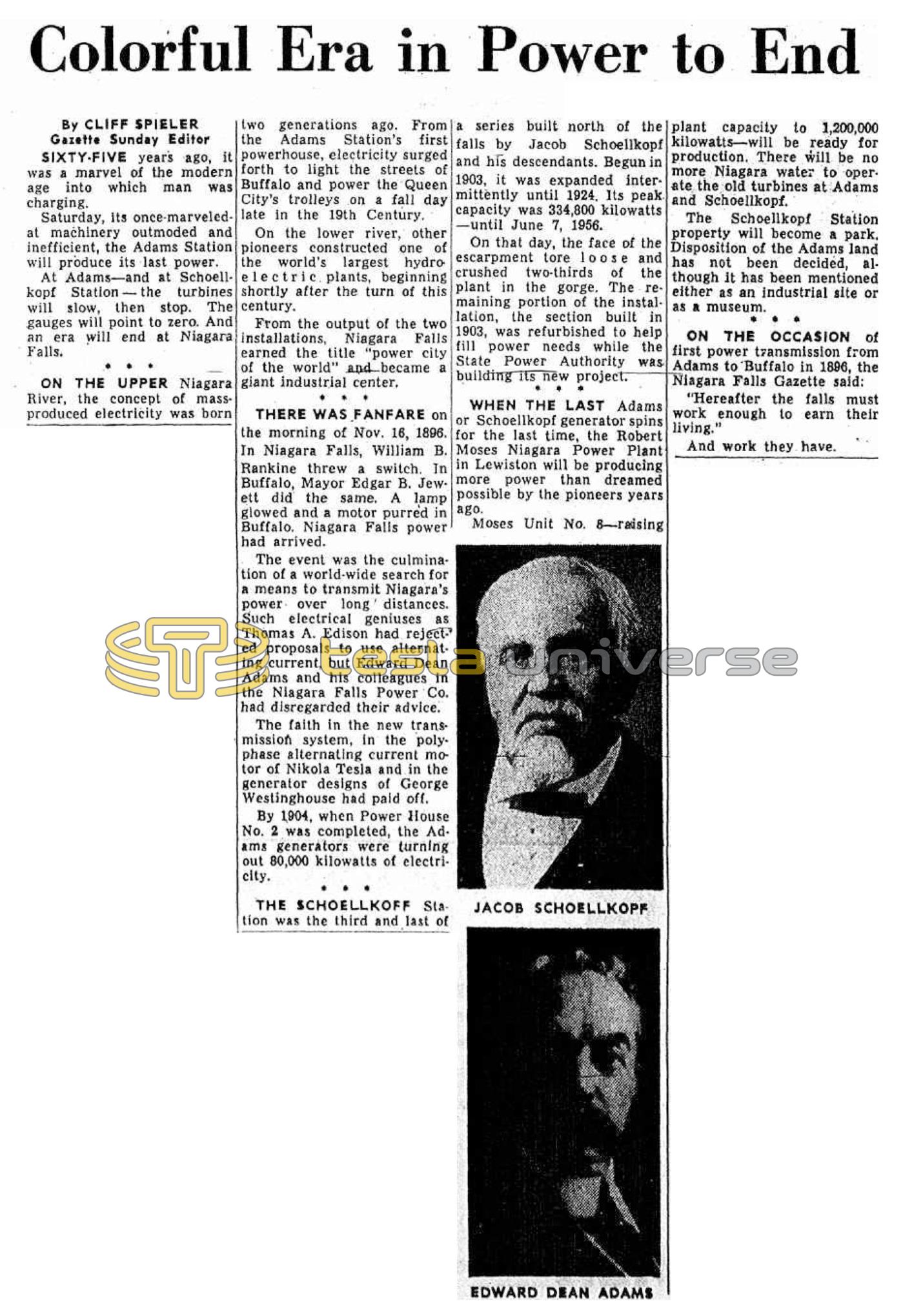
Colorful Era in Power to End
By CLIFF SPIELER
Gazette Sunday Editor
SIXTY-FIVE years ago, it was a marvel of the modern age into which man was charging.
Saturday, its once-marveled-at machinery outmoded and inefficient, the Adams Station will produce its last power.
At Adams — and at Schoellkopf Station — the turbines will slow, then stop. The gauges will point to zero. And an era will end at Niagara Falls.
ON THE UPPER Niagara River, the concept of mass-produced electricity was born two generations ago. From the Adams Station’s first powerhouse, electricity surged forth to light the streets of Buffalo and power the Queen City’s trolleys on a fall day late in the 19th Century.
On the lower river, other pioneers constructed one of the world’s largest hydroelectric plants, beginning shortly after the turn of this century.
From the output of the two installations, Niagara Falls earned the title “power city of the world” and became a giant industrial center.
THERE WAS FANFARE on the morning of Nov. 16, 1896. In Niagara Falls, William B. Rankine threw a switch. In Buffalo, Mayor Edgar B. Jewett did the same. A lamp glowed and a motor purred in Buffalo. Niagara Falls power had arrived.
The event was the culmination of a world-wide search for a means to transmit Niagara’s power over long distances. Such electrical geniuses as Thomas A. Edison had rejected proposals to use alternating current, but Edward Dean Adams and his colleagues in the Niagara Falls Power Co. had disregarded their advice.
The faith in the new transmission system, in the polyphase alternating current motor of Nikola Tesla and in the generator designs of George Westinghouse had paid off.
By 1904, when Power House No. 2 was completed, the Adams generators were turning out 80,000 kilowatts of electricity.
THE SCHOELLKOPF Station was the third and last of a series built north of the falls by Jacob Schoellkopf and his descendants. Begun in 1903, it was expanded intermittently until 1924. Its peak capacity was 334,800 kilowatts — until June 7, 1956.
On that day, the face of the escarpment tore loose and crushed two-thirds of the plant in the gorge. The remaining portion of the installation, the section built in 1903, was refurbished to help fill power needs while the State Power Authority was building its new project.
WHEN THE LAST Adams or Schoellkopf generator spins for the last time, the Robert Moses Niagara Power Plant in Lewiston will be producing more power than dreamed possible by the pioneers years ago.
Moses Unit No. 8 — raising plant capacity to 1,200,000 kilowatts — will be ready for production. There will be no more Niagara water to operate the old turbines at Adams and Schoellkopf.
The Schoellkopf Station property will become a park. Disposition of the Adams land has not been decided, although it has been mentioned either as an industrial site or as a museum.
ON THE OCCASION of first power transmission from Adams to Buffalo in 1896, the Niagara Falls Gazette said:
“Hereafter the falls must work enough to earn their living.”
And work they have.