Nikola Tesla Articles
Electricity at the World's Fair - Nov. 11, 1893
A more marked change than that presented by the appearance of Jackson Park before and after October 31st would be difficult to imagine. The gala existence of the exposition came to an end with absolute abruptness, and the World's Fair is now in truth a "vanishing city." In common with all the other exhibitors, those in charge of the electrical machinery and appliances in machinery hall and electricity building are packing up and getting away as fast as possible, and many exhibits have already disappeared. The great central station plant in machinery hall is being rapidly dismantled. All arc lights except those used for patrol lighting have been cut out, and it is probable that this service, which will last until next spring, will be thrown on the block of Standard machines entirely. The Westinghouse company is supplying incandescent lighting to the administration, woman's and service buildings only, while all the power circuits except those supplied from one C. & C. generator will soon be cut out.
In all directions the electrical activity at the fair has ceased entirely or is only feebly existent. The electrical fountains were stopped in the middle of last week for lack of water and current; the searchlight apparatus has been removed from the roof of the manufactures building; the electric launches are not running, and the electricity building contains a confused mass of exhibits in various stages of packing and removal. On the intramural railway trains of two cars each, instead of four or five, are running, but at less frequent intervals and carrying but few passengers. The process of dismantling the plant in the intramural station has already been begun, and the 2,000 horse power generator is being taken apart for shipment to Brooklyn. The road is run by the Lake Erie upright engine, with plenty of power to spare. General Manager Baker furnishes the following interesting figures, showing the number of passengers carried on the intramural during the six months of the fair:
| May | 151,550 |
| June | 784,756 |
| July | 854,107 |
| August | 992,958 |
| September | 1,447,882 |
| October | 1,580,980 |
| Total | 5,812,233 |
The line complete is said to have cost between $800,000 and $1,000,000, and adding the anticipated proceeds of the sale of the material to the receipts from fares it is believed that the company will come out about even - a much better result than was anticipated early in the season.
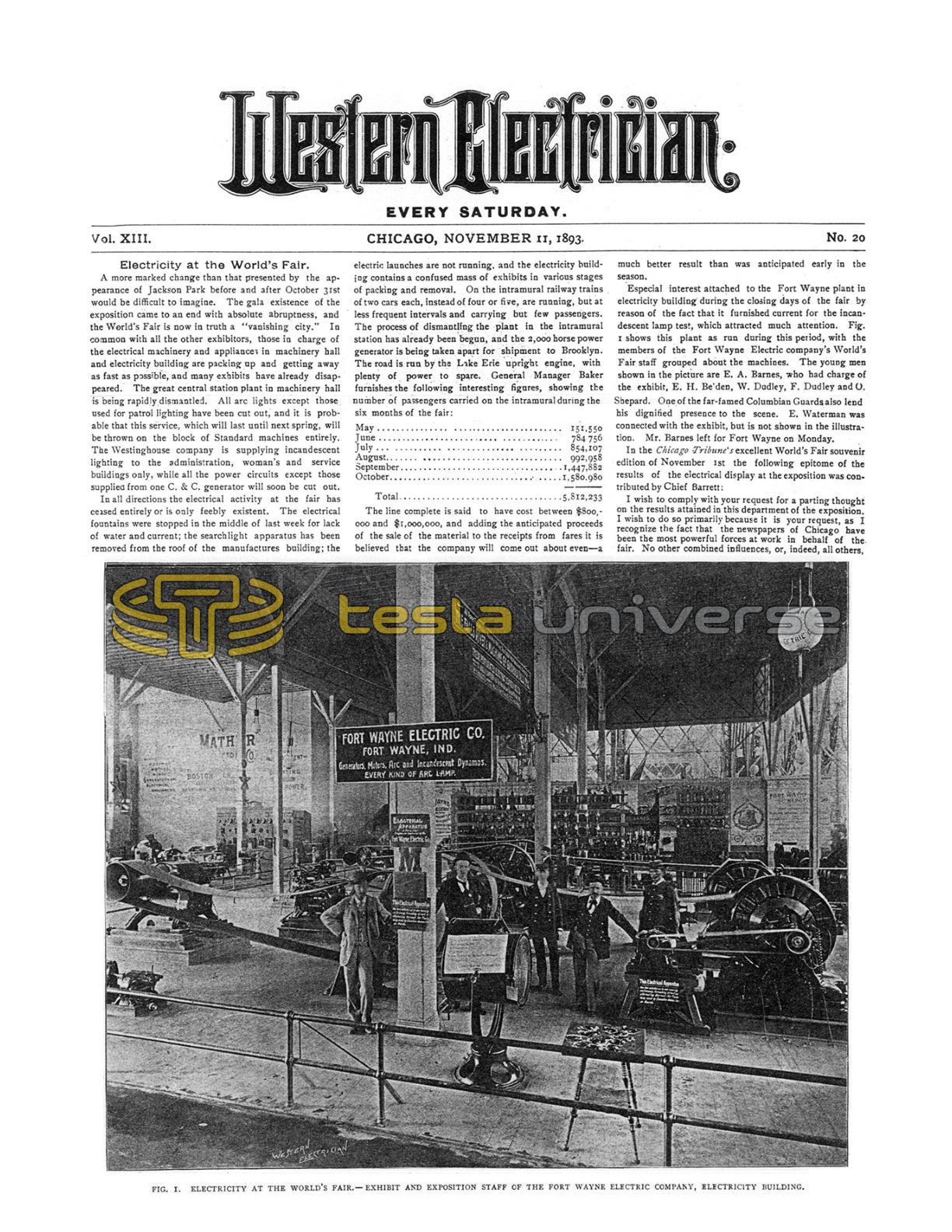
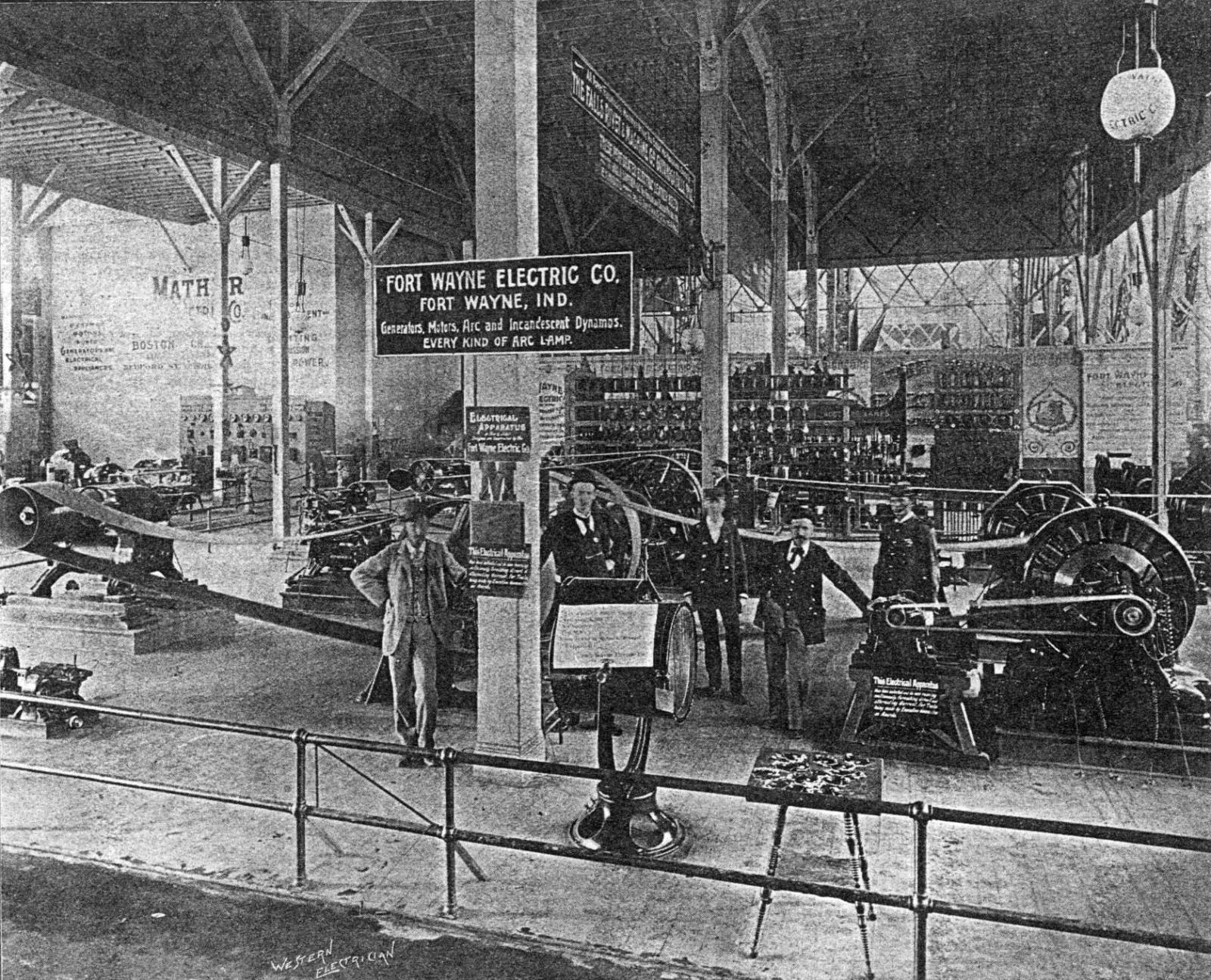
Especial interest attached to the Fort Wayne plant in electricity building during the closing days of the fair by reason of the fact that it furnished current for the incandescent lamp test, which attracted much attention. Fig. I shows this plant as run during this period, with the members of the Fort Wayne Electric company's World's Fair staff grouped about the machines. The young men shown in the picture are E. A. Barnes, who had charge of the exhibit, E. H. Belden, W. Dudley, F. Dudley and O. Shepard. One of the far-famed Columbian Guards also lend his dignified presence to the scene. E. Waterman was connected with the exhibit, but is not shown in the illustration. Mr. Barnes left for Fort Wayne on Monday.
In the Chicago Tribune's excellent World's Fair souvenir edition of November 1st the following epitome of the results of the electrical display at the exposition was contributed by Chief Barrett:
I wish to comply with your request for a parting thought on the results attained in this department of the exposition. I wish to do so primarily because it is your request, as I recognize the fact that the newspapers of Chicago have been the most powerful forces at work in behalf of the fair. No other combined influences, or, indeed, all others, have done so much to bring about whatever success has been achieved. They have been, as it were, guiding and protecting genii, or, like an approving or protecting conscience, they have held up our hands when we were right, and in a spirit of friendship have reproved us when their judgment was against us. While we may differ from the judgment passed by the Chicago papers many times, we have never impugned their motives nor respected them the less because of those differences.
Speaking of the department, I desire to say that we have accomplished the highest aim which the well posted man could have set. We have not been the instrument for bringing out any great new principle, like the arc or incandescent light, telephone or dynamo. It seems that this is not an epoch of radical inventions. What we have done, though, is to demonstrate beyond question the commercial applicability of electricity in lines not heretofore mastered. The incandescent plant in service at the Fair is not alone the most extensive but the most economical - to the contractor - and the most efficient ever constructed, leaving out of consideration the perfection attained in decoration. Its chief merit, of course, apart from careful mechanical construction of the machinery, lies in the fact that it employs what is known as the alternating system of transmission, which means to the financier a saving of immense sums in copper and the further possibility of lighting territory at long distances from the source of supply of power.
One of the most powerful strides in electricity is in the adoption at the fair for the first time of very large units in machines and in their operation by what is known as the multiphase system of transmission. These large machines, especially those doing away with shafting and belting, by being directly coupled to their engines, open really a new epoch in the direction of economy and efficiency. Saving in friction, saving in the expenses of operation, and saving in first cost are among the advantages. Nearly all the large companies are going into this class of machine construction, and business competition will do the rest for perfection and progress.
Motors for power service have been demonstrated in greater variety than ever before. Beginning with the operation of the sawmills used in the period of construction, and ending with the tiny motors operated by exhibitors in an infinite variety of ways, we have some of the possibilities of the future.
The electric launches have demonstrated that this class of service is cheaper than by any other power. These boats have earned more money with less outlay in cost and maintenance than would have been possible with steam or any other power. Moreover, they are cleanly, rapid and in every way enjoyable.
Cooking by electricity and its application for domestic purposes is also henceforth commercial if it had not been before. It may not be uninteresting to the public to know that electric cooking and other domestic applications of the current have been commercial for a good while and that the lack of success hitherto in these directions has been due almost entirely to fights over patents.
I think these few words will indicate a train of thought for the intelligent reader to follow as an indication of the ends intended to be reached by me in the organization and execution of the work for this department.
Following Prof. Barrett's article the Tribune prints the following interesting personal gossip of the assistants in the office of the department:
Prof. Barrett's first assistant in the department, Dr. J. Allan Hornsby, has been in the work from its inception, having been appointed secretary of the department on the day that Prof. Barrett's commission was approved by the directors. Mr. Hornsby has done the actual work of the department under Prof. Barrett's direction, consulting with the chief on all matters at all times. Prof. Barrett's position as city electrician has made it impossible for him to give all his time to the work, hence the necessity to have a man with him in whom he had perfect confidence. John W. Blaisdell, general superintendent, is best known before the footlights, having been on the stage for some years and having become famous in theatrical work with the best actors of the day. He was for some years manager of Hooley's theater, and was with the best companies at all times. Mr. Blaisdell has had the thankless task of passing upon applications for passes for those in business with the department. W. W. Primm, engineer for the department, is a West Point man, and has been the brains of more than one large engineering project for which some famous engineer got the credit. He has been with Prof. Barrett for nearly two years, and is in no small degree to be credited with the success of the department. Willis Hawley, one of the assistants, came to the department from the active management of a large station at Urbana, O. He is an expert in every branch of the business, having secured his early training in the factory of the Western Electric company of this city. He can do anything from winding an armature to building a station from his own designs. George J. Henry is an inspector of electrical service. Largely to his efforts is due the magnificent fire protection of the building, which has in it concentrated power enough to burn a hole in Lake Michigan. Mr. Henry is also an expert amateur photographer, and has been taking the photographs for Prof. Barrett's report to the director-general. Orlando Shepard came to the department as Mr. Henry's co-laborer in the inspection department from one of Prof. Barrett's lighting plants. Frank J. Sullivan and Stacey Butler are two young men through whose hands has passed every piece of apparatus exhibited in the building. They have kept all the records of the receipts of goods and have delivered every piece, not one case having been lost. They have relieved each other for night duty, one or the other being in service during the whole twenty-four hours of every day since the fair opened. Last but by no means of least importance in the department is the stenographer, George E. Moore. When the work of the office became city too severe to be done by two young ladies Mr. Moore was employed in their stead. In closing it may be stated that Prof. Barrett's men have been paid salaries, as a rule, in excess of those paid in any other department. He has insisted on the best men he could find and has likewise insisted that they be paid for their services. One of the secrets of Prof. Barrett's success as an executive lies in the fact that every man in the department has specific duties to perform and is held to a strict personal account for their proper and prompt execution.
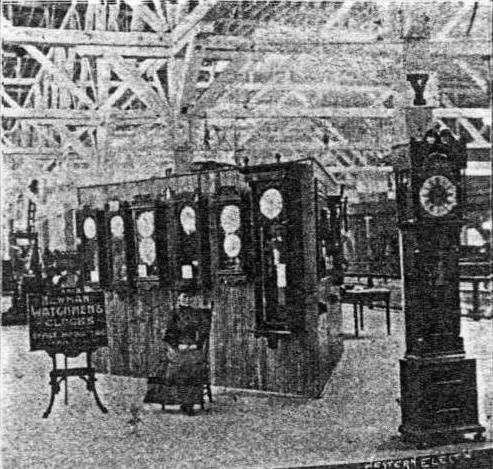
The exhibit of electrical and mechanical watchmen's clocks illustrated in Fig. 2 was made in the gallery of electricity building by the Newman Clock & Manufacturing company of Chicago. Mr. Newman was personally in charge, and succeeded in impressing the merits of his apparatus on many visitors.
Portions of the personal exhibit of Nikola Tesla in electricity building, in connection with the Westinghouse display, are illustrated in Figs. 3 and 4. In the former is shown, on the right, a curious experiment with the alternating current. A current of 100 volts with 7,200 alter- nations was transformed to a potential of 15,000 volts and the frequency also greatly increased by a spark-gap and Leyden jars. A ∩-shaped bar of copper three-quarters of an inch in diameter was placed in the circuit thus created, and three lamps connected across at intervals, as shown in the illustration. When the current was turned on the lowest lamp burned about up to candle power, the next above burned dimly and the highest showed a slight red glow, demonstrating that the current took the path of high resistance through the lamps rather than the infinitely slight resistance of the copper bar, and that this seeming resistance of the thick copper decreased toward the top, allowing more and more of the current to pass through it instead of the lamp. This curious effect is explained by the theory that the extremely high frequency of the current set up local or eddy currents in the copper bar, and that this impedance was sufficient in to divert the current through the small conducting medium and high resistance of the lamps. In approaching the top of the bar the impedance grew less and a greater proportion of the current passed through the mass of copper, lighting the lamps but feebly in consequence. With a direct or ordinary alternating current this apparent contradiction of the laws of electricity would not occur.

On the left in Fig. 3 are shown the transformers, circuit breaker and Leyden jars used in producing the high potentials and high frequencies used in the Tesla experiments in the Westinghouse "dark room." A 100 volt alternating current was first transformed to 100,000 volts by two 50,000 volt transformers in series. By the use of the wheel shaped circuit-breaker and Leyden jars shown on the table in the illustration the rate of alternation was multiplied many times and an additional transformer raised the pressure to about a million volts. This was the current used for the Tesla vacuum tube experiments.
The experimental apparatus used by Tesla in developing his polyphase system was shown on a table near the "dark room," and is represented in Fig. 4. Here are all sorts of fields and armatures for motors, and the whole made an extremely interesting collection. In the center was shown the "Columbus egg" of the Westinghouse company, embodying the principles of the Tesla system. In the rear of this table were shown small two and three-phase motors of the latest Tesla type. In the space illustrated the Shallenberger meter, Wurts non-arcing and "Keystone" lightning arresters were exploited on display boards.